
Global problems in terms of human thought processes
What is temporal blindness?
What are its global implications?
Jack Alpert
copy –for review only Email Alpert@skil.org © 2000 J. M. Alpert
Introduction *
Part 1 - What is temporal blindness? *
Chapter 1. Distorted expectations *
Chapter 2. Caps on planning skills *
Chapter 3. Boundaries between ability and disability *
Summary of Part *
Part 2 - Where temporal blindness leads *
Chapter 4. Unwanted unintended social destinations *
Chapter 5. Distortions in morality *
Chapter 6. Retention of a culture's false transmissions *
Chapter 7. Dysfunctional educational designs *
Summary of Part 2 *
Part 3 - Temporal sight as a goal *
Chapter 8. Temporal sight – what is enough? *
Chapter 9. Action *
End parts *
Acknowledgments *
Indexes *
Appendices *
Useful pieces (they fit somewhere) *
Before seat belts, drivers made their children sit close to them. That way, when they stepped on the brakes, they could hold them back and prevent them from flying into the dashboard. The behavior prevented a lot of chipped teeth and bloody noses. However, the "hold back" behavior was not perfect. If the car crashed in spite of heavy braking, the "hold back" behavior increased the child’s injuries! During the 50 years before seatbelts, hundreds of thousands of deaths, and millions of sever injuries, could have been avoided if drivers just kept their arms down.
From where did this imperfect behavior come? No one learned the "hold back" behavior from a driver training manual. No one learned it from applying physics. (If they did, rocket scientists would have chosen a different behavior from fruit pickers.) Instead everyone learned the same behavior from experiencing things sliding forward during abrupt stops. After a couple of spilled grocery bags, arms almost unconsciously pulled back on whatever is on the seat before braking. We, today are still learning the "hold back" behavior from these experiences. We are still putting out our arms during heavy braking. The increase in injuries is avoided only because our kids are wearing seatbelts. If they were not, our normal learning processes would still be adding to the highway death toll.
If you want to understand the physics that explains why holding back children increases their injuries, read the note at the end of this introduction. If you want to understand that learning process and its implications for human wellbeing, read this book. I describe how normal learning results in behavior that causes scarcity, social conflict, and environmental destruction, just as surely and unintentionally as holding back the unrestrained increases their injuries. I show how normal learning fails to accurately predict future conditions, weakens values for predicted conditions, and diminishes ability to connect predicted conditions to behaviors that cause them.
Some of these learning processes are acquired after birth. Each of us learned them from interactions with the environment. Part of this environment was produced by our culture. Therefore, part of six billion sets of imperfect behavior is the unintended by product of cultural activity.
These behaviors might be improved by changing what culture contributes, not to knowledge, but to cognitive development. Finding and implementing these changes might develop a new generation whose thinking and learning takes them to an environmentally balanced, abundant, and peaceful future.
The learning processes on which I focus contain a common thread "time." Our perception of time shapes both our predictions and the values we assign them. When a person fails to use available "temporal information" I call these distortions in prediction and value, "temporal blindness." When an entire society is time blind, and we try to fix social problems by changing the temporal cognitive abilities of all individuals in the next generation, I call the activity "cognition based solutions to global problems."
In the first book I describe the "time blind problem" for the lay reader. I show that our weak abilities to gather, process, and value information, distort our expectations. These distortions cause people to smoke, skid off roads, not wear seat belts, and contribute to global problems. The book's conclusion:
Unless the next generation thinks better than we do they will continue to create conditions of scarcity, violence, and environmental destruction for future generations. Each reader should finish this book convinced that if we raise the level of temporal cognition in most members of a future generation, they, through collective action, would be able to end these unwanted conditions.
The text is not designed to upgrade the reader’s temporal thinking abilities. The text is designed to get each reader to acknowledge: 1) their own thinking limitations; 2) the implications of these limitations in terms of their behavior’s impact on future conditions; and 3) the utility of creating new "thinking development environments" that prevent these limitations from being a part of a future generation’s cognitive tools.
In the second book I outline a solution to the time blind problem. I connect "behavior selection" to "thought processes," and "thought processes" to "learning environments." I show the ability, to predict and value outcomes of behavior partly results from nurture and partly from nature. Some of our global problems occur because "nurtured cognitive abilities" produce predictions or values that are too weak to compete with those produced by our animal nature. Or they are too weak to compete with the incorrect predictions, and shortsighted values we obtained through rote learning.
I show, using graphs of information flow, how existing development environments unintentionally induce temporal blindness. I hypothesize how alternative learning environments may prevent it. The conclusion:
We use experience, transmission, and inference thought processes to shape our behavior. Each process can be enhanced by developmental environments. Here is a framework of how we learn and use temporal inference. Use it as a basis to develop cognition based solutions to global problems.
(physics of injury" note)
During a 30-MPH crash both the car and the child must abruptly stop moving. The stop is like landing on the pavement after jumping off a 3rd story balcony. If any of the parents had a choice between landing on a thick cushion or a thin one, they would all pick the thick one. However, the "pull back behavior" is like picking the thin one. "Not holding back" is like picking the thick one.
In such a crash, the car’s front-end crushes 15-inches. This crush acts like a 15 inch cushion for the dashboard and everything that slows down with it. If the child is against the dashboard at the instant of crash, he or she slows down in 15 inches. The dashboard applies a 500-pound force to the child’s body. It seems large. However it causes no severe injury. Seat belts prevent injury because they act like the dashboard. They apply the 500 pound force for the 15-inch stopping distance.
No parent however, can create 500 pounds of restrain with one arm outstretched to the right. The child’s body overpowers the arm and continues moving forward at 30 MPH. Unfortunately, by the time the child moves from the seat to the dash, the dash has already moved 15 inches and has already slowed to zero MPH. When the child collides with it, he or she slows to zero MPH in the 1 inch or so the dash deforms. What could have been a 15-inch cushion is now little more than a one inch cushion. The forces on the child are ten times higher and so are the injuries.
---> This analysis is confirmed by crash data of unbelted car occupants. Sleeping passengers, drunks, and un restrained children, that slid forward during braking, and were "on-the-dashboard" at the time of collision, walk away from accidents only slightly injured. Passengers that hold themselves, or are held like children, away from the dashboard during braking, and then collide with it during collision, get seriously injured or killed.
Part 1 - What is temporal blindness?
In 1968 my first engineering job was at the Safety Research and Development Laboratory of General Motors. My task was to find ways to reduce occupant injury during automobile crashes.
Engineers ran hundreds of tests. Special movie cameras captured crash dummies colliding with steering columns, instrument panels, and windshields. Or better: not colliding, because of seat belts.
Replaying these movies in slow motion and comparing the impact forces imposed on belted and non-belted dummies, showed that seat belts prevented injuries. Case closed. With public dissemination of crash test findings, everyone would buckle up. Tens of thousands of lives would be saved annually. And I would be out of a job within a matter of weeks.
Unfortunately, it didn't work that way. Inconceivable as it seems, few people in 1968 were willing to wear seat belts no matter what information or movies were available for view.
People chose not to wear seat belts. Sometimes they would go to great lengths to defeat the buzzers, lights, and ignition interlocks that coerced them to wear them.
Why did drivers and passengers choose the dangerous over the safe behavior? Why did the enormous injury reduction provided by seat belt wearing seem unimportant? Why did normal thinking lead to perverse behavior?
This was just the first of many discoveries where a chosen behavior reflected the inability to see or consistently value the predictions made possible by available information. Each distortion of human thinking by itself meant little. However, these views collectively describe a cognitive limitation I call temporal blindness.
Chapter 1. Distorted expectations
Distorted prediction, distorted expectation, distorted behavior
Behavior results from expectations of future condition. When individuals are unable or unmotivated to correctly use available information to make predictions, the resulting strange expectations and behavior become starting points to describe our temporal blindness.
1.1. Poor use of data
Wisconsin record!
17 killed on Highways
Labor Day Weekend.
Long before seat belts first appeared in cars, newspapers reported "weekend state highway death tolls" like baseball scores – in a box in the top right corner of the front page. In the 60's, about 55,000 people were killed on U.S. highways each year. 350,000 were maimed. The numbers may seem impersonal. However, everyone knew of someone that had been killed during the previous year. Everyone knew someone who was severely injured in the last two months. Some were bad drivers. Some were hit by bad drivers. Some were drunks. Some were hit by drunks. The data’s implication was clear. Everyone exposed themselves to injury and death each time they went for a ride.
The data about the injury reduction resulting from wearing seat belts was just as clear. Chances of death over a lifetime were reduced from: 1 in 150 to: 1 in 25,000. Even if people did not understand the difference between these two probabilities, it was explained to them in simple terms. Seat belts were a wonder drug against injury – as powerful as the polio vaccine. The GM accident/injury database contained almost no fatalities for passengers in the belted category.
This data was not kept a secret. It was as impossible to miss the intense dissemination of this information as it is for us today to miss the Surgeon General’s notices on cigarette packs. Yet, while seat belts had been installed in millions of cars and tens of millions of Americans could have chosen to wear them, they didn’t buckle up.
Something was amiss in their thinking process. Something in the individual’s thinking discounted the data’s inference enough that accidents and injury did not appear in the individual’s expected future. Instead each person held two fantasies: "I won t have an accident" and "If I am in an accident I won’t be injured"
How did the individual find it so easy to exclude himself or herself from a danger the data said everyone else faced? There are many answers and they fill volumes. To this ever growing body of knowledge about how or why we think so poorly, I want to add another hypothesis. A potential seatbelt wearer misused the available information because it contained temporal content that was not fully understood and valued. It contained content that did not influence expectations.
This hypothesis is my starting point for describing temporal blindness. Consider a logical argument for wearing a seat belt. Then consider how the argument is weakened when temporal content is misunderstood and undervalued.
The terms we misunderstand or partially value are: sequence, preceding, motion, caused, time, next, change, and expected. The terms seem simple enough. We feel we know what they mean. However, we the temporally blind are like the colorblind person saying he can see the difference between colors when all he sees is differences in grays. We understand and value only a paltry subset of each word's temporal meaning. The reason our "invincibility fantasies" have not been expunged is that arguments made with these partial word meanings are not strong enough to do it.
This lack of word definition also prevents the creation of concepts that would rely on word constructions. For example, when a decision-maker does not see life as a sequence of connected conditions. When a decision maker does not see one set of conditions as the basis for the next. When motions do not have to transpire to change one condition into another, then, future conditions predicted by motions (rates of change and time durations) appear no more compelling than alternative future conditions predicted by fantasies. Also when future events are disconnected from physical causes; when, physical behavior has no role in creating or preventing those events, then, there is no need to choose behavior to alter them.
These generalizations when applied to the auto-crash-injury environment mean, when accidents are not related to car speed or mass of the object impacted. When, injuries are not related to collisions with the instrument panel, windshield or steering wheel. When, the wearing of seatbelts doesn’t have any effect on expected injury, there is no motivation to buckle up. If injury events are random, then not wearing a seatbelt can be OK'd by a belief in one's own invincibility.
1.3. Perception of physical motion
When an automobile crashes and people are injured, there are actually two collisions. The first is between the car and the road obstacle. The second is between the occupant and the car's interior. The first collision everyone understands correctly, the car stops. The second collision, hidden within the simple view of the first, happens when the passengers inside the car, still traveling at the original speed, run into the stopped dashboard, steering wheel and windshield. We saw in the introduction the second collision produces the injury. Being up against the dash or buckled-in prevents the second collision. It follows, that buckling a seat belt, relies heavily on understanding that the second collision creates the serious injury and bucking up prevents the second collision.
Getting a view of this second collision is not easy. The initial pre accident view "cruising down the road," and the post accident views (bent sheet metal, broken glass, and human injury) do not describe two collisions. The second collision can be teased from information three ways. However, none of the ways are easy. First viewing movies taken by auto safety engineers show second collisions. However, these views are not are not easily connected to the initial or final views normal people have of the accident.
Second, the laws of physics can convert the initial and final speeds and geometry into views of the second collision. However, most of us are not physicists and even if we were, the existing pre and post accident information does not motivate even physicists to investigate and use their tools to discover the second collision.
Third, our physiology understands some collisions and injury. For example we all duck fly balls. However, our physiology can not help us understand and respond to the second collisions in auto accidents. Human physiology can not obtain a view of the auto crash as a two collisions because too much change happens in too short a period of time. Both collisions are over in the pop of two fingers. Our physiology can not capture and process information fast enough.
To describe our temporal blinds we will eventually expand all three. Here I will limit the discussion to just physiological reasons.
Our physiology can not convert feelings of motion before the accident to into potential for injury. A crash at 50 mph is 100 times as violent as a crash at five. Yet a car going 5 MPH "feels only slightly different that a car going 50MPH. People can feel that it takes more time to speed up to 50 miles per hour than 5 MPH. However, a blindfolded passenger can not tell the difference between 5 mph on a bumpy road or 50 mph on a smooth road. Habituation soon dissolves differences initially sensed in wind and tire noise. The blur of the pavement just below the side window at 10 mph can not be distinguish from a blur at 50. The speed of a cruising commercial jet feels about the same as a car at 50mph yet the speed is 8 times faster and a collision at that speed is 100 times more violent. Changing lanes in your car at 50 MPH produces the same feelings of motion as swinging on a porch swing. No wonder no one wanted to wear seat belts in 1968, they were visualizing themselves wearing seat belts on the porch swing.
Our physiology can not covert the concept of impact with the car's interior into the correct protection or avoidance behavior. When a ball is seen coming toward one's face most people duck or put up a hand to deflect the impact. How that head ducks, or how that hand gets moved to the right place and at the right time to catch or deflect the ball is not a conscious computation. The computations are done at the physiological level. However, these computations are not universally correct. Physiological computation also causes drivers and passengers to "stiff arm the instrument panel" during braking before crashing and this increases their injuries ten fold.
Why the difference in capacity? In the ball case the ball’s approach could be sensed by the body’s physiology. The "ball’s approach," approximated hundreds if not thousands of previous experiences. Using these present and historic data, physiological computation can correctly determine the impact location, the damage, and even the ducking or blocking behavior.
When a car accident occurs there is no previous data of the human impact and injury part of the event. Even after an accident, if the physiology made a record of the events sequence it would be only a single instance. This limited data would not allow computation of a protecting behavior like buckling up. To generalize the limitations of our physiology, it will not work went there are two few experiences of the event to be felt, or when the event happens too fast or too slow to capture the data by direct sensation.
1.4. Even true movies produce fantasies
In 1968, I though we circumvented the thinking limitations caused by our physiology, our lack of temporal meaning for words, and our inability to appreciate compiled data. I thought the super slow motion movies of an unbelted dummy using his head as a sledge hammer on the dash board, held in contrast to no impact for the belted dummy, provided a visual and conceptual route to seat belt wearing. What surprised me was that when these movies were disseminated they did not significantly influence seat belt behavior.
Psychologists were not surprised. They knew a viewer of a violent adventure movie, sees no connection between the movie’s murdered victims and themselves. The psychologist would say the viewer of the dummies has no belief that he or she will be in the accident predicament of the dummy any more than he or she sees himself or herself in the same predicament as the murdered movie victim.
The viewer has two automatic mechanisms that shielded him or her from association with the dummy’s condition. The first is that the dummies are like actors. We are accustomed to believing that actors have only "make believe" injuries and pain.
The second is the belief that the character that got shoot in the movie was in the bad part of the town. A part of town the viewer would never visit. It follows that the viewer of the crash movie believes that while the dummy was in the crash environment the viewer will never be in that crash environment. Therefore he or she doesn’t have exposure that needs to be mitigated by wearing a seat belt.
"Behaving differently than our fantasies dictate" also relates to an inability to understand how the passage of time should affect the certainty of a prediction. For example, if you are playing Russian roulette and there is one bullet in the six chambers of a six-shooter, then your chances of not shooting yourself if you play "once" are 5 chances in 6 or 83 percent. However, if you play once everyday for 25 days your chances of not shooting yourself drop to less than half a percent.
Think of it this way, if you play with 100 friends on the first day 83 live to play the second day. On that day 83 percent of the 83 people live to play the third day. Then 83% of those left living on the third day... etc. By day 25, most likely none of the original 100 friends will be left to play. Time (number of days of exposure) changes the probability of life from 83% to .5 %. However if you handle the temporal aspects of expectation poorly you don’t see it.
If we review how people see death in car accidents we see the same analysis. The probability that you die in a car accident on any trip is about 1 in 8 million. This seems like a very small chance for you to take. Why buckle up? However, if you expose yourself to this probability 100,000 times (the number of car trips per lifetime) your chances of being killed are one in 150. Your chances of being injured (6-8 times higher than being killed) are 1/25.
It is only after you include the temporal aspects of the environment that the data argument to wear seat belts acquires the strength to overcome fantasies of immortality.
Each of us in 1968 had several views of the accident environment; driving experiences with near misses; personal experience of accidents or injuries; crash tests movies of unbelted dummies hitting the dash board; and ever refreshed views of other people’s accidents and injuries. Taken singularly each did not influence seat belt wearing.
More surprising was that the group working together did not either. I suggest that the temporal aspects of each prevented their integration. To connect these views together to make a stronger influence than any one image could produce singularly, requires an additional cognitive ability we still don’t have. We are missing an ability that takes the separate images and visualizes them as a part of the same sequence.
"Sequence," that’s one of the words for which we have only partial meaning. For example, when we do get the entire sequence, as we do with fly balls, we do choose the correct ducking behavior. However, this vision of sequence was built by our physiological capabilities. In the auto accident/injury environment this physiology can not provide sequence. Sequence must be provided abstractly. To integrate the accident environment's independent views, an object’s mass and motion must be visualized as part of a system which obeys the laws of nature. The object’s motion must be visualized as continuous. The object previous condition must be seen as the basis for the next. A behavior must be seen as something that transforms one prediction into another. Behavior musts be seen as an additional force working (during a time interval) to cause this transformation.
A long as the accidents reported in the newspaper are not connected, for example, to initial car speed, or as long as injuries are not connected to human movements similar to those seen in movies of crash dummies, we should not expect any internal motivation on the part of an individual to wear seatbelts. Today seatbelt wearing is not influenced by the abstract visualization of complex motion. Instead seat belt wearing is culturally coerced. Without our culture we still would not wear them.
1.7. Direct experience failures
"The trouble with the future is that its is not like it used to be."
Pogo
What we learn from experience does not always accurately predict the future.
Repetitive experience
Repetitive experience is our most powerful teacher. Most of us buckle up because of habit. However, before this habit is in place. During the habit learning period, part of the experience forms a logical path to not wearing a seatbelt. From the many repetitions of putting on a seat belt and not being in an accident, we learn that the belt buckling causes delays, wrinkled cloths, chafed necks, and feelings of confinement. The absence of an "experienced-accident" prevents learning that a seatbelt could also produce injury reduction.
Single incidence experience 2/9
What if you do have an accident? And you are not wearing a seat belt and you do not have injuries. Does this single experience teach you ‡ "seat belts are not needed?" What if you were wearing a seat belt and you do have injuries. Does this experience teach you ‡ "seatbelts are useless in preventing injury?" Neither single experience tells you to wear seat belts?
How would you know when an experience produced spurious learning? How would you know that an experience happened too fast for you to register the sequence of crash events? How would you create a record of what transpired?
With no logical path to create understanding of cause and effect, there is no way to determine that the absence of the seatbelt causes injury and that the wearing of the seatbelt prevents injury. The more common "learning" resulting from an accident experience is "being in an accident is a random event." "Being injured is random."
These examples describe domains where our experiential capacities can not learn and thus describe part of our temporal blindness.
It is a good story and maybe it even happened once. However, it does not match the facts. Being thrown out almost always guarantees serious injury. Getting thrown out of a moving car is the same as jumping off a bicycle at the same speed. (Except cars are bigger and crush you when they roll over on you.) Individuals who were thrown out during accidents accounted for about half of all traffic fatalities in 1960. Car fires happened only once in every 5,000 injury-accidents. Which condition do you prefer, taking your chances getting thrown out, or taking your chances getting burned to death in a car fire
We see the same misuse of information when the decision-maker decides not to wear a seat belt because of a story where a belted passenger was crushed to death between two surfaces of the car’s interior. Again, the incorrect conclusion is that the passenger would have survived had he not been belted into the crushed spot. Without the belt he or she would have moved away from the crushed area of the interior. The facts: for every accident with a crushing injury, there are 50,000 where the belts reduced injury.
So why are these stories so influential in the seatbelt decision? You guessed it, "temporal aspects." If the true images of unbelted people bouncing around inside cars and getting injured during accidents, or the true images of belted individuals not being injured in accidents, remain invisible, all that is left visible is the silly mythology offered by the officer.
With our temporal blindness we don't see the benefits for wearing seatbelts. We can not convert post accident images of bandaged, bruised, scarred, hobbled, wheel chaired, or buried bodies into "caused by not wearing seat belts." In this vacuum, the police officer’s story is most convincing and influential.
Habituated experience
More rock climbers are killed or injured on the roads to Yosemite
than scaling its 3,000 ft rock walls.
Temporal distortions in expectations from the misuse of information extends beyond the auto safety world. I reviewed injury data related to the broad spectrum of human activity and realized that people cannot tell the difference between safe and unsafe activities.
This discovery got a few engineers at the Safety Laboratory to run an informal experiment. We wanted to see what people thought were dangerous activities, and what they thought were safe. Maybe then we could explain why people would not wear seat belts.
We made a list of common weekend activities:
We put our friends, colleagues, and neighbors to the test, and asked them to rank the items according to relative danger. They were to put a "1" next to the most dangerous class of activities and a "30" next to the safest class of activities.
This survey experiment would never withstand rigorous scientific scrutiny. Almost everyone knew we were auto safety engineers and should have been biased to raise "driving to the store" higher on the list than they thought it should be and maybe they did. But our point was made loud and clear in spite of this, because car driving, the most dangerous item, never made it near the top of anyone’s list. That’s right, driving to the grocery store was far more likely to cause injury than was anything else on the list.
Why did rotor-tilling the garden appear to most people more dangerous than driving to the grocery store? Maybe because the rotor tiller is a noisy growling gasoline powered machine, which jumps and bumps along as its mix master blades claw and churn the soil. Certainly not because the little guy has 1/50 of the horsepower, weight and speed of your car. Not because there are many fewer and less severe injuries derived from rotor tilling than car driving.
The answer is related to the temporal aspects of the two experiences. You drive your car several times every day. It is your faithful servant. The daily experience habituates any sense of danger. The routine creates a belief that injuries never happen and car driving is safe.
Rotor tillers come to the front of conscious but once a year. Each spring just the thought of the whirling blades creates images of being eaten or maimed. Just starting the thing takes an extra portion of breakfast courage. This fear, even though the potential for injury is much smaller, is never reduced by habituation and thus roto tilling was ranked higher (more dangerous) on our test.
1.8. Extending experience failures
Experiences are sequences of conditions. We remember condition "A" was followed by condition "B." This memory allows us to predict "B" the next time we see "A." We also remember that condition "A" acted upon by behavior "X" produces condition "C" instead of "B." This allows us to predict a difference in outcome that depends on our behavior.
We can also guess that a smaller behavior than "X" will get a future condition with less change than "C." A slightly larger behavior than "X" will produce more change. These predicted, yet non experienced conditions, I call extensions of our experience.
When the behavior is tried and the expected condition does not occur it shows us that our thinking processes distorted the prediction and thus the expectation. In the dynamic systems presented next these distortions are so consistent they describe temporal blindness.
Partial extensions of experience
When I was a small child there where no seat belts in cars. I liked to ride standing with my chest and my chin on the instrument panel. I was extending my experiences where braking threw me into the panel. I learned that it hurt more when I was farther away and less when I was closer.
My father and mother had another view. They made me sit far away from the panel on the seat next to them. That way they could hold me back when they had to step hard on the brakes. My parents were extending their experience. They had the leg strength and arm reach to keep themselves in place on the seat during extreme braking. They learned to hold themselves back. And they extended "holding themselves back" to "holding me back."
Each of us, looking at the same environment, saw different things then extended them to different predictions, expectations and behavior. If this could happen, there is a good chance there were additional parts of the existing environment that neither of us saw and extensions that neither of us made. For example, neither of us could or did extend our experience with coasting and braking stopping distances to the very short stopping distances that occur during a crash. Neither of us extended our experiences of forces created by coasting stops, and braking stops, to predictions of very high forces during a crash. If we had, our expectations would have had us both diving for contact with the dash board just before a crash.
Let me describe the kind of thinking that might have transpired. Coasting stops, hard braking stops, and crash stops are different stopping distances. For a car going 30 mph, coasting to a stop could take a 1000 feet. Hard breaking a car stops it in 50 to 60 feet. Crashing stops a car in one or two feet. These are not just instances. Stopping distance is a continuous range from 1000 feet to 1 foot. Extension processes, if they are working properly, should be able to take the cases that have been experienced and extend them to cases that have not. This is partially true. Even though we have not experienced every braking case with every object on the seat , we know when to put out our hand to hold objects back and when not to worry about them.
However, there are limits to this extension processes. For stopping distances during crashes(those between 49 feet and 1 foot) the extension processes does not produce correct predictions or expectations for the forces. That's why we hold ourselves and our kids back just before crashes.
In the next section, I show how our physiological thought process makes these incorrect extensions. I show that our physiology plays a pivotal role in our temporal blindness. However, that discussion depends on an understanding of the information that is available but not used.
To create and present this information I rely on a law of nature that connects stopping distance to force needed to impose the stop. By connected, I mean that if one variable is known the other is determined by law. A simple example of such a relationship (law) is included in the example below.
In the stopping distance/stopping force law, one variable goes up the other must go down. From the table in Figure 1.8-6 you can see that the product of the stopping distance in feet and the stopping force in g's is equal to a constant. In this case the constant is "32." Choosing a many stopping distances and calculating many stopping forces in the g's produces the graph.
Normal driving and hard breaking experiences of stopping forces and distances are depicted by the far right portion of the line and the line's extension off the right side of the page. For most of the line in the figure, which depict stopping distance and forces that occur only in crashes, most people have little or no direct experience. The relationship between the experienced and non experienced portion of the line is useful for describing the limitations of our mental process that perform extension on our experiences.
Figure 1.8-6 Stopping distance vs. force domain
For example, when you slam on the brakes and the car stops in 64 feet everything in the car experiences (from the table) .5 g's. To stop a 200-pound man requires (200 times .5) a 100 pound force. To stop 100 pound woman requires (200 times .5) a 50 pound force.
This means, when slamming on the brakes the 200 pound man, between his feet and his hands has to produce 100 pounds of restraint to stay on the seat. This is not a big number. When the 200 pound man is standing up, his legs have to create twice that force just to keep him from falling down. However, during a crash into a tree (a stop that brings the car to a halt in two feet (see table) the force in g's is 16. He will have to produce 16 times his weight (16 times 200) or 3200 pounds of restraint to stay on the seat. A seat belt can do that but he, with just his arms and legs, can not.
When a driver tries to hold himself or herself on the seat in a crash environment he or she has incorrectly extended his daily driving stopping experience (those on the far right portion of the graph) to the crash situations described on the left.
In summary, the driver’s view of this "stopping distance/stopping force problem is so partial, it has been extended over such a small part of the range of stopping distances, it explains why our parents learned to put out their arm to protect us in both heavy braking where it worked and in crashing where it didn’t.
–––––
At the proving grounds I did not interpret this discovery as grounds for rewriting the driver-training manual. Instead I realized some additional general descriptors of our human thinking.
People see their experiences as independent events not as instances of a continuous function. As a result they can not extend these experiences into a view of the full range of possible experiences to which they are exposed.
A full description of why we do this is the discussion of the second book in this series. In this book a brief description of limits in our extension processes is useful as a means for describing our temporal blindness.
Next I show that total reliance on our physiology to perform the extensions that help us choose behavior works only in a part of the domain in which we are immersed. Outside of this part, the choice of good behavior requires manipulation of abstractions. If we can not find and manipulate these abstractions we can not keep ourselves from taking tragic behaviors.
Limits of physiological extensions
That people can not physiology extend their "stopping experiences" across the entire stopping domain to which they were exposed, was just the first of many examples I observed at the proving grounds. The next example, while a little long and complicated, is included because it was pivotal in helping me describe temporal blindness. Your attention to its mechanical and sometimes abstract issues will be rewarded beyond learning something about your temporal sight. You will learn how to drive your car when it is skidding out of control. I will teach you why having your graduation tassel hanging from your rear view mirror makes managing skids much more difficult.
A skidding car
In normal everyday driving, we place ourselves in serious jeopardy. Sometimes we know it and sometimes we don’t. On icy roads we know it. This knowledge makes us focus on learning the special behavior required to not skid into things on the road or into the ditch. Our learning processes determine how much we do learn – and how much we leave unlearned. They describe how we gather information, how we assemble it, and how we arrive at behavior. When that behavior does not implement our expectations, the processes describe our temporal blindness.
At GM, for a short while, I was part of a group that taught performance drivers how to drive safely at high speeds. Drivers normally learn through practice. Each driver experiences the unsafe condition over and over until he or she learns to control it. "Skidding around" is the process by which they learned how to manipulate the gas pedal, steering wheel, and brakes to control the car.
The learning process is little different than that used by hockey moms to manage the skids on a snow day. Except the GM driver’s exercises included more vehicles, road surfaces, speeds, etc. And the GM drivers had special roads with wide grass lawns on each side. If the GM driver lost control, he or she took an unexpected excursion onto the grass. Cars and drivers generally made it through without a scratch. This excursion injured only the driver’s pride.
These special roads had their limitations. Each modest increment in speed required vastly greater lawns to accommodate the car’s wild antics. As testing speeds increased even the shoulders of the GM’s Milford proving grounds could not be made any wider. Suddenly the training used for 40 years did not seem adequate for the powerful sedans of the 60's.
So a group of engineers began to design a new training program. One that would make it possible for performance drivers to handle emergency conditions for the higher speed driving conditions without direct road experience. That is, without learning to drive the event by trial and error; or as they called it "by the seat of their pants." The exercise was an engineering challenge and it contributed to my understanding of temporal blindness.
We began by reviewing in detail the "seat of their pants" practice sessions. The only mental skill required was the motivation to do it again and again, until senses and motor coordination got unconsciously connected. An aspect of this learning process, possibly one I fully understood only after 20 years of learning research, was that it allowed the drivers to successfully controlled skids for only those cases directly mastered in practice. If the car design, road surface, speed, or severity of the initial skid deviated more than a small percentage from the cases they had mastered, the behaviors they learned would not help recover from the skid. For example, for the same skid in a car with different power steering than the one they had practiced, performance drivers and soccer moms respectively turned the steering wheel in what they thought were the right directions and timing, and it did not keep them on the road.
What each had learned about skid control was not the whole story. The behaviors did not recover from every skid into which they could drive. Their skid recovery training produced behaviors that were a lot like the behaviors of individuals who learned from sliding grocery bags to put their arms out to reduce child injuries. It worked for the skids they practiced but not much more.
Examination of these learning limitations describe several additional parts of our temporal blindness. However, for you to understand, I will have to explain a little more about, skidding cars, behaviors that respond to the skids, and ways to learn those behaviors.
First let me describe a way of choosing behavior called "pattern matching." In pattern matching a car’s present skidding condition is subconsciously connected to a memory of a skidding condition experienced in the past. This memory in turn, is subconsciously linked to a memory of the executed behavior that resolved that skid.
Pattern matching finds successful behavior for any well practiced skids. It fails when we get into a skid which we have not practiced. And as I have explained above each of us has practiced skid control in only a small portion of the situations we may experience in the real world. For example, recovering from most emergency skids is beyond the little slipping and sliding to the grocery store stuff most of us learned.
To choose behaviors for a non-experienced skid, at least from our direct experience, requires that our memories be interpolated or extrapolated. These processes are not difficult to perform on a 2 variables system like the "Give /Eat cookies" problem (see footnote previous section.) If you eat two and half cookies it is not difficult to calculate that you can give away "a half." However, in the skidding problem where there are many variables, when they change continuously and independently, as the timing of a behavior becomes as important as its direction and magnitude, the extrapolation or interpolation process becomes complex if not impossible to perform. Physiological extrapolation or interpolation manages skids that are only slightly different then those we practiced. For skids more than slightly different and our behaviors exacerbate them.
Our research found that controlling any skid, requires a driver to compute a series of behaviors from unfolding information. If direct pattern matching could not perform this task. If physiological extrapolation or interpolation, could not perform this task, maybe there were some things we can teach (transmit) that will help drivers control skids.
To understand how hard this transmission solution is consider the following. You may be able to ride a bike, however, if you learned to ride it subconsciously (we all did) you have no idea what physical world variables you are measuring or how you are manipulating them to produce the controlling behaviors that keep the bike from falling over. This is painfully clear when you try and help your child get started on his two-wheeler. What meaningless gibberish do you yell from a distance when your child is headed toward the play ground flag pole, "turn!" "lean!" …? Those of us that have had this experience know it’s a terrible feeling even if we do not understand the learning theory.
It is the same for teaching skidding. Experienced drivers could not sit with skidding student drivers to tell them what to do next. At the conscious level, the experienced drivers did not know what they measured or how they used those measurements to produce appropriately scaled and timed behaviors. And even if they could correctly find ways to convert their knowledge into sentences, the student driver, normally operating under a physiologically driven experiential learning process, had no way to use it. For both instructor and student it was an impossible situation.
If all the processes that we have in learning tool box, pattern matching, physiological extensions of direct experience, and transmission could not accomplish the task of teaching skid control, we had to search for a new process. Next we considered a process that allows the driver to consciously compute and execute behavior by manipulating an abstract mechanism. The mechanism describes the car/driver system. It consists of connected variables whose values can be extracted real time from the unfolding skid information.
This alternative behavior creation process is far different from those we all so easily accomplish. Creating a manipulatable abstraction, a mechanism of connected variables, is conscious work. It is not easy work. Physiological sensitivity to mechanistic relationship is not something natural selection has treated kindly. Most people can’t do it.
No trainer wants want to consider this alternative as the only way to attain safe drivers. Yet with the physiology based learning models unusable. The transmission model, based on the experience of gifted performance drivers, unusable, GM had no other choice. The alternative meant GM was going to send performance drivers out to drive in domains for which they had no experience and for which they could not be trained. Forty years into a driver training program, this was not great news. However, the revelation motivated the launching of a very intensive effort to find a better way to train drivers, so their driving skills would extend over the range of circumstances to which they were exposed. (Read this paragraph four times. It is an analogy for "cognition based solutions to global problems." It is probably the most important paragraph in the whole book.)
Abstract extensions of experience
To design a driver training program I began by looking analytically at simple skids. For example, consider a car traveling in the right lane of a straight 4–lane divided road Figure 1.8-10. A deer jumps out from the shoulder and blocks the right lane. The driver has just enough time to steer the car to the left of the deer.

Figure 1.8-10 Car misses deer then skids
The car is now pointed, and is traveling, straight down the center of the left lane as shown in both the figure above and in the figure below. However, it is rotating clockwise. Within a second, Figure 1.8–20, while the center of the vehicle moves neither right nor left in the lane, the rear moves left and the front moves right.
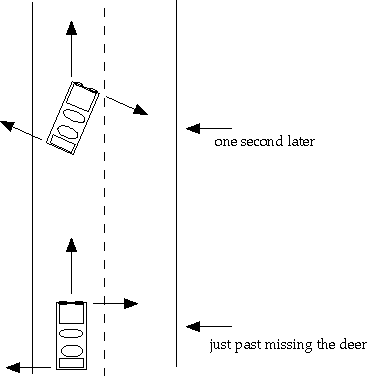
Figure 1.8-20 A second after missing the deer
We all know what to do in this situation. It’s the same as normal driving. We turn left to get the car to point down the road.
We also know that if we turn too little – or too late – the clockwise motion will continue. The rear of the car will pass the front on the left side, and the car most lightly will end up in the right ditch as shown in Figure 1.8-30.
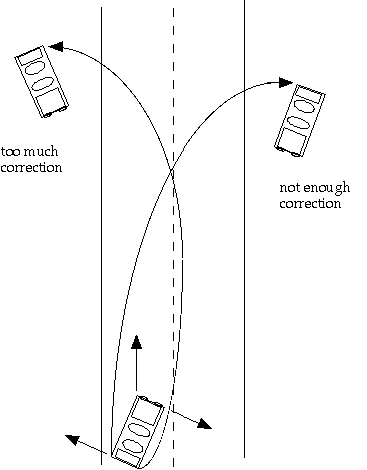
Figure 1.8-30 Outcomes of steering too much and too little
We also know from experience that if the steering wheel is turned to the left too much – or the correction is held too long – the clockwise rotation will be replaced by an even larger counterclockwise rotation. The car will go from pointing right to pointing so much to the left that the rear of the car will pass the front end on the right side. The car will end up in the left ditch. Thus, in the skidding condition that immediately follows missing the deer, too much or too little steer – or taking out the steer too early or too late – will cause loss of control.
This is where the "skidding around" learning environment is a good teacher. Drivers learn through practice precisely the amount of turn and the timing required to prevent loss of control. Trial and error experience allows the body to subconsciously measure all the needed variables and find timely behaviors that allow the car to get "straightened up" with the road.
However, this learning design could not be used on public roads. It could not be used even be used on GM roads. Even with wide grass lawns they were not big enough. In the new learning design, control behaviors would have to be created without previous experience. Behaviors would have to be created from information consciously gathered and consciously manipulated as the skid unfolded.
Not relying on subconscious processing, imposes two constraints on the new training design. First at a conscious level a driver can measure little more than one or two variables. Second, at the conscious level calculation could be performed on little more than one or two variables. Within these limitations we set to work to find: which variable provided the most important information about car skids, and what relationship could convert this measurement to performable and successful behaviors.
The critical variable to measure was found to be "heading movement"– this can be determined by the horizon movement (right or left) in the windshield frame. This discovery is within the capacity of a high school physics student. It is found in Appendix A: "Finding the Skid Indicator." However, for our search for understanding about our temporal blindness the derivation is not important. What is important is that the variable "heading movement" or more specially "not finding and understanding the variable," demonstrates a blind side to our cognitive process. It is not a small mistake. It is responsible for hundreds of thousands of lives in the past and untold lives in the future.
To understand the concept of "heading movement" paint a black arrow on the car’s hood with the tail near the steering wheel and the head straight forward the length of the hood as show in Figure 1.8-40.
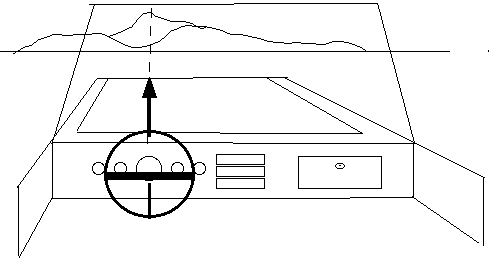
Figure 1.8-40 Defining heading movement with hood arrow
Assume the steering wheel is straight and the arrow points at a mountain peak. If after an instant of driving the arrow points at the same mountain peak then heading movement is zero. If instead the arrow points to the right of the mountain peak, this heading movement would indicate a clockwise skid. This measurement can be made without any road reference. All that is needed is a reference point somewhere on the horizon. It does not have to be at the end of the arrow just that the end of the arrow moves toward or away from the point.
Thus skid control, at least the hard part of skid control, is to stop the heading movement. Getting realigned with the road after the car stops spinning is a secondary and much simpler problem every driver can solve.

Figure 1.8-50 Controlling skids using the "heading movement"
The table in Figure 1.8 - 50 summarizes what to do with the steering wheel for each detection of undesired rotation. If the car is rotating clockwise – turn left. If the car is rotating counter clockwise – turn right. If there is no rotation (no heading movement), return the steering wheel so that the front wheels are pointed in the direction of the headlights.

Figure 1.8 –60 Wheels straight ahead when heading movement is not changing
Even if the headlights are pointing off the road when the heading movement stops, that is the car is sliding down the road sideways, take the steer out. You can visualize this in the figure above.
You are probably asking yourself two questions about controlling car skids. If the car is not rotating but is sliding down the road "sideways," and the front wheels are pointed off the road, what behavior realigns the car with the road? This is simple. You steer in the direction you want to go. If the road is to the left – you steer to the left. Slowly and carefully to get the car to go there with out creating any large buildup in counter clockwise momentum. Have confidence you will be able to master this part of skid recovery with no additional training or practice.
The second question is "How much steer to put in?" The amount to steer (proved in Appendix "A")is:
"as much as possible,"
such that when there is no heading movement, the steer can be removed to allow the front wheels to be pointed in the direction of the headlights."
The table in Figure 1.8-50 when combined with the "Turn the steering wheel as much as possible rule" seems too simple a solution to control car skids. How does a three condition three behavior table do the work of sensing all those variables and computing the magnitude and timing of all those behaviors. The proof, besides that contained in physics, is that the table works extremely well in practice. It is very easy to learn. Timid drivers can learn it and perform it just as well as hot shot performance drivers, Using it, both groups can handle in skids neither has previously experienced. Furthermore the table solution is very robust. It resolves the skidding vehicle problem for busses and go-karts, on icy roads and dry pavement. It works for high speeds and low speeds, and little skids and big skids. It works for airplanes, space shuttles, submarines and oil tankers.
However, another useful aspect of the successful use of this table, is that it contributes a critical piece to my description of temporal blindness. It illuminated the difference between two pieces of information. One, the "misalignment with the road," and the second "heading movement." Misalignment with the road, most of us understand and can use to steer our vehicles "Heading movement," few if any of us use because its power to manage the skid control, remains invisible at the conscious level. My proof of this conjecture is that when we are in an unpracticed skid, we use the first variable and not the second almost every time.
Describing our temporal blindness is the goal of this book. I am less interested in teaching you new ways to learn to control car skids. However, I promised that because you concentrated on the primary task there would be a reward in the form of a short course in skid control. (If you are not interested just skip forward a few pages to Section 1.9)
What follows is the remaining portion of a skid recovery course. It develops three supporting skills that allow a driver to implement the behaviors dictated by the table in Figure 1.8-50:
1) determining heading movement,
2) justifying the use of very large steering inputs and
3) being able to steer the front wheels to align with the headlights even when the car is not traveling in the direction the wheels are pointed.
Determining heading movement
To determine heading movement, a person simply watches the horizon and determines if it is moving right or left. Optimally I have suggested a long stripe painted on the hood of the vehicle, from steering wheel to a spot left of the hood ornament.. If you look at pictures of old race cars (when the driver had to sit right or left of the engine and transmission) you will find they where painted that way. However, most family sedans lack such a stripe. GM if your listening 32 years later you can still follow up on my recommendation.
Lacking such a paint job, drivers might use any two points fixed relative to the centerline of the car. The two points should make the longest line possible and be close to the line between the driver’s eye and the horizon maker.
Without the special paint jobs, one unconscious line selection is accomplished by assuming that the driver’s head is fixed relative to the car’s centerline and the far end of the point is the hood ornament. With down sloping of hoods higher seated positions and the removal of hood ornaments this line was removed from the choices. Drivers were forced to use a dirt spot on the windshield or the edge of the rear view mirror. These choices make the detection of heading movement weaker than a hood stripe first because the line is shorter. Furthermore the eye socket of the driver is really not fixed relative to the vehicle's centerline. In an emergency maneuver, the head flops around like a jack in the box creating all kinds of car "heading movement" indications that do not exist.
The worst but most obvious choice of front reference point is the thing hanging from the rearview mirror, for example a graduation tassel. It’s better than a point in that it is a vertical line. It cuts through the horizon no mater what its elevation in the field of view. At slow speeds, when it hangs straight down and you are making regular turns it is quite useful in smoothing out your driving. The fact that it moves like a crazy pendulum when the car is skidding means that both ends of the reference line (your eye and the tassel) are moving relative to the car’s centerline and not necessarily in the same direction.
Heading movement, if it is to be useful in vehicle control must be delivered accurately and timely. All this secondary moving of the reference line requires so much computational correction its utility is greatly reduced.,
To summarize; skid control behavior depends on determining "heading movement" several times a second. This is done using a reference a long distance from the car (e.g. mountain on the horizon) and a line fixed to the car that can be used to report small changes in the car’s heading relative to the reference. A student upgrades his or her means of determining heading movement when he or she knows to choose long lines that are stable relative to the vehicle’s center line, and near the line between the eye socket and the distant point.
Justify the use of violent steering inputs
Steering right or left as much as you can seems like a pretty rash thing to do. Timid drivers, and drivers that love their cars are loath to turn the steering wheel so violently. These turns make the car tip and the tires squeal. It spills your coffee and throws everything right or left. Such violent steering does not have to be learned – just justified. The justification is one paragraph long.
Assume a driver slammed on the brakes in front of you and you needed to stop to keep from running into him. You would step on the brakes as hard as you could. It would make no difference if your car was going 60 mph or 30 mph. So it is with turning the steering wheel to stop the rotational skid. The steer wheel correction should create the maximum force no mater what the size of the angle between the car and the road.
Steering front wheels independent of vehicle heading
Getting the steering wheel back to center when the heading movement stops changing is a little trickier. It is easy when the car is not skidding and the direction the car is travelling in the direction the car is pointed. However, as in Figure 1.8-60, when the car is skidding sideways as the heading movement stops changing, the car is pointed off the side of the road. Then aligning the front wheels so they point in the direction of the headlights is a whole different problem.
All the experience in the world is not going to help you. The task is accomplished not by feel. The driver must count the steering wheel turns "put in" from straight ahead to the "as much as you can" counter steer. Then when the heading movement stops changing, the same number of turns can be removed without any other cues from the environment.
Let me explain one more detail about learning to control skids. Then back to temporal blindness. During the development of the course many performance drivers said they used the heading movement to choose how much and when they turned the steering wheel. It was difficult to show what they were, or were not, using because they used so many things and they were using them subconsciously. However, we could prove to them that even if they were using heading movement they were not using it to tell them when to make the front wheels parallel to the vehicles centerline. We could prove to them that they could not align the front wheels with the vehicle centerline any time the car was skidding.
To prove this to the most adamant drivers we ran the following demonstration. We had them driving very slowly in a parking lot. We had them turn the steering wheel to the right very slowly until the vehicle was making it sharpest turn to the right. While in this very slow tight turn, we asked them to stop the car and set the parking brake. After sitting there a minute we asked them to make the front wheels point straight ahead without releasing the brake (that is with out allowing the car to roll forward and get a sense of where the wheels were pointed.) This being GM, most of the students turned the wheel until the Chevrolet logo was right side up. But they still didn't know if the wheels were straight ahead, one full steering wheel turn to the right or one full steering wheel turn to the left.
Summary of skid recovery course
1.9. Learning to learning failures
The table in Figure 1.8 - 50 helped resolve the driver-training problem at GM. It also helped me learn about how people handle skids. I learned about the tools they use to learn and even how they learned those tools. These "learning to learn" processes describe some additional distortions in our expectations, which in turn describe aspects of our temporal blindness.
The table in Figure 1.8 – 50 was created through a learning process that identified and manipulated symbols that represented the driver/skidding-car-system. It is a strange process that few of us have the motivation or capacity to perform. Physicists who could create the table were not motivated do so from their exposure to car skids. Even my motivation was not my well being during driving. My motivation came from being assigned an unsolved training problem.
This common limitation in people's learning to learn capabilities is the starting point of Time blind – the solution the second book in this series. Here, I have a simpler use of my discoveries. I assume that the table correctly describes the magnitude and timing of behaviors that implement skid recovery. Then, use the table as a reference by which to measure the performance of learning processes we all have and use.
Let me begin by dividing all the skids that a driver might have into those she "has practiced" and those she "has never experienced." This is a useful division because the behaviors we learn to recover from skids we have experienced, succeed (not surprising they match what is in the table.) While the behaviors that we learn to recover from skids we have not experienced, cause us to drive off the road (not surprising they don’t match the behaviors in the table.) By looking more fully at these two cases we can add to our view of temporal blindness.
Experienced skids
When the driver experiences a skid "over and over" she learns to control it using "feel." We say the driver is using physiology based learning tools. Her physiology learns to sense and create behaviors subconsciously. When the driver gets into a previously experienced skid the correct behaviors are magically performed.
Why do I say magically? Because, the driver, while being able to perform these behaviors, can not "explicitly describe" how much and when she turns the wheel to recover from a skid. She can not describe measurements used to dictate this behavior. The driver can not describe how she "figured out the connections" between "measurement and behavior."
Even learning theorists can not explain how the connections between measurement and behavior were created during practice, and how they are retrieved and executed during a sudden emergency. And they are certainly not able to describe how the physiological learning capacity was put in place. The only thing we are sure about is that it happened long before it was used to learn to control skids.
Non experienced skids
Now lets look at the other part of the skid domain. When the driver gets into a skid which she has not practiced, her powerful physiology fails to provide any behavior. If the driver gets beyond "freezing up," her conscious learning tools have to "kick in" and create the behavior. These tools it seems produce two guides for behavior selection.
1) use proportional steering to the misalignment angle between the car and the road." That is a small angle is a small skid and requires a small correction, while a big angle is a big skid and requires a big correction.
2) put corrective steer "in" when the car is not pointed in the direction you want (has an angle with the road) and take the steer out when it is (the angle with the road centerline is zero.)
Notice that both guides use "angle between the car and road centerline" to determine behavior." This choice of variable is different from the variable "heading movement"suggested in the table in Figure 1.8 – 50. If the table suggests correct behavior and normal conscious learning suggests something else, it would appear that our conscious learning process produces incorrect behavior.
What does this tell us about our skid recovery skills?
If in everyday driving, we can enter into a skid for which we have no experience, then, our lives, the lives of our family, the lives of other people on or near the road all depend on our abilities to regain control of a couple of tons of skidding steel. We don't have these abilities. The ones that we do have will choose behaviors that will probably make the skid worse.
If we knew about these limitations in our skid control capabilities, we would probably slow down. We would take driving more seriously. We would develop a much more powerful driver training course for everyone to take before they got behind the wheel of their giant SUV. We might even limit drivers without this special training to smaller vehicles, bicycles, motor scooters or mini cars.
What does this tell us about learning?
Studying the skid control learning environment illuminates many learning activities. Some, interesting in their presence – some, interesting in their absence. These include:
Learning processes produce expectations that shape behavior. If there is absence of, or a limitation in, learning processes, expectations are distorted. Distorted expectations, result in behavior that produces the unexpected.
For example, if two learning activities are operating in parallel and produce different expectations for the same behavior. At most only one can be correct. In the competition to be the guiding expectation, the more well developed learning activity wins whether it is correct or not. The weaker expectation is not believed even if it is correct. Similar distortions happen when the learning process that could produce the correct expectation is absent all together.
All of these failures were present in the car skidding problem. That is why it provides a view of undeveloped or underdeveloped learning processes and an avenue to understand our temporal blindness.
Learning processes can create a view of themselves. In learning to learn each of us asks, possibly subconsciously, questions like, "Is my learning process working properly?" "What are the components of my learning activity?" "How did I acquire these components?" Any questions that can be answered become starting places for another round of the same questions. Learning about learning is like investigating the layers of an onion. The learning we all see is preceded by learning …that is preceded by learning … that is preceded by learning, …that is …. Any weakness or limitation in a visible learning process can be explained by studying the preceding supporting processes.
Skid control learning, shows strengths and weaknesses of learning activities at many levels. We have seen that 1) some learning at some levels in some parts of the skid domain automatically produce the correct expectations. For example, our seat of the pants (physiological learning activities) work pretty well. 2) Learning at some levels in other parts of the skid domain produces incorrect expectations. For example, our conscious learning produces for all of us two rules of thumb which do us no good. And 3) some learning at some levels does not progress and does not produce expectations. For example, our abstract learning fails to make the skid recovery table.
Let me focus on learning that does not result from the skid control environment. Most of us did not understand that we had subconscious and conscious learning processes helping us choose behaviors to recover from skids. We did not realize skids fell in two domains – experienced and not experienced. We did not realize that physiological based learning worked only in the experienced domain. We did not realize that conscious based learning failed to provide correct behavior in the un-experienced domain.
Most of us never realized that our physiology was subconsciously choosing which information to collect. Or that subconsciously our physiology was creating ways to convert sensed information into correct behavior.
Most of us never realized our conscious learning process gathers the wrong information. We don’t realize that it divides the system into skids with different "angles with the road." Or that it creates incorrect ways of converting that information into behavior. We didn’t realize that when we ended up in the ditch, it was the behaviors that we choose that got us there. We do not know if some other behavior (letting go of the wheel) would have been a better solution to the skid than the behaviors we took.
By reading the previous section of this chapter, we learned there is an abstract learning capacity that can build a table to control skids. It provided us with a view that an abstract learning process produces very robust solutions to the skidding car recovery problem. The solutions are more robust than either of the two learning processes we normally use. However, we never realized that we do not have that learning capacity. Nor did we realize that "temporal abstract learning" could or should be part of any normal person’s abilities if he or she lives in our dynamic world. Even after reading this, most of us still feel these special abilities should only be the capacities of engineers.
However, engineers have all of the above temporal blindness and more. Engineers that created the table normally never learn the huge difference between the physiological and conscious learning processes. It just does not seem important to the problem they are solving.
Even the learning theorist seldom if ever learns, that learning done by engineers requires several levels of abstraction. First realizing the skidding car is not under control. Second, dividing the physical system into variables and operations. Third transforming them into symbols and functions. Fourth, connecting these into a manipulatable simulation. Fifth, "distilling generalizations" from the simulation experience that do not exceed either our physical abilities to measure sensations and manipulate the controls at the conscious level, or the physical limits of the car.
Most drivers, even after being shown the table, even after learning to use it, will not realize that the "table" and their in place "conscious learning process" create different skid recovery behaviors for the same skid. Most drivers will not recognize that both behaviors can not be correct. They will not recognize that they have to consciously make a choice as to which process they are going to use to choose behavior in the next un-experienced skid. Most drivers, without practice using the skid management table, still regress to "2 rules" or freeze when faced with a new skid.
Finally, most drivers, engineers, and even learning theorists, won't see most limitations in their learning processes. This makes it impossible for them to learn the limits of what each has learned.
In summary "distortion in expectations" arise from the presence or absence of each level of learning as well as imperfections within each level. The details learned from the skid recovery problem are so extensive they provide the foundation of the second book in this series. (For the reader who can not wait I provide a few examples in the footnotes below ,,.)
What does this tell us about our temporal blindness
What do you call it when drivers never realize the domain where they can control skids is partial. What do you call it when 50 years of experience driving on icy roads never develops the table solution. What do you call it when even after the table training is completed there is no view that there has to be a conscious decision as whether to use the behaviors supplied by the table or those supplied by old conscious processing that has been in place for years. It might be called temporal blindness.
When these missing views of learning are absent, there is no motivation to learn more. There is no motivation to go looking for ways to overcome these invisible limitations in our learning processes. Without this motivation learning content and process stops. Cognitive development stops.
Even thought millions of people have been injured because of these "limitations in cognition" we still do not realize, these limitations, exist. In this sense our temporal blindness shapes our behavior, prevents us from discovering that our behavior is inappropriate, and prevents us from ever creating learning tools to create the discovery.
1.10. A journey toward temporal sight ***(does this belong here)
What is wrong with our learning? What is wrong with our education? What is wrong with our judgment? What is wrong with our brains? The questions kept mounting. When people were asked to judge, they seemed to misjudge. Why did relatively safe activities look dangerous? How could relatively dangerous activities look safe? When something was obviously dangerous – what crippled thought process, what spuriously learned knowledge, allowed people to dismiss the danger?
Tens of thousands of injured and dead children each year did not make car driving dangerous. Millions of minor skids did not provide individuals either images of future crashes or the motivation to learn to control them.
My faith in the rational mind was shaken. How could people misjudge the potential danger of rotor tilling the garden? How could they believe it was more deadly than driving a car? It was inconceivable. And yet people on the street did it. Doctors, lawyers and college professors did it. Even automotive safety engineers, and professional drivers paid more attention to safety procedures during rotor tilling than while driving their cars.
Thus began a journey to discover the limitations of human thinking in the temporal domain; the limitations of temporal learning as they exist today and the study of temporal learning as it must exist in the future if we are to avoid tragedy.
I have studied temporal blindness for several decades. I have arrived at a common sense description of temporal blindness. I can produce the first feeble answers to questions like: What is it? Who has it? How did we get it? (And we all did!) How does it affect personal decisions? How do these decisions shape the human condition? And – most importantly – what can we do for the next generation to prevent their becoming temporally blind?
Chapter 2. Hidden by common absence
I can not prove that temporal blindness is a universal affliction of the human population. Yet my experiences drive me to find ways of making such a proof.
2.1. First attempts to measure temporal blindness
As a graduate student years, I implemented a crude test to evaluate temporal blindness. While the test never progressed beyond an experimentally flawed prototype, the experience suggests that most individuals, independent of their culture, education, or intellect, are equally time blind. That is they share the same limits when choosing behaviors to respond to dynamic environments in which they were immersed.
The test was specifically written for sixth graders. It required fifth grade math skills and sixth grade reading skills. Each young subject of the experiment was given an island, a herd of bison, and some beans. The goal was to use the beans to keep the bison from starving to death. The beans could be fed directly to the bison as well as planted, harvested, and stored. At the end of each year, points were awarded for each bison living and subtracted for bison that had died. The object of the test was to maximize total points earned over a decade.
There were some obvious pitfalls. If all the beans where fed to the bison the first year, and no beans were planted, then at the end of the first year there would be no bean harvest. In the second year, there would be no beans to feed the bison and all would starve to death. Conversely, if all the beans where planted and none were fed to the bison in the first year, all the bison would die. It was a planning problem. The decision makers had to live in the second year with the results of the decisions they made in the first year. During the fourth year they had to live with the results of their decisions in the previous three years.
It sounds like life. However there was one new twist. In this management problem there was no uncertainty. The result of each action was completely predictable. Which means the test taker could figure out exactly what each round of decisions produced without having to try them. He or she could figure out before the first year's decisions what would be the size of the herd, the bean reserves, and the point standing at the end of the first year. With this information they could make decisions and figure out what would be the size of the herd, the bean reserves, and the point standing at the end of the second year for the combined hypothetical decisions of the first year and second year. Using the same procedures they could actually figure out their final score at the end of the tenth year before making the first irreversible decision in the first year.
The test was designed to give people who "guessed" – terrible scores. Only subjects that planned their way through the first four years, only those that discovered the potential pitfalls before experiencing them, survived to manage ten years. The mathematics where quite simple. There were two hard challenges. The first was for the test taker to visualize that the problem allowed itself to be solved without guessing. Second was to visualize a process to separate the behaviors that lead to desirable results form those behaviors that lead to tragedy.
The bison/island test was a little like the driver/deer/skid/recovery test. In both the decision maker was presented with conditions they had never experienced and future conditions depended on immediate behaviors. The two problems were different in that the bison island system did not change while the thinking process proceeded to figure out what these conditions were and what behaviors to take to obtain desirable conditions.
A great deal of effort was expended to make the crux of the test these temporal inference aspects. The number of relationships and the numbers that describe the states of the system were chosen to make visualization and calculation easy. The text was written to minimize errors in reading.
The bison/Island was suppose to invite people to plan – not guess. The directions told them not to guess. However, subjects guessed anyway. They probably thought that they would be given a second chance. However, for my purposes these secondary scores were not indicators of their temporal inference skills. How well people improved over multiple tries on the test would predict the quality of their experiential learning skills not their inference learning skills.
The computer based test kept meticulous notes on what each test taker read and reread and how much time was allocated to each reading and computation task. Providing an on screen calculator, allowed the record to show exactly what numbers were used and how they were used at each decision point. If they failed because they miss read a piece of data or a relationship and then used it to make decisions their score was thrown out. Their failure to "do well" was tainted by factors other than poor inference skills.
Test takers with temporal sight, should succeed in a clear way. Test takers that fail should fail, not because of some mistake in reading or adding and subtracting, but because they simply did not realize the form of the problem, and or were not motivated to implement a planning solution which was within their capacity.
Even after throwing out the tests where other factors appeared to influence the final score, the test results were so uniformly dismal at the sixth grade level, that I tried seeing if Stanford students could perform better. Their distressing results next led me to give the same test to a diverse group of Stanford professors. These were exceptionally bright, well–educated people from diverse backgrounds including operations research, engineering, psychology, political science, economics, computer science, education and business.
Comparing the results was astounding. The professors' scores could not be distinguished from the sixth grader’s scores. Both groups, the sixth graders and the Stanford professors, did poorly. By preventing the starvation of any bison in the first years they (due to lack of full use of the information) set in motion a plan that predictably sacrificed most of the herd in the third or fourth year.
The hypothesis that needed proving was that, temporal inference (not experience or transmitted knowledge) is equally undeveloped in both groups. However this was not to be. Word quickly spread that there was a simple test making the rounds, one which implied that Stanford professors were no smarter than sixth graders. Faculty, initially inquisitive and amused, became hesitant to volunteer. Professors I didn't even know would run the other way if I happened to wander toward them in the corridors, carrying the computer monitor under my arm.
From this experience I believe that a more rigorous test design would show, most adults perform no better than sixth graders in this type of problem solving. A temporally blind sixth grader sees no better than a temporally blind college professor. In some domains that require planned behavior we are all equally blind.
2.2. Even temporal experts exhibit temporal blindness
Consider the learning implications implied by the fact that most technically trained individuals between 1920 and 1968 did not request seat belts in cars. The computation of motion and forces of a human body inside a car during an accident is well within their capacities. It is well within the capacity of a high school physics student. However, physicists and engineers, even safety engineers did not request seat belts for themselves or their families.
Even thought they knew about accidents and injuries, it never occurred to them that there was an opportunity for an application of their temporal analysis capabilities. Even thought they could have easily calculated the reduction in forces provided by seat belts, they just did not do it. Like everyone else, they continued to perish on the highways and to insist that their children sit back on the front seat, so they could be manually restrained during braking and god forbid collision. They fared no better in accidents than the general populace.
It appears temporal blindness exists even for those that have had training that makes explicit the motion and forces in dynamic systems. There is a difference between specialized training in temporal problems and temporal cognitive skills. While this difference is described in detail in Time blind - the solution the second book in this series, here the inference of its existence helps describe our temporal blindness.
2.3. If you are like everyone else?
OK smart guy how come you think you are such a good driver when you really stink? How come you never figured out that your "skid control skills" only worked in a very small part of the skid situations into which you could drive? How come you were not motivated to understand skid control by accident injuries you saw every day of your life?
The inference is, if your temporal inference skills were a little better you would not make these kinds of errors. More importantly you, at least in the temporal inference domain, are about as smart as everyone else.
The fact that no one developed and used the "heading movement" solution to skid recovery after a half century of individuals driving cars (and there were billions of drivers during this time period) contributes to my belief that temporal blindness at least at a level high enough to resolve skids is probably universal.
Chapter 3. Boundaries between ability and disability
How fast are you going when you are sleeping? You might say zero mph, "I’m lying here still." However, you are sleeping on a moving body. If you were at the equator you are traveling at 1000 mph on your daily trip around the center of the earth. In addition earth is traveling around the sun a distance 288 million miles each year. So add another 33,000 miles per hour. Even our sun is moving in our galaxy and our galaxy is moving in the universe. So how fast we are going is probably a lot more. You are certainly not still. The changes we see proceeding around us are only part of what exists. And our common sense, our way of processing information, seems designed to keep it that way.
Human beings do understand some motions and use them to choose behavior. We understand that shaking baby rattles make noise, thrown balls have trajectories, and planted seeds grow to be flowers. We choose behavior that correctly reflect these diverse motions.
However, there are motions, we fail to see. There are motions we see and still fail to predict conditions they produce. We predict future conditions and still fail to give them value. In the competition among alternative behaviors, these distortions influence choice.
The following examples show changes in behavior that would result from underused or incorrectly used information when it describes temporal aspects of the environment. The examples show where our cognitive abilities accomplish their tasks well and where they fail. They describe the boundary between our temporal abilities and our temporal disabilities.
3.1. Boundaries from limitations in learning
Learning processes like learning to play catch or riding a bicycle demonstrate both the power and the limitations of our temporal thinking abilities.
Learning to play catch
Learning to play catch with a baseball is within our temporal capacities. However, it lies very close to the boundary. For instance, too few practice throws prevents learning. Too much time between iterations (a week between each throw and catch) prevents learning. If the object is traveling two fast to see (like a bullet) it prevents learning. If the object was light enough that its trajectory was greatly affected by the slightest air currents it would prevent learning.
These limits describe temporal boundaries of our learning capacities in understanding trajectories of thrown objects. They explain why we all learned to play catch, and why we all failed to wear seat belts in the 60's. These explanations will eventually show, in Time Blind - the solution, why what we learn in early in childhood supports learning in environments like baseball and not in environments like auto accidents; why we learn to duck fly balls so easily. It also explains why we don’t learn to wear seat belts from being in or observing car accidents.
-iteration and delay
A child plays with rattles and forms her understanding of physical motion. She is not temporally blind to these physical motions. The proof is that she gained cognitive capacities to learn more complicated systems of motion like playing catch.
These learning capacities have limits. Consider the case where after playing with many toys, but prior to learning to play catch, our subject moves to a different world. In the different world it takes six months for a thrown ball to travel the distance between pitcher and catcher.
In this slowed down world she can never learn to play. The temporal capacity previously developed while playing with toys, cannot support experiential learning in this different world. She would not live long enough to get in enough throws and catches. In a lifetime, they would not equal the learning iterations she would have gained in just one quarter hour of backyard practice on earth.
Furthermore, if a consequence iterates every day and the behavior that made it happen occurred everyday six months ago we can not learn it. As the delay between behavior and action increases the learning problem gets harder.
For example, it is impossible to learn experientially to control wars if they happen only once every 30 years. Even if you lived 50,000 years and experience as many wars as you have throws and catches. It would still be impossible to learn to control wars. There are simultaneously many actors' behaviors contributing to the war. Even an individual's behavior contribution is not singular but the accumulation of behaviors over the 30 year time period.
Thousands of historians, limiting themselves to experiential records of past events, have little chance of producing either: a) predictions that illuminate that "contained in even peaceful conditions is the trend toward war," or b) a structure that shows which behaviors change the trend. In this sense the historian is like the seatbelt non-wearer, they have the data that suggest wars happen in every future but can not discover the social causality nor the behaviors to prevent war.
-physiological memory
Why can't a child that lives 50,000 years in the slowed down world learn to playing catch? There are enough iterations. I think this can be explained by limitations in what I call physiological memory.
To learn how to throw, we establish a destination for the throw. We throw the ball. We perceive where the throw landed. We measure the difference between desired and actual destination. With this difference we modify the previous throw.
One of the cognitive capacities that makes this process work is that the initial throw was "remembered." This includes precisely how we held the object, how the muscles tensed, and when and how it was released from our grasp, etc. It is this "remembered" throw that must be modified by the difference between desired destination and actual. We change the trajectory by modifying the combination of remembered physical actions.
Remembering the throw is, in fact, quite complicated. Far too complicated to do consciously. Fortunately, human physiology does the remembering for us. The body remembers how all the muscles felt. It remembers if we started on the back foot and changed weight to the front foot, how we swung our arm.... etc.
While the physiological memory process is beautiful, it does have limitations. Physiological memory, at least that part we use to learn to play catch, is stored for only a few seconds. In our world this short life is of no problem. The next throw is well within this brief period. However, in the slowed down world the physiological memory is long gone when it is needed as the basis to design the next throw six months later.
We can’t learn to play catch in the slowed down world even if we lived long enough to get in a normal complement of throws and catches.
From this we can identify another boundary of our temporal abilities. We can learn to perceive and control motions using direct experience only if we can rely on physiological memory to remember the intricate details of the actions that we took to implement the last physical action.
-physiological computation
To implement trial and error learning, the student must proceed through a series of iterative adjustments. In learning to play catch, these calculations modify each successive throw, so that the next will have a destination closer to that originally targeted. How these calculations are performed also defines part of the temporal sight/blindness boundary.
As the "memory" required for learning exists at the physiological level, not at an explicit conscious level, so too is the "computation" of each successive throw done at the physiological level. The amount a given throw must be changed is physiologically computed using the perceived error in the first throw. Also done physiologically is the translation of the error into physical actions for the second throw.
Doing this computation in an explicit and conscious way would be an extraordinary task. Few of us could be encouraged to even attempt the physics and math to accomplish it.
Consider for a moment how hard it would be to try to explain to a novice which arm muscles to contract to throw a ball five degrees to the right and 10 feet farther. The modification of the throw "by feel" may be quite easy to perform. But it remains devilishly hard to make explicit.
This dependence upon physiological computation helps describe a third limitation in our abilities to understand and control motion. In cases where physiological computation cannot be used (situations where motions can not be physiologically sensed or remembered) we will have greatly diminished capabilities to modify "motion-controlling-behaviors." The next example of riding a bike makes this abundantly clear.
Learning to ride a bicycle
Learning to ride a bicycle is another example which illustrates the boundary between those motions we manage well, and those which exceeded our cognitive abilities. Most of us have learned to ride a bicycle. Frightened as we were, after a few close calls, we tamed our two–wheelers.
To begin, we had to be rolling fast enough to make balancing easy. If we attempted to travel at very slow speeds, learning became impossible. Learning to bicycle may have been the first time in our lives that we could not master the learning task muscle by muscle, at a very slow speed first.
We all took our bruises in the learning process (we fell down) and were eventually glad we did. For that bicycle, once tamed, extended our speed of travel by more than three times, and the area we could explore without a ride from parents perhaps ten–fold.
The quickness and the almost universal success of people learning to ride a bike belies the complexity of the learning task. To realize the boundaries of those capacities brought into play, we must recognize both what we are doing when we bicycle; and also why we fail to learn to ride when we can not use these capacities to help us.
Physiological memory, and physiological computation are playing indispensable roles. These capacities together accomplish a task equivalent to that performed by a very well trained and disciplined mind first mastering physics, understanding all of the mechanics of the bicycle, the human body’s sensors and muscles, and formulating them into a set of interacting equations called a program. The program’s job is to read the sensors that describe the condition of the bike and rider, and dictate a stream of behaviors for the muscles to execute.
Bike riding is so "computation -intensive" that until recently even the fastest computer could not perform the program’s calculations fast enough to keep a robot-driven bicycle upright. Even with the computer power to run the program, the computer is doing only a fraction of the computation that a young child does when she learns to ride a bike. The computer already has a fully designed program installed. The child, during his or her efforts to ride the bike did not have this finished program. The child in learning how to execute the required behaviors to ride the bike, had to simultaneously write program. During learning the child had to create a primitive version of the program and then write improvements from riding experiences.
The combined learning task, as the child performs it, is almost beyond comprehension. Yet a young child, with the temporal capabilities she gained by learning to walk, playing with toys, etc. can learn to ride a bicycle in an afternoon. While this impressive task shows immense design and computational power in a temporal domain, riding a bike lies near the limit of these capabilities. Tasks just slightly more complicated or tasks which can not depend on the human body’s physiological computation will be beyond human ability.
To visualize such a task, consider a new world wherein falling off a bike is fatal. While riding the bike remains about as difficult as in the normal world, the consequences make successful learning unlikely. Almost no one masters a bike without at least one fall.
In a world where falling off a bike is lethal, instead of "feeling our way," we must make explicit the physical parameters of the system. We must unerringly infer from analysis the correct behaviors for each state of the bicycle, so that we can perform them correctly the first time, without experience.
This may seem like an impossible task. You and I may never be able to learn to ride without relying on our physiological capacities. However, given a situation where bungling our first attempt will kill us, we have no choice but to learn to first explicitly express and then manage the motions in which we are immersed.
Given such circumstances, developing a program to make predictions of outcomes based on a range of behaviors is extraordinarily complex. It requires realization or discovery that we are immersed in motion, followed by analysis which connects the causal mechanisms of system motion. It requires not only an understanding of the temporal aspects of the physical world but also a more advanced form of temporal capabilities all together, what may be called temporal sight. Temporal sight must include the capacity to recognize when trial and error learning will be expeditious, or wildly inappropriate.
Thus one boundary between temporal sight and temporal blindness can be described as the difference between individuals who expertly handle the physiologically–based bicycle learning (that is most of us) and that individual who can handle temporal learning tasks which are not physiologically based trial–and–error (this excludes most of us.)
3.2. Boundaries from idiosyncrasies in use of information
"System change" can be derived from observations of a variable at two points in time. When the change is large and the time interval is small as with a thrown object, physiological computation can produce feelings of motion. However, when the change is small and the time is long, as with the stars moving across the heavens, physiological computation can not produce feelings of motion. In the latter cases the motion (change during a time period) can only be computed using conscious cognitive processing. That is recording position and time at two instances. Computing the differences in position and time interval. Dividing distance by time to get average velocity for the interval (inches per second, ft per minute, miles per hour, etc.)
Sometimes the "difference descriptor" of an object is not its location but its amount. For example gallons of water in a pail under a roof drip. Whether it is a distance or an amount, what is being calculated is a trend - a change in a value per unit time.
Trends can be depicted by graphs. The size of a descriptor at several points in time are plotted on a graph. If the line connecting the points rises we call it a positive trend. A horizontal line denotes a zero trend. And a downward line denotes a negative trend.
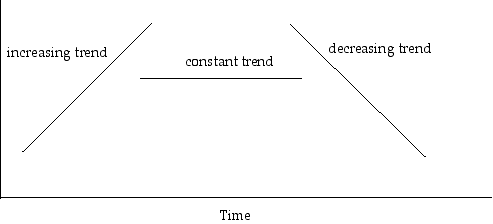
Figure 3.2-05 increasing decreasing and constant trends
If you know the value of a variable and the magnitude of its trend at a point in time, "without any more information," you can predict the value of the variable at a future point in time.
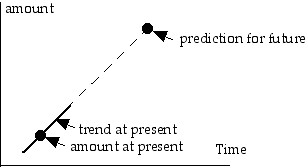
Figure 3.2-07 Predictions from present points and trends
This prediction can be used to choose behavior. This behavior is based, not on the experience of the event, but on a image produced by a computation of consciously gathered environmental information. Even the algorithm that facilitates the computation had to be acquired, stored in memory, and retrieved consciously.
Each of these conscious activities, each successive product of these activities, like their subconscious physiology counter parts, impose limitations on the behavior selection process. Inspections of these "conscious abstractions" help define additional portions of the boundary between our temporal blindness and temporal sight. Let me provide three examples of limitations in our capacity to give meaning to motions within our environment or trends that describe these motions.
Predictive and non predictive trends 1/24
All trends are not equally meaningful. Some trends predict future values of a variable. Some trends only quantify history. This subtle difference delineates yet another boundary between our temporal sight and our temporal blindness.
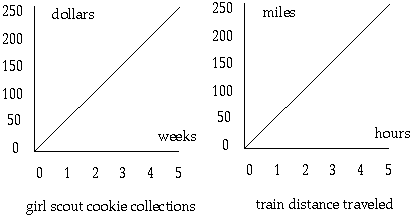
Figure 3.2-10 Predictive and non-predictive graphs
Above, are two sets of measurements have been graphed. The first shows the account balance of a Girl Scout troop. The second shows the distance a train has traveled. These two graphs, while appearing similar, are very different. One shows a non–predictive historical record. The other presents a historical record and predicts the measurement’s value at future points in time.
The money in the girl scout account graph is money raised by a Girl Scout cookie sale. The vertical axis is the amount of money. The horizontal axis is the number of weeks duration of the sale.
At the start of the sale, the amount of money in the account is zero. Each week, for five successive weeks, the amount climbs. The graph of the amount when plotted is a rising line. The slope of the line is the trend.
If the girl scouts make $250 dollars on their cookie sale after five weeks, we can derive a trend from the historical data. We say that they made $50 dollars per week. The trend describing sales is 50 dollars per week.
The second graph tells the distance a train has traveled along an interurban rail loop that runs 24 hours a day. Each hour the distance traveled is plotted on the graph. Similar to the Girl Scout’s graph, the points form a rising line to the right. The graph starts at 0. Five hours later, it reads 250 miles. Like the first graph, the trend in the variable "total distance traveled" is 50 MPH.
The trends in both graphs appear identical. Both lines slope upward to the right – one at 50 dollars per week and the other at 50 miles per hour. But do the two trends mean the same thing?
The girl scouts have been selling cookies to their neighbors. Let's say they sell cookies to 1/5 of the households in town each week. The amount of cookies sold each week remains about the same, and the graph of the dollars in the sales account rises evenly at 50 dollars a week, to 250 dollars.
Does the line’s slope upward (its trend of $50 per week) predict how many dollars the troop will make after 10 weeks? Of course not, the girls have canvassed and sold cookies to the entire town by the end of five weeks. Guilt and civic appreciation have their limits, as does one's appetite for butter cookies. Sales per week will plummet. The trend in the Girl Scout graph is not predictive of sales in the sixth week.
The train’s 50-MPH trend, however, is predictive. It correctly predicts the train will have traveled 500 miles after 10 hours.
Whereas the number of weeks into the cookie sale eventually does affect how many cookies can be sold, the distance traveled by the train in the future is not affected by how many miles the train has already traveled. Thus the two trends are different – one is predictive and the other is not. Successfully distinguishing between predictive and non-–predictive trends is not always easy. The capacity to make the distinction is another demarcation of the boundary between our temporal sight and temporal blindness.
Disregard for historical predictions
The Girl Scout example displayed how we might give relatively rapid trends indicated by historical data undeserved credibility. Below, I show how we give historical data concerning slow trends too little credibility.
In the US in 1993, we suffered two major natural disasters. Hurricane Andrew destroyed 70 thousand homes in Florida. The Mississippi River flooded and destroyed thousands of homes in the Midwest.
These are not unknown natural events. They are recurring events. Floods and hurricanes of equal severity have occurred over and over again in the very same regions, for many thousands of years.
Such events have diminished in neither magnitude nor frequency. Thus the historical record predicts that they will continue in the future.
Temporal blindness is indicated by a belief that the predicted future will not come to pass. Temporal blindness is indicated when people build or buy their homes in the probable path of such disasters. They just don’t believe that the recurrent phenomenon will ever recur.
Disregard for causal structure predictions
A mechanism is a group of parts that are connected together. A clock’s hands are a good example. Gears make the hour hand move if the minute hand moves. Gears make the minute hand move if the second hand moves. Because of the interconnectedness of the gears and by knowing how many seconds have ticked off, you also know how many minutes and how many hours have elapsed.
Parts of our world are like a very complex watch. We know the value of some variables (hand positions), and some functions that relate the variables (gears.) If one of these variables changes by an amount, then we know variables, connected to the first also change proportionally. For example if a car gets 10 miles per gallon and a trip odometer reads fifty miles, then it is a good bet that five gallons of gas are missing from the gas tank too.
If adjacent variables change, then it is possible to trace changes through chains of connected variables. Many predictions can be made, not through direct experience but through computation.
Gears make the relational movements of watch hands immutable. None of us believe that the hour hand can change with out the minute hand changing. In our world, there are mechanistic systems for which we should feel equal strength in our predictions. Part of our temporal blindness is revealed when we fail to see that a system is mechanistic, that some of the variables have causal connections, that they form immutable predictions. Part of our temporal blindness is that our predictions, our estimate of the feelings that we will have when a predicted event occurs, will be less than those feelings if the event is happening now.
Below I will give examples where predictable motions based on structure were invisible or visible but ineffective in influencing behavior. As a result, the chosen behaviors produced an undesired future. These examples reflect limits in our cognitive abilities. They reflect the boundary between temporal sight and temporal blindness.
-Electric blankets make structural predictions
Electric blankets maintain a bed temperature set on the blanket control. If the room is very cold, the bed temperature is maintained at the set temperature using lots of electrical energy. When the room temperature is just below the set temperature, little electric power is fed to the blanket. The person under the blanket did not request more energy on cold nights and less energy on hot. They requested a bed temperature. It was the blanket’s control that requested the energy to maintain "that" temperature. The blanket’s control acts like the thermostat on the wall of your house.
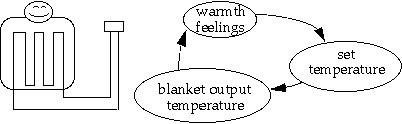
3.2-30 Single control Single person electric blanket
The blanket system, Figure 3.2–30 is sketched as three components; the thermostat the blanket heater and the sleeper. The sketch can be converted into ovals and arrows. Each oval is a state of a component. Each arrow is a mechanistic connection.
The "signal flow graph" was built using simple questions.Since the last variable effects the first, the chain of affects is shown as a loop.
Let’s see how this loop system works. Let's say a person comes to bed feeling chilled. He turns up the dial, The "higher" dial setting makes the blanket warmer. Then his chill goes away. The blanket makes him feel too warm and he turns the dial down to the original set temperature. In this system, the sleeper can correctly predict what will happen if he changes the dial.
-Electric blanket for two with single control

Figure 3.2-40 dual person - single control blanket
The first electric blankets for double beds had only one controller Figure 3.2-40. Couples negotiated the set temperature. The system reflects a delicate equilibrium between the always too cold spouse and always too hot spouse. No one dared change the dial again. A cold spouse would wear socks. A hot spouse would sleep nude. If someone came to bed chilled and tried to change the dial there would be unhappiness. Everyone knew it. They understood how the structure controlled the system, or if they did not, they had rules to govern behavior.
-Electric blanket dual coils right side up
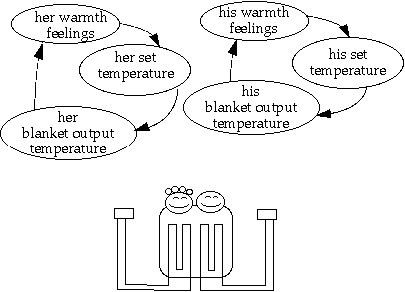
Figure 3.2 - 50 Dual control blanket
It was not a good design to have two people under a single control blanket. Eventually, electric blanket designers developed an alternative design. They created distinct right and left side heating coils in the blanket, and hooked the right side coils to the right controls and the left side coils to the left control as seen in Figure 3.2-50. Each partner could pick his or her own blanket temperature, independently. And if they wanted to change it, they could without affecting the blanket temperature of their spouse.
-Electric blanket dual coils upside-down
While engineers solved the crisis created by the single control blanket they made possible the creation of a completely new and unintended system. The two independent and stable control systems shown in Figure 3.2–50 could be changed into one unstable system simply by turning the blanket over - something that could be accidentally accomplished every time the bed was remade.
After the blanket is turned over a trace of the information path among the six components shows the wife's controller now affecting the heating coils over the husband. The husband’s controller now affecting the heating coils over the wife. The connections now make a single loop as shown in Figure 3.2–60.
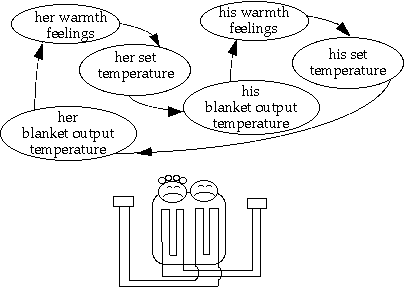
Figure 3.2 -60 Dual control blanket flipped
Let's see what happens when the husband feels chilled and turns up his dial. He makes his wife’s side of the blanket warmer. She feels too warm and turns down her dial setting. This in turn makes his blanket colder. He responds by turning his dial higher. His wife, feeling the extra heat, turns her dial down again. Each variable keeps bumping the next until she is roasting and he is freezing.
The new loop no longer causes either individual’s feelings of warmth to hover about set values. Instead, any change in any of the variables will cause each person’s feeling of warmth to change continuously away from their desired value.
The structure predicts that any change will lead to an unending chain of undesired changes. The structure of the system predicts this instability before any change exists. It shows the succession of change without any change happening.
The structure cannot predict "when" this instability will occur; that is, when one spouse will come to bed chilled or over heated. If both spouses have their controller set to the same number, when the blanket is turned over neither experiences any change in comfort. They could live with the unstable system for months before a chilled or overheated spouse starts the spiral toward undesirable thermal conditions.
The structure cannot predict the direction the system will travel. That is it can not predict who will freeze and who will roast until one spouse reaches out and requests a new temperature, cooler or warmer for his or her blanket.
If system structure was a normal tool for understanding the physical world, then the system's structural change (caused by the blanket flipping) could have been recognized and used to prediction its instability before any changes were experienced. Figure 3.2-60 does describe the potential trends and final conditions before they occur. However, how many of us do create structural models for physical systems that surround us? Just about as many as those who would not put their arms to stop a flying child during braking; or learn to ride a bicycle by reading a book.
The capacity to predict the consequences of change (which have not occurred but which are stored in our system's structure) has been beyond normal human cognitive capacity. However, like learning to protect our unbelted kids, the ability to predict consequence from structure may have to be second nature for us to survive in our world.
The undesired conditions produced when a husband and wife have no structural model for their electric blanket, provide us with an additional view of the limits of our temporal capacities and the demarcation between our temporal sight and temporal blindness.
3.3. Boundaries from temporal distortions in values 1/25
Values can be associated with groups, cultures, religions or governments. However, at the individual level, we commonly equate value with "gut feelings." The economist makes these feelings explicit using costs and benefits. What ever the quantifying mechanism values shape our behavior. Distortion in creating values shape behavior.
Some distortions reflect temporal factors in the environment. For example, the costs or benefits of the same event commonly appear to us to be bigger if it happens immediately and smaller when it happens in the future. Economists call this shrinking value "discounting." By analyzing past behavior they quantify an individual's propensity to discount the future." However, this quantification does not explain "why" people discount. Just that they do. In Time blind - the solution I suggest temporal aspects of mental processes cause us to discount. However in this section, I have the far more limited goal of using discounting to describe the boundary between our temporal sight and our temporal blindness.
Most objects or variables in the world are in a constant state of change. That is they will not be in the same location or have the same level in the future. These changes occur even if their is no behavior. A behavior causes the location or level to be different.
The accuracy of the predictions is of course a factor in driving behavior. However, if the quality of the prediction is held constant while other factors are varied, like the delay in the occurrence of a resulting event, then we can see that values assigned to the same event are distorted as the event is displaced in time.
Grandfather's choice – fingers and legs - now and latter 1/25
Any grandfather, given the option, would willingly cut off his finger in order to save the legs of 20 grandchildren. However, he will not chop off his finger to save the legs of 20 unborn great-great-grandchildren. Assume that the social system is heading toward a war in 70 years into the future. Assume that paying a painful tax now will avoid a war where many young men will loose their legs. As that future war with it loss of legs get closer to the present the value of the loss increases. Somewhere there a place where they are equal and this describes the boundary between our temporal sight and our temporal blindness.
Grandfather’s choice – progeny at the table 1/25
A man, a few days short of 65, sits at a 5 sided table with his son 45 his grandson 25 and his great grandson 5. An empty chair represents a yet unborn great-great grandson who will not arrive at the table at age 5 for twenty years. On the man's lap is a weapon that is timed to implement execution when the man reaches 65. The weapon can only be applied to one of the four progeny. The man must decide which will die immediately or in the case of the unborn die when he reaches the table 20 years from now.
The grandfather’s choice is quiet simple. Since the lose of the great great grandson seems is in the future it seems less. We all know that if that child was sitting at the table he would have equal standing with the other three. The value of the tragedy of the loss of the great-great grandchild increases as the time to his execution gets closer to the alternative executions of one of the others at the table. Actually the great great grandson does not have to get all the way to the table. Somewhere as a toddler, somewhere as a pregnancy, some where after the marriage of the great grandson, the presence of the g-g grandson is adequate to give him full standing. What ever the time is, where his value equalizes that of his father, grandfather and great grandfather is the dividing line between the great great grandfather’s temporal sight and temporal blindness.
3.4. Boundaries from hypothetical situations 1/25
A problem that you and I can not solve with our mental abilities, yet has a solution which we can understand, denotes a point on the boundary between our temporal blindness and temporal sight.
Wear a seat belt without coaching or experience 1/25
Imagine a well educated 18–year–old child who lived his whole life on Mars where everything was in walking distance. He has never driven a car or seen or heard of a car accident. He has not seen an accident injury. He has not been in any vehicle that has seat belts. He arrives on earth and is given a car to drive. He is taught how to stop and steer and obey the traffic laws. He is not informed about accidents, injuries, or seat belt wearing.
He drives the vehicle for two weeks. During that period, he does not have an accident. Nor does he observe an accident. Nor does he talk to anyone, or read information, that would inform him about accident injuries or seat belts. However, he does have the following experiences:
1. He is driving down the road at 30 MPH. There is an apple pie on the seat beside him. He sees a stop sign 300 feet away and he takes his foot of the gas and coasts to a stop. The apple pie remains in place on the seat.
2. The next day he is driving on the same street at the same speed with a second apple pie on the seat beside him. As he approaches the same intersection, changing the station on the radio distracts him. When he looks up, the stop sign is only 30 feet away. He slams on the brakes. The car just stops at the stop sign. The apple pie slides off the seat and falls on the floor.
Now to determine a point on the boundary between our temporal blindness and our temporal sight consider the cognitive abilities that would be required to allow this teenager to figure out that wearing the seat belt he is sitting on, "is a good idea." Imagine what cognitive skills would be required to motivate an investigation and use of this small database. What thinking would be required to infer from it the existence of accidents – the production of injuries in an accident, and the attenuation of injuries created by wearing a seat belt.
These questions are the ultimate challenge for cognitive scientists. I will not be able to address them hear. However, a cursory look will help us see a demarcation between abilities we have and those we need to choose behaviors for problems within our system for which each of us personally has no experience. Also for the cases when we have not been coached by people who have had the experience, and have learned a proper behavior.
The cognitive skills include the abilities to conceptualize the relationships that connect the system together into a mechanism. Then initializing the motions of the mechanism to match those that we can measure. And finally manipulating the mechanism across a full range of possible changes in the mechanism’s motions.
In the car example, this would mean getting the mechanism to show scenarios for all the possible but inexperienced stopping distances of a car going 30 MPH. One of those scenarios would be the three foot stopping distance that occurs when running into a tree.
Next expanding that scenario, by tracing the movements of components with the original mechanism, as they respond to the newly discovered conditions. For example, human bodies crashing into the dashboard will describe injuries during the crash. And with this information and with more components added to mechanism show the injury reduction capabilities of seatbelts.
This learning process has both conceptual and computational components. The computational parts is easily learned in math classes. However, the conceptual parts, putting things together so computation can begin is not directly addressed in today’s curriculum. The conceptual weakness describes the limitation in our abilities to use a mechanistic process to make scenarios. Thus it is our capacity, or incapacity to create scenarios that describes points in the boundary between our temporal sight and temporal blindness.
The interaction between the conceptual and computation forms another point on the boundary. The conceptualization part develops motivation to perform the computation part. Yet the computational part develops the scenario, that contains the unwanted event which is the motivation for creating the mechanism. Part of this boundary is described by the success or failure to incrementally creep toward understanding using a little conceptual work to get part of the scenario to get part of the motivation to implement another round of conceptualization.
In the seat belt example, this means that the teenager’s temporal sight would have to get sliding pies and not sliding pies to build a mechanism to connect stopping distance to deceleration of forces. That is that teenager would have to have a little of the curiosity of Newton. He would have to have the motivation to search the domain provided by the mechanism to find the accident. Then proceed to find the implications of the accident that would abstractly discover injury. Several more rounds would be required to get to an understanding of the injury reduction capabilities of seat belts.
Obviously, none of us today has the cognitive capacities this example suggests the teenager must have. However the passage puts into perspective part of the boundary between our temporal sight and our temporal blindness.
Cognitive transitions we can not make 1/25
While engineers at general motors were successful at changing the way performance drivers drove skids, the drivers themselves, with decades of experience, never made the transition in the natural environment. Each driver had to be taught what to measure and how to use the measurement to create response.
"Being able to make the transition:
from: learning to drive skid recovery through experience
to : learning to drive skid recovery through manipulation of abstraction.
defines a boundary between our temporal sight and our temporal blindness.
Solving no motion problems using structural dependence 1/25
The final boundary demarcation is described by temporal capacities that create or fail to create motivation to identify the structure of a system. For example, with expanded temporal abilities, the "bed maker" (of the dual control electric blanket example) would model the implications of putting the blanket on the bed upside down.
Admittedly the person would have to be more disciplined than you and I. However, they could do it with no more trouble than you and I would have in tying a weight on a helium filled balloon before giving to a child. We would do this because our mental model would be adequate to suggest to ourselves that the child would not have the discipline to hold on to the string at all times. One lapse in the attention to grasp the string and the balloon would float away.
This chapter has described the demarcation between our temporal sight and our temporal blindness. I have used limitations in how we learn, how we make predictions, how we create value for future events, and how we change our thinking processes.
The boundary exists and in some cases is distinct. I will show in the remainder of the book that the behaviors that cause scarcity, social conflict or environmental destruction, and our perception of causality for these conditions lie beyond the boundary defining our temporal sight.
Summary of Part 1 5/17
Temporal blindness is an imperfection in human cognition. We see, understand, and value only a part of the visible world. We are constantly being surprised by events we should expect. We unwittingly behave to cause the events. If there were alternative behaviors that would avoid the events, our blindness to the event’s approach prevents the search and analysis that would find the behavior. If we find these behaviors, the value our thinking processes place on their future consequences is too small to make us implement them.
Part of temporal blindness is described by our physiological limitations. When motions happen too slowly or too quickly our senses can not perceive them. When our experience does not contain enough repetition, when the delays between behavior and result are too long, or when senses of continuous motion are habituated, the connections between motion and behavior can not be made.
Part of this blindness is described by limitations in our abstract abilities to deal with these physiological limitations. For example, future events can be perceived (predicted) if the physical world could be converted into a moving mechanism that can be sped ahead in time. Alternative future conditions could be predicted if alternative behaviors can be entered into this mechanism. However, most of us can not build these mechanisms. Most of us lack the motivation to build these mechanisms. Lacking this motivation we don’t collect the information that would allow us to build them. Nor are we motivated to find ways of connecting this information together.
Part of this temporal blindness is described when our direct experience incorrectly tells us we have the problem solved. When all we have solved is a small fraction of the cases for which we must respond. For example in the skidding example we believe we can control most car skids when in reality we can control only a small portion of them.
-----
Almost everyone is afflicted by temporal blindness? Physics and engineering training to integrate information does not produce mechanisms and future images if temporal blindness prevents a motivation to do so.
It follows, most of us, most of the time, are less temporally skilled than we ought to be to keep ourselves out of trouble in our daily life.
------
The boundary between our temporal sight and our temporal blindness is blurry. However, our actions, and the failures of these actions to keep us safe, describe parts of this demarcation. We easily understand some motions and we correctly learn behaviors that respond to or control them. For example we easily learn to play catch, ride bicycles, and drive cars under normal conditions. For less frequently experienced sequences, we fail to either understand the motions or learn to control them. For example, car accidents fail to help us conceptualize that: "our environment contains motion we don’t fully comprehend." Car accidents, resulting from skidding, seldom help us learn the behaviors that will extract us from future skids.
Our views of tragic events are often limited to pictures of their final states. Those pictures usually do not contain; a) the motions that got us there; b) the system mechanisms that converted these motion to twisted metal and human injury; or c) how our behavior first created and then failed to manage these motions.
When the motions remain invisible, we fail to realize that an event was the direct result of our mismanagement of these motions. We failed to realize when our behavior was creating a motion away from preferred conditions. For example, we think auto crashes just magically came about. Injuries just occur. This illusion prevents us from identifying and developing the behavior that controls the invisible motions.
When we assign an incorrect cause to accidents; when we choose new behaviors to address that incorrect cause; when our behaviors have no affect; we incorrectly conclude accidents and injury are beyond our control. We continue to drive our cars as if we play no role in their crashes. We continue to wear no seat belt as if we will not be injured in a crash.
When future results of today’s behavior are clearly visible but fall on members of our community that are distant cousins or unborn future generations, they fail to influence the avoidance behavior we would take if the event was to happen tomorrow to our children.
When physicists and engineers are faced with problems with temporal aspects, we should not expect that their special experience and education will prevent them from choosing the same behaviors as less trained people. For example, their training in 1950 did not make them clamor for seatbelts. It did not make them wear them in 1968. Their special training did not overcome the temporal blindness we all share.
While our temporal blindness does not undo what we learn from direct experience, it also does not undo what we learn from direct transmission. For example, We all learned from the Red Cross in the 1950's that "back pressure arm lift" was the best way to resuscitate a drown victim. Yet "back pressure arm lift" did not reflect the existing image of the cardiovascular system which visualized breathing as putting oxygen into the blood and heart pumping as a way of moving oxygenated blood to the brain. If it had, the Red Cross would have taught us CPR ("mouth to mouth" and "chest compression" both of which were known for hundreds if not thousands of years.
Temporal blindness affects our problem solving at a more fundamental level. We are unmotivated to discover if our daily problems have been (invisibly to us) caused by our past behaviors. Each of us is not looking to see if we, or someone who loves us, unintentionally caused these problems. Furthermore, each of us lacks the motivation to investigate our lives today to see if they contain future problems.
Our temporal blindness directs our senses. It determines which information we consider important. It determines our predictions. It determines how we value predictions. It even determines which behaviors we consider and which behaviors we enact.
Part 2 - Where temporal blindness leads 5/23
individual behavior and social outcome
When you see grass growing... Wait a minute. No one sees grass growing. It grows too slowly. However we know if we don’t mow the lawn each week the front yard looks like a hayfield. So the grass must be growing each second even if we can’t see it. While the unseen growth can’t motivate behavior, the cumulative growth causes us to allocate time each week to mow the lawn.
The lawn is an easy system to understand. Everyone, through experience, learns to manage it without special coaching. However, every system is not like grass growing, and lawn mowing. Some consequences are bigger than having your front yard look like a hayfield. Some motions are slower and take 50 years to create a condition large enough to trigger behavior. The objects in some systems have mass. Which means they have momentum, the power to keep going when the behavior that created the momentum is removed.
In car systems, some mechanisms for getting rid of the momentum (crashing) are much different than others like stepping on the brake behavior. The former is almost invisible in to the driver. That is the injury potential of accumulated momentum is invisibly created. Stepping lightly on the gas is not viewed as the means to create sever injury.
Momentum creeps into the systems and stays there without our full conscious knowledge. Its hidden existence is a manifestation of our temporal blindness. In our temporal blindness, we create momentum and do not appreciate its implications. We take behaviors which create it without our intent. We suffer accidents that get rid of it. We suffer injury we would have avoided if only we could have understood this hiding entity.
Our cognitive limitations create behavior that creates our crashes and our injury. Our cognitive limitations fail to take behavior that will avoid injuries that are already implicit in our system. Our challenge is clearly seeing what we have not been seeing, finding behavior we have not found. Our challenge is to build a cognitive sensitivity to system characteristics, like momentum, that have always been with us, but which have always remained hidden from us.
-----
We have seen that mechanisms can be built to overcome our limited vision. The mechanisms are formed from the visible relationships within the physical system. The mechanism is given motion to reflect the motions we can see in the physical system. Then, by watching the rippling movements throughout the clockwork, each if us can predict other motions in the physical system we have not seen. We can see our previously unseen, and possibly unwanted, future. We can see the implications of behavior on our physical system by trying the behaviors on the mechanism and letting it produce scenarios.
Using mechanisms appears quite powerful. They allow us to see motions in the real world that our senses missed. However, without the predictions of unwanted events, there is little motivation to make these mechanisms. There was little motivation to record past events in away that would produce the relationships and variables needed to build these mechanisms. Our experience in using mechanisms this way is so limited we today are still not motivated to record the temporal aspects of the present.
Behaving to prevent our system from crashing, requires thinking we are unmotivated to do. We need the products of analysis to motivate the analysis. The motivation to collect variables and relationships and to integrate them into mechanisms, and manipulate the mechanisms to make predictions does not exist until the predictions exist. Or more normally until the events exist.
In our blindness our behaviors, the ones that move us toward unwanted events, remain unchanged. New behaviors that could change these motions and our course remain undiscovered and not taken.
The power of our temporal blindness extends beyond just not seeing motion, not seeing futures, not seeing behaviors to change motions and futures. It includes not valuing their meanings when we do see them. When others see these motions and make correct predictions of unintended conditions. When others discover alternative behaviors which could change our course away from these conditions. When these people transmit to us their findings and we believe their analysis. We fail to value the avoidance of the future condition enough to pay today’s cost of implementing the required behavior.
The previous examples showed how not seeing and not valuing motion conspire to shape each individual’s behavior. In seatbelt wearing one person acted and one person collected the unwanted events. Next I show how, when temporally blind people share the same social system, unwanted conditions can unknowingly be created by six billion peoples’ behavior. An unwanted temporally immoral" morality can be universally adopted. Behavior can unintentionally force changes in that morality. A culture’s incorrect assumptions can be transmitted to individuals and their thinking will not expunge them. Our collected behaviors sacrifice the future for the present. And our education practice perpetuates our temporal blindness.
In part I, my goal was to describe an individual whose temporal cognitive capacities are so limited that his or her behavior constantly creates future conditions that individual does not want. I focused on futures that result from a single individual's behavior. In Part 2 I focus on futures that require more than one decision maker to create them. These include events that occur only if two or more temporally blind people interact and events, that occur only if most members of a group take the same act. I describe when the common temporal blindness of the constituency determines the social destinations of violence, scarcity, and environmental destruction.
Chapter 4. Unwanted unintended social destinations 4/4
Mechanisms, trends, and predictions
Our social system is full of unwanted events. We don’t see them coming. They appear to us just like car accidents. We believe, we were just in the wrong place at the wrong time. We believe we had nothing to do with creating them and could not have acted to prevent them.
However, we have seen that car accidents are not random. There are behaviors that control car skids. If our social system is hurtling along like our car there are behaviors that can keep it on course and prevent its crashes. These behavior can be found and implemented. All we need is appropriate images of the system we are trying to control.
Unfortunately our "normal" thinking did not convert our views of the car skidding into "appropriate" images. This was accomplished by a special form of thinking that was not in our intellectual tool box. The images were created by combining relationships among the system’s variables into a mechanism. Then the mechanism was manipulated to create these images - value for these images and finally discovery of behaviors that change the images..
When a social system has relationships among its variables. When these can be connected into the mechanisms. Then the resulting images can keep us from being surprised by social outcomes we create. The images can create values for these outcomes and they can show which behavior avoids them.
These special thinking processes are useful in describing system motion that we can not directly sense. For example, accumulation of 50 years of social momentum that carries us toward and then into war.
This special thinking can be performed before the fact of war. It by passes the limitations imposed by more normal thinking processes which require direct experience, and which during war are far too overwhelmed with the problems of managing the conflict to reflect on its causes.
The mechanisms do not have to be complex. Remember only three variables and three relationships described an electric blanket. Two sets of these were enough to show what happened when a dual control electric blanket was flipped over.
In the following chapters I show that simple mechanisms can describe unimagined future conditions of social systems. I show that mechanisms make very strong social predictions. I show we should doubt these predictions no less than predictions that if the minute hand of a watch is moving the only way for the hour hand to remain stationary is for the gears to be disconnected.
If a mechanism matches the connections, components, and initial motions of a social system, then, its predictions are just as has immutable. If we desire different future conditions we must add or subtract a relationship (Equivalent of changing the mechanism’s gears) or changing the motion of one of its variables.)
The mechanisms in this section show that nice people, in choosing personal behaviors, make life nasty for future generations. My goal is not a call for the reader to regret past behaviors. My goal is not to challenge the reader to change his or her future behaviors. It is not a call for the reader to learn to make better predictions. These sections are presented to establish the meaning to future generations of the temporal blindness of us in the present.
4.1. Destinations controlled by system structure 3/14
In the last chapter, a dual control electric blanket was modeled as two loops. Under normal operation these loops represented two stable systems. Each half of the blanket provides its user with a comfortable environment. However, the simplest behavior (flipping the blanket over) transformed the same components into a single loop system that could at any time in the future overheat one person and freeze the other.
The loop diagram of the flipped blanket system makes its prediction with no experience of the predicted events. The prediction derives from causal structure - it is not a guess. Causal structures make immutable predictions. If there is change in any variable in a causal loop new conditions follow. If one spouse changes his or her set temperature, we know the outcome.
In the next sections I present two social systems. I show them to be unstable loops. I show that seemingly benign behaviors, not much different than a cold spouse turning up the set temperature, can trip them into motion toward undesirable future conditions.
Preventing the inevitable in these kinds of systems will not be solved with normal behavior. An individual who operates within one of these systems, must realize it. Instead of normal behavior, the individual’s behavior must stem from forethought that reflects predictions made by the loop’s structure. He or she must have some temporal sight.
Medical students getting divorced 3/14
At the University of Wisconsin (1973) I taught modeling classes to non-engineering students. For their final exam they modeled everyday problems. They had seen this electric blanket example and one woman recognized some of its structural aspects as those contained in a problem she was facing as she completed her senior year.
She was on her way to both medical school and marriage. The problem lay in her knowledge that 93% of all married medical students were divorced by the time they reached residency 5 years latter. Those were poor odds. Since she sincerely loved the man she was about to marry she wanted to know what she could do to improve their chances of staying together.

Figure 4.1-15 Marriage happiness
She constructed a simple model. The diagram, Figure 4.1-15, was even more simple than that which described the electric blanket. It had only two elements in the loop. The right variable was her happiness. The left variable was his happiness. These two variables were connected together by relationships to form a single loop. The loop had the same unstable characteristics as the upside down electric blanket. For example, if she was happy and was nice to her spouse, he would become happier. If he was happier, he would be nice to her. Which would make her happier and would solicit another round of contributions to each other’s happiness. What caused the first goodwill gesture after several cycles – neither would be able to remember. What drives the loop is that the last gesture brought happiness.
She also reported from her model that the converse trend was true. If she were unhappy and not nice to her spouse, he would become less happy and would act unkindly. His unkind act would make her even more unhappy and she would feel that his rudeness was uncalled for and would lash out at him. Again after a few rounds neither would remember who performed the first unkind act. All that either could remember was that the last unkind act was completely undeserved. That the other spouse was and is behaving completely unreasonably.
The model she has drawn is what every relationship faces, it is unstable like the upside down electric blanket, except with couples, the slightest nudge starts it going toward harmony or conflict rather than temperature extremes. When nothing happens for a while the system lays dormant ready to spring into action.
Any outside event that changes a spouses happiness. Something as little as a stubbed toe, or a sour throat can trigger a downward spiral. It is no wonder that 50% of all US. marriages don’t make it past the 5th year. However, 93% as is the case with one spouse being a medical student is especially high. My student modeler wanted to know why.

Figure 4.1 - 20 Outside events in medical student marriage
Her experience with the flipped blanket caused her to go searching for outside nudges to the loop. It did not take but a couple of interviews with first year medical students to realize what these nudges were. Medical school is fraught with failure. Failure that sends you home feeling terrible each night. Each day you are faced with a new problem that has no solution and thus you fail. Your cadaver is not perfect. A nerve does not lie exactly where you expected it to be. You destroyed what your were suppose to find before you got to see it. You have a pediatric case where the child lost an extremity and you and all of medical science have no means to make that small child whole. You have a geriatric that is fighting to stay alive but dying despite you unrelenting efforts.
Medical school is a tough teacher. You come home every night physically exhausted, ego bruised and emotionally stressed. You unconsciously express your despair to your spouse with a rude bark like "Why can’t the mashed potatoes be hotter. Who then barks back "since when did you become such a mashed potato queen?" A couple of interchanges around the loop and no one remembers who cast the first bark. All each can remember is that the last bark was a justified response to the previous verbal abuse.
My student modeler was sure every relationship had to weather some buffeting from the outside world. However, maybe it was more intense and unrelenting for medical students. Maybe it was going to take some planning to deal with this special case or their marriage was going to end up being one of the 93 out of hundred failures.
What change in behavior had to be implemented to make a difference. Does this objective have a familiar ring? It should, the goal of the section is to understand structure that describes the invisible motion — the motion that leads to future conditions that no one in the system wants. Once enlightened by the structure, it seems appropriate to choose the behavior that normally no one wants to take.
So my student reported the following plan. Since we, (meaning her husband and her self) know that I am coming home each night from medical school with this bashed psyche. We know what will happen if we treat this bashed psyche with normal courtesy... we will be divorced in five years. If we don’t want that end, we have to choose some very non-normal behavior.
"I propose," she continued in her final paper, "every other week one of us will take responsibility for behavior - contrary to what we actually feel. That is when it is your turn (her husband’s week of behaviors contrary to feelings) even if I come home and bark at you, you will be nice to me even thought I don’t deserve it. If you keep being nice even though I continue to bark at you, it may not make me happy but at least our relationship will not sink into a terrible tragedy for that week.
Then the following week the burden is on me to come home and be nice to you even though inside I want to bark. I know I may not be very good at it, and I know I won’t feel like it but it is the only way we can keep our relationship together from the attack mounted by medical school."
Actually I don’t know if they got married or if they did stay married. I don’t know if they had the right stuff to keep a marriage together independent of medical school. But I do know that they had a firm grasp on what non-obvious behavior was required and the special levels of self-control that would be required for its implementation. They were able to grasp the invisible motions of their predicament and recognizing what behaviors were required to control them.
Arms race 3/14
Let me give a second example of a system where seemingly peripheral factors to an unstable system are most important in predicting the system’s future state and discovering the behavior that will shape alternative futures.
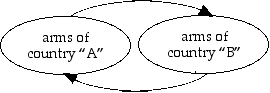
Figure 4.1- 30 Arms race
The arms race is a well-known two-element system, Figure 4.1- 30. With two confrontational nations, the generals from each, fearing a weak position, watch each other with suspicion. Each change in military strength of Nation "A" is analyzed by Nation "B’s" generals and addressed with a corresponding change in military strength. Nation "B’s" success in "upping its arms strength" is seen by Nation "A’s" generals and results in a Nation "A" arms increase. The resulting succession is called an arms race.
Like the medical students model, the arms model also suggests that if a general from "A" sees "B" not maintaining arms, it makes him relax and eventually not maintain Nation "A’s." arms. If the general from "B" sees "A" not maintain its arms then "B" can reduce its arms again and still maintain the previous power parity. The spiral should continue until neither nation had any arms.
However, in all of recorded history we have never seen this "zero limit" approached. We might conclude that, like the medical student divorce model, the arms race model has outside contributors that restart the escalating spiral.
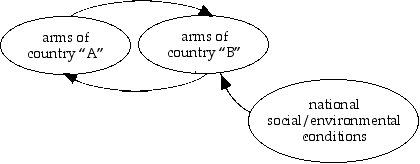
Figure 4.1- 35 Outside events ignite arms race
This outside contributor could be the paranoia of a vigilant general. However, it might be more hidden. The simple behaviors of a society's individuals to improve their lives increases the gross load on the available resources. New resources are found and acquired (possibly from a neighbor through marriage, exchange, or physical force.) When one group feels "left without resources" the confrontation begins. Even if these two nations did not have armies and generals they would make them a new.
In many discussions of the arms race model, the outside driving conditions are considered so peripheral they do not even appear. However, like the medical student marriage problem, the behaviors to solve the arms race problem are only found when the unstable loop structure is combined with the peripheral conditions driving it.
The sign of the trend 3/14
Part of the predictive power of these diagrams is in their simplicity. None of the diagrams used numerical values to make predictions. They used only the sign of a trend. For example, behaviors to control a skidding car were determined using the "sign" of the "horizon sweep" variable not its measurement in degrees per second.
Using the sign of the trend means, that instead of using 10, 20 or 60 MPH as a measurement of the speed a car is traveling away form an origin, we say it has a trend away form an origin (or the distance from the origin is increasing.) Instead of saying it has a speed of -30 or -70 mph away from the origin we say it has trend toward the origin (or the distance to the origin is increasing.) Thus, in the model, instead of having a infinite number of quantities that describe trends, we have only three, increasing, constant, or decreasing.
Preferences can exist for the "sign" of the trend rather than its many possible "values." For example, for a car pointed into the garage and touching the front wall, the preferred trends are – standing still or backing out. A forward trend relative to the forward wall would mean damage to the vehicle and garage.
Let me give one more example to make clear the difference between size of a variable quantifying a trend, and using just the sign of this quantity in describing a trend.
There are two descriptors that might help us maintain our body weight, the "amount" and the "change in the amount." If we are one of the lucky people whose weight hovers around our ideal, we give little thought to the minor weight changes that occur daily. However, for a recovering anorexic, any amount of daily weight loss, even if the body weight is near ideal, indicates a large incentive to change eating behavior.
The same is true for someone who has lost a great deal of weight and is near his or her desired weight. For them, small amounts of daily weight gain demand a change in behavior. For example, a few ounces of "weight gain a day" ("increasing" trend) adds up to a pound a week and unchecked - over 50 pounds a year. Ounces daily not the accumulation of 5 or 10 pounds should be enough to cause changes in eating behavior.
Next I show that trends, besides a powerful way to manage weight are an equally powerful way to manage social systems. People (social groups) who do not use trends to guide their behavior will experience future conditions they never wanted.
4.2. Destinations from collected individual behavior 12/08/00
What if six billion people fail to make a correct prediction? If six billion people undervalue a seen and unwanted prediction? Then six billion individuals will choose the same behavior. If six billion don't see their action will beget a future condition they don't want they will not prevent it? If six billion people blindly act to cause it? Are these people temporally blind?
Most people believe that national needs are the accumulation of individual needs. Most people believe that national needs push nations into confrontations with nations that hold the resources. However, most people do not see the connection between an individual's personal consumption and national confrontations. People do not see the power of their behavior for the same reason they never found limitations in the behaviors they were using to control car skids. Or put another way, for the same reasons they never discovered the more powerful behaviors described in the car skid control table.
For most of us the world appears too complex to know "which behavior causes which outcome." In both skid control and conflict control our understanding derives from a temporally blind analysis of direct experience and public record. Our statesman choose our national behaviors, in the face of impending conflict, by matching present conditions to historic conditions recorded in "look up tables." These tables connect historic conditions to historic behavior used to get historic results.
In many cases these tables were created by the same "seat of the pants process" that formed the look up table for controlling car skids, which we know is fraught with limitations. Staying out of war using that type of learning is pretty "iffy." The same behavior that reduced conflict in the historic case can encourage it when the present conditions appear the same in static analysis but different in dynamic analysis[.
In the skidding car example, our learning limitations were overcome (by engineers) by first converting the car skidding system, into variables and causal connections. Second connecting these into a manipulatable mechanism. Third, using the mechanism to show possible entry points for behavior. Forth, using the mechanism to make predictions for existing and untried behavior.
While the process produces robust skid recovery behaviors, beyond the limits of trial and error learning activities, most of us are not skilled at making and using such mechanisms. Each of us , even with 50 years of driving experience, never learns behaviors that are half as robust as those produced by the mechanism process.
Even if someone else figured out these behaviors and created a curriculum to teach them to us, as was accomplished in the skidding car example, our learning abilities, hindered by our temporal blindness, barely had enough capacity to learn them.
Even after it became apparent that what we learned in the curriculum had miraculous powers, the learning experience did not impart an appreciation for either the limitations of our present learning abilities or the potential benefits of new ones. We remain unmotivated to build such mechanisms to understand any part of the world in which we are immersed.
Consider the possibility that our social system contains variables and causal relations not far different from those of the skidding car system. Imagine that we can build a mechanism to reflect our social system. Imagine that we could manipulate such a mechanism to show how behaviors of individuals influence social trends?
In the next two sections I present mechanisms that connect changes in social conflict to changes in productivity, available resources, distribution of resources, and per capita consumption. The mechanisms further connect changes in these terms to different collections of individual behaviors. End to end, the mechanism connects different collections of individual behavior to trends in social conflict. I show which collected individual behaviors are most important in creating peace.
"Overlap trend" controls conflict trend 12/08/00
Changes in population size affect a change in peace
or
The hidden linkage that makes benevolent parents into warriors
Most of us want peace. We believe we act to promote peace. However, history reveals that, without exception, every social system evolves toward war. One of two scenarios explains why we keep reaping the conflict no one wants.
1) "Individual’s impotence"– common people do not have control of their social system. No matter what actions they take, other more powerful actions, possibly those of leadership, determine the path toward conflict.
2) "Individual’s potency"– common people do have control of their social system. Their actions move their community toward conflict.
We want to believe we are impotent to control our movement toward violence. It relieves us of responsibility for the injustice in the world. However, what follows is a proof that we are potent: "decisions distributed among common individuals, collectively do control the direction of a society toward or away from peace."
Begin the proof by assuming:
If:
most individuals want peace and believe that their acts, if mimicked by others, would lead to a peaceful world.
and
there are no deranged leaders who take these peaceful people to war,
Then:
for the actions of these benevolent people to create conflict, there would have to be a hidden linkage, which converts their good acts to conditions of confrontation.
Thus, to complete the proof I must show that a mechanism exists that converts their benevolent acts into conflict conditions.
To search for this mechanism, consider two individuals who need the same resource. To the extent that the resource can not service both, they have overlapping needs. Between these two individuals increasing overlap increases social stress; decreasing overlap decreases stress. The contracting or expanding of the overlap determines whether the social stress contracts to peace or expands to war.
The "change in overlap equals change in conflict" mechanism also suggests that any system, which already contains too much stress (manifested as violence) can reach peace only by decreasing overlap. It follows that for benevolent actors to inadvertently maintain conflict all they have to do is not decrease overlap. If our world contains scarcity, social conflict or environmental destruction, our objective, at least predicted by this mechanism, should be to reduce overlap.
A second use of such a mechanism to identify points of access where alternative behaviors can be applied to create different future conditions. For example to use the mechanism to identify which actions reduce overlap, consider a sunbather who has a need for sunlight (a resource). In filling his need he casts a shadow. When that shadow falls on a second bather the two bathers have overlapping needs.
If the beach contains only two people of equal size, the amount of shadow and possible overlap depends on the alignment of the sun and to the two bathers. Assume the beach is so narrow that the second sunbather must stand exactly behind and thus is completely in the shadow of the first. In this case the overlap is one. For the resource consumed there is only one unhappy person.
Next consider the case where 100 people are aligned with each other and the sun. While the resource consumed by the first person is the same, the number of shadowed individuals increases to 99. The overlap, or unmet need, is 99 times bigger. There are 99 unhappy people. The potential for creating conflict is 99 times higher.
On our earth, the consumer of any resource is like the first sunbather. He creates a resource shadow. The magnitude of the overlap associated with this shadow, sums anyone who perceives himself with an "unmet need" for the consumed resource.
If the needy are millions or billions, the original consumer plays only an insignificant roll in the size of the overlap. Should he discontinue his consumption, it would change the remaining overlap almost insignificantly. In the sun bathing example, if the first sunbather left the beach, there would still be 98 people in conflict with the new person in front of the line.
Next consider the behavior of redistribution as a means of reducing conflict. Redistribution of the sunlight among the 99 remaining individuals does not decrease overlap. If the remaining 99 individuals redistributed the sun light so that each got 1/99 of the light, the shadowed area would still sum to 98 people's worth of shadow.
From these two cases we can see that overlap is largely determined not by the consumption of a few resource consumers, but by the number of people with unmet needs for that resource. Changes in overlap and thus changes in conflict relate most directly to changes in population size.
If the determinant of population size is the choice of children per family, we can assemble the hidden mechanism connecting the creation of peace and procreative behavior. The mechanism’s links are:
If this mechanism correctly reflects the physical world, billions of one-child-per-family decisions will produce peace on the globe. Any other choice will create war.
Population trend controls peace trend 12/08/00
Wellbeing, peace, and population are all descriptors of social systems, Each variable can have three trends, up down and constant. As individual’s, we have preferences for these trends. We all want wellbeing, and peace to increase. If we want one, two, or more children determines if we want the population trend to go "down," "remain constant" or "increase." However, consider the possibility that a mechanism connects the movements of these three variables together, just as the second, minute, and hour hands are connected together in a watch. The mechanism, I envision, suggests that to get an increasing wellbeing and peace, requires a decreasing population.
This mechanism reflects an analysis of an island community. To make the analysis easier to understand, I have designed the community so that changes in well being, conflict, and population are easy to calculate and compare. To make it easier to calculate wellbeing on this island:
To make it easier to count the number of people being fed by any piece of land assume:
All eating groups are couples. So assume
On the island, each couple has a plot of land and thus some food to eat. The farms are not all the same size. The land poorest do not starve, and the land richest could still eat more if they had more land. To increase wellbeing requires increased land holdings.
Again to make calculations easier, assume that a couple does not change land holdings during their lifetime. All changes are made at the time the old generation passes away and the new generation begins life. Assume, two neighboring couples, have equal size plots of land, equal numbers of children who inter marry and inherit their parents' farms.
Two decisions determine the new generation's land requirements:
1) Parent couples determine the number of offspring to replace themselves.
2) Offspring couples, determine how much food to eat.
These decisions together determine the amount of land required to feed the offspring generation. The movement of land to or from this group determines its contribution to the island community’s march toward peace or war. The movement of land, I will show is dependent on changes in wellbeing, and population.
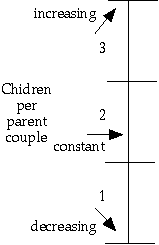
Figure 4.2-10 Children per couple ‡ population trend
Figure 4.2-10 shows the population trends caused by the parent couples' choice in number of children. If the two couples have two children each, the two offspring couples will just replace the parent couples and cause the trend in population to be "constant." The "2" in Figure 4.2-10, depicts the children per couple choice. The horizontal arrow depicts a constant population trend.
If the parent couples choose 3 children each, the three offspring couples, who replace two parent couples, and will cause a population increase, shown in Figure 4.2-10 as a "3" with a rising arrow.
Figure 4.2-10 also shows that if the parent couples choose to have 1 child each, then one offspring couple replaces 2 parent couples and the population trend is downward.
The food trends are determined by the offspring couple's decisions to increase or hold constant, or decrease their food intake relative to their parent's food intake. I use 1 unit as the amount of food consumed by either of the parent couples.

Figure 4.2 - 20 Food consumption per couple ‡ wellbeing trend
"1" in Figure 4.2 - 20 also means the offspring couple(s) requires the same 1 unit of food that the parent couple consumed. The horizontal arrow in the figure means a constant trend in the food consumption between generations.
The "1.5," represents the food units required by an offspring couple if they consume 50% more than their parents. The up arrow reflects the rising trend in consumption.
The ".5" units of food reflects the food required by an offspring couple if they choose a 50% reduction in food relative to a parent couple. The downward arrow denotes the decreasing trend in food consumption.
Notice the parent's choice of number of offspring Figure 4.2 -10 can cause only one of the three population trends. The offspring couple's choice in required food Figure 4.2 -20 can cause only one of the three food consumption trends. Thus, for the assumptions made there are only nine combinations of the two choices.
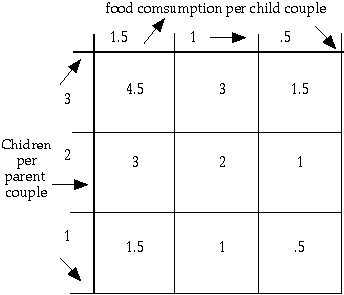
Figure 4.2 – 30 Food requirements for next generation
Figure 4.2 - 30, shows the food units needed to facilitate these nine combinations. The food units are calculated by multiplying the number of offspring couples, (children/parent couple) by the food/"offspring couple." For example, the top left box contains the number "4.5" units of food to feed three couples at 1.5 units per couple. The center box in the chart shows 2 food units (2 offspring couples, who each require one unit of food.)
Remember that on this island each unit of food requires a unit of land for its creation. Thus the food units in Figure 4.2 -30 also represent the number of land units required by the offspring. Since the offspring inherit two units of land, two units can be subtracted from each box in Figure 4.2 -30. If the resulting number is positive it reflects the amount of additional land needed to produce the required food units. If the number is negative it reflects the amount of land that can be relinquish and still achieve the required production.

Figure 4.2 - 40 Violence trend - land acquired or relinquished to achieve consumption
In Figure 4.2 - 40 the top left corner, for example 3 couples each consuming 1.5 units of food will require that the couples take an additional 2.5 units of land to meet their needs. Also that 1 couple consuming 1.5 units may give up .5 units of inherited land and still meet their chosen requirements.
When the number in a box in Figure 4.2 - 40 is positive, it implies a need to take extra land. The land has to be taken from someone who will eat less. Thus the positive numbers in the cells mean a trend toward violence in the community. A negative number means giving up inherited land which others can acquire. This produces a trend away from violence.
Conclusions from trend analysis
Shaded squares Figure 4.2-40 reflect the only combinations of parent procreation and child consumption behaviors that produce peaceful trends. Clear boxes reflect behaviors that produce trends toward violence. The zero reflects behaviors that maintain the island's current level of violence.
Parents must make their decision about number of children without knowing if their offspring will choose more, the same, or less food. Thus parents who wish to ensure their behavior reduces violence must choose a number of children (a row) where all of their offspring's' alternative food choices reduce violence. For example, if the parent chooses one child, every food choice available to the offspring in the bottom-shaded row will reduce violence.
On this island parent and offspring decisions that ignore the violence trend arrows in Figure 4.2-40 that reflect their conjoint behaviors are doomed to reap the resulting violence trend even if they have another preference.
Sensitivity of analysis to assumptions
The trend in violence that results from the parent and offspring decisions, is the same whether the parent is among the least or most malnourished in the community. Both the poor and the rich contribute to the violence trend, through their population and consumptive decisions. If either all the rich or all the poor died from disease leaving the other alone on the island the resulting trends in violence (after the initial redistribution) would be the same.
Generalizations from the island to our world
Summary
This introduction to "trend analysis," while not completely convincing when applied to our more complex world by our trend insensitive thinking, at least provides a window into the kinds of thinking that future generations must be able to perform.
While this discussion, is too weak to encourage a reader to limit him or herself to one child per family, it may be powerful enough to persuade us to work toward creating a generation that can perform and respond to trend analysis.
The power of the "1 child/family" trend 12/08/00
Almost everyone believes that having fewer children is powerful enough to reduce famine. However, almost no one believes that having fewer children is powerful enough to create peace. If you don’t think having fewer children is powerful enough to stop war answer this question; "How many people would be fighting if no one had any kids for 100 years?" Answer: Zero. In 100 years there would be no one left to fight.
This argument might imply that "The road to less starvation and less fighting is toward fewer people." However, we are strongly influenced by the counter argument, that history contains records of famine and fighting, and in every case there were less than six billion persons. So why should less people help prevent conflict? Fewer people should not make any difference.
That we use this truth in our construction of belief shows that we do not differentiate between the "size" of a population and the "trend" in the size of a population as discovered in the beach and island examples. Both suggest that to attain and maintain peace we need a "decreasing" not a "decreased" population. We need a population that continuously decreases fast enough that the available resources and technology result in a "universally held perception" of rapidly increasing quality-of-life.
Combining the two arguments.
Conflict relates to peoples’ perception of changing overlap. Conflict between people occurs when each individual perceives an increase in overlap. Peace occurs when each perceives "continuously decreasing – overlap." Conflict resolution activities that fail to create perceptions of "decreasing–overlap" produce only a temporary peace.
"Perceptions of continuously decreasing – overlap" are created by rapid decreases in population. If each couple limited themselves to one child, each couple is married at age 25, has its one child, and each person dies at age 75, during each 25-year period the population would halve. Each person would have twice the resources. Each person could hold an image that he or she was experiencing "reduced" overlap. If all people on earth required the resource consumption of middle class Americans (without overburdening the world’s resources) some suggest the population of the world could not exceed 200 million people. 125 years of "one–child-families" would be required to reduce the globe’s six billion inhabitants to 200 million.
During this period, absolute hardship would still exist; however, "perceptions of continuously decreasing-overlap" would be maintained. If during the 125 years the amenity per capita requirements continued to rise, even 200 million people could cause overlap. Population would continue to decrease below 200 million until the remaining overlap produces little conflict.
An equilibrium population would be established when overlap became so low that loneliness was worse then overlap. This occurs when any individual becomes worth more as a companion then the cost of the companion’s support. That is, a 'street person" would be picked up and taken home for companionship because spouses, relatives, and children were scarce.
Decreasing population is enacted by billions of procreative decisions by individuals. Procreative decisions are shaped by genetic drives, political and cultural coercion, and personal economic incentives. No combination of forces has ever, delivered a continuously decreasing population.
To get "one child per family" decisions (independent of coercion) requires a higher order of intellect than is now established by existing educational practice. It requires a human mind that can give meaning to future abstractions. It requires a mind that either predicts future liabilities, or absorbs an image of future liabilities from transmission. And a mind that can give these predictions and images meaning.
None of us can give meaning to the idea "extermination of the human species," or "a dark age of deprivation." The human mind can not predict. The human mind can not create the causal connections among components of a mechanism, that show slow cumulative change, leads to these future upheavals. For example, the mind does not have the power to infer that some procreative decisions will cause a future war, while other procreative choices encourage peace.
To have these intellectual powers, all minds require more than enlarged data bases. Each requires expanded capacities to manipulate information and create future images. It requires the capacity to give meaning to these images that motivate actions that are uncommon today. Mental capacities must be able to compare the benefits from avoiding huge abstract future liabilities with the immediate concrete costs of acting to avoid them. Individuals would need capacities to give enough meaning to the benefits of "not exterminating the human species" to overrule the meaning given to the liability of "not having a second child."
Which has more people China or the US?
China with 1000 million has 4 times a many people as the US with 250 million. Since China and the USA are roughly the same size China is four times as crowded as the US.
Living conditions in China are very harsh. In areas with similar winter weather patterns as the US, China’s residents do not have heated homes or hot water and most commute to work walking or with bicycles.
Its intense population load on its resources has prevented the Chinese from attaining a western standard of living. Its attempts to attain an industrial society is denuding its forests, eroding it farmland, and polluting its air and water.
The Chinese economists, agronomists, and industrialists feel that at a billion people the pre-industrial living conditions may not improve even with improvements in technology. The social scientists feel population will become dissatisfied with their wellbeing and hold the government responsible. The future looked so bleak that the Chinese totalitarian leadership have chosen to implement the most drastic infringement of individual rights ever conceived by a central planning authority. The government is telling its individuals to have only one child per family.
Two children per family would stop population growth but china realizes this is not a solution. China's government is telling each family to have one child per family so that population will rapidly decline.
Assuming the Chinese are successful at implementing their plan and the US continues on its plan of not influencing family planning beyond making contraception and abortion available, what do to you think the populations of these two countries will be in the future.
Let me give you some help. Answer the following questions first.
|
Question |
Answer |
|
25 yr. How many parents did I have? |
two. |
|
50 yr. How many grandparents did I have? |
four. |
|
75 yr. How many great grandparents did I have? |
eight |
|
100 yr. How many great great grandparents did I have? |
|
|
125 yr. How many GGG grandparents did I have? |
|
|
150 yr. How many GGGG grandparents did I have? |
|
|
175 yr. How many GGGGG grandparents did I have? |
|
|
200 yr. How many GGGGGG grandparents did I have? |
If we started one-child families with you G....G grandparents 200 years ago there would be one person (you) replacing all 256 people. China is not going to be this successful in 200 years their population would be only 4 million. On the other hand, the US has doubled in population in less than 50 years this century but we should not expect this growth rate either.
Now you can make guesses in the blanks below.
|
Years |
US population in millions |
China population in millions |
|
today |
250 |
1000 |
|
in 100 years |
||
|
in 200 years |
Lets work out the possibilities. At current rates of procreation and immigration the population of the US population could conservatively double in 100 years. China if their program was marginally successful could conservatively half during the same period. In 100 years China and US would have the same population 500 million. In 200 years China's population would be 250 million and the US population would be a 1000 million.
Even with these conservative estimates the two countries in 200 years, 8 generations, the same time since the American Revolution, will have reversed roles in terms of population density. Today there are 4 Chinese for every American. In 8 generations there will be 4 Americans to every Chinese. Our great grandchild may be illegally immigrating to China because it will be the most beautiful place on earth – even if it does limit its members to one child per family.
Summary "For Life Two is Too Many," 3/22
The chapter presented and manipulated mechanisms that inferred our global community was headed toward events no one wanted. These events were the result of individuals choosing behavior as if the behavior had no contribution to the event’s occurrence when in reality the behaviors cause them. The behavior’s affects were hidden because of cognitive limitations that hide four truths: 1) There were vastly too many people in existence. 2) Even zero population growth would not stop the trend of ever-increasing load on the environment that leads to its destruction (at least as we know it.) 3) Rapidly decreasing population is probably the only social condition strong enough to reduce the human load on the environment, and 4) one child per family would halve our population each generation.
The first title of this book was "For Life Two is Too Many," – where two was the number of children in any family. My readers told me that if I used this title it would be too depressing to read. So this bold, true and distasteful argument has been buried here in Chapter 4.
Chapter 5. Distortions in morality 4/4
People do what they feel is best at the instant of behavior. No matter how conscious or subliminal, no matter how complex or simple, thinking creates the itch that behaviors scratch. An instant later the itch could change and require a different behavior. Only in reflection are some behaviors singled out by the individual as moral. These reflections, if they exists at all, depend on thinking processes. Thinking processes determine the moral code of an individual and ultimately a group. A missed or undervalued impact can make an immoral behavior moral. If temporal blindness influences the perception and value of future events it also determines our morality.
5.1. An individual’s "temporally immoral" morality 3/5
Evil can be defined as the lack of empathy
If we can not feel what the people in the future will feel as a result of our behavior
- we are evil.
Morality defines fair interactions between entities. An individual's behavior is moral if other entities are impacted fairly. Fair is defined as the individual and the entities affected (as a group) are willing to change places. Each is willing to accept the other's impacts of the behavior.
This in theory sounds simple enough. However, in practice we see several distortions caused by not seeing and/or fully valuing the impacts that accrue to entities other than the actor. The effect is that these are excluded from the fairness computation.
For example, in some moral codes the impact of a behavior on slaves was not included. Therefore an immoral behavior when applied to the neighbor was a moral behavior when applied to the slave. When slave "James" became a freeman the impacts on him were included and the same behavior which was moral became immoral. When women, children, the vanquished, and the believers in other gods, change from being excluded to being included in the group governed by the moral code, old behaviors toward them change from moral to immoral.
Today most people, outside of religious fanatics, ultra nationalists, and racists include most human beings in their analysis. Does this mean that most individuals have a moral code that treats everyone impacted by their behavior fairly? Would each individual, gladly change places with any person impacted by their behavior?
I am not so sure. Next I present examples where a behavior, most of us consider moral because of its impact on people in the present, is immoral because of its impact on people in the future. For example, if we currently experienced the impact of the behavior that people in the future experience, we would have no trouble understanding the behavior’s unfairness. However, because of limitations in our cognitive abilities we create no such understanding. In our ignorance, we fail to see our adopted moral code facilitates unfairness to people in the future. I say we have adopted a "temporally immoral" morality.
Killing your children 3/5
Place yourself in the following predicament. You must choose among three distasteful behaviors whose outcomes are immutable.
behavior "A" ––>> results in the deaths of 1000 of your descendants, 1000 years from now.
behavior "B" ––>> results in the killing of one progeny each year starting this year for 1000.
behavior "C" ––>> results in the immediate death of one of your living progeny
Take the choices two at a time and rank your preference.
Both "A" and "B" are not pleasant alternatives. If you choose "B" one of your living children or grandchildren will be killed this year. Another will be killed next year etc. for 1000 years. While if you choose "A" the same number of decedents will be killed but the killing will occur not in your lifetime but 1000 years from now. If you are normal and have to choose between "A" and "B" you probably choose "A." In this way you put off the killing until long after you are dead.
A over B
In the first year "B" and "C" are equivalent in that each act causes the death of one decedent. However, in the second and third year "C" is a better alternative because it kills no one. If you have to choose between "B" and "C" and you are normal you choose "C." It kills fewer decedents.
C over B
In the first year and all the years that you live "A" is superior to "C." You see no killing in your lifetime. If you choose "C" you will miss your child every day of your life. If you choose "A" you won’t be around in 1000 years to see the bloodshed.
A over C
You have now ranked the three choices. You have preferred "A" over both "B" and "C." And you have preferred "C" over "B."
Your preferences are first A then C and finally B. list is below.
What is the magnitude of death of each option?
A = 1000 killed
C = 1 killed
B = 1000 killed
When you choose behavior "A" should you be shunned as a mad killer for killing 1000 of your great-great... great grandchildren, 50 generations from now, when you had the option of killing just one of your children this year with behavior "C. " Or should you be heralded as a saint because you saved the life of a living child.
What makes it "OK" to choose killing 1000 in a thousand years over killing one now is the temporal immorality of our moral codes? The creators of the code had inadequate means for including the full value of future impacts.
Killing your neighbors 3/5
Lots of people in this world are dying from starvation, pollution, and violence. However none of us, the good people are responsible for any of these deaths. We, the moral folks, lay all the blame on others.
Consider the possibility that this view exists only in the presence of limited cognition. Consider the possibility each of the six billion people on this earth contributes unknowingly to one or more of these deaths. If we do contribute then our moral high ground is gone and our moral behaviors become immoral. Our morally could exist because we don’t know how many people we kill, simply by living as we do.
People do starve, freeze, thirst, get sick, and for the lack of resources to overcome these hardships die. If we have anything to do with their flow of resources we have some responsibility for their hardship and their dying.
For example We drive our cars to work. The car requires fuel a subsistence farmer could have used to till, plant, irrigate, fertilize, or get his crops to market. However, since we could pay a higher price for the fuel, than he could, he failed to get crops to market. Because of our driving to work people starved and died. If we track all of our behaviors and identify all of their impacts, how many deaths will each of us cause?
In the next section I calculate this number. I will show why each individual and each culture has trouble calculating this number. I will show that the result of this inability is a "temporally immoral" morality.
Viewing global immorality using a ship analogy
Consider a large that ship never makes port. Getting on the ship requires a birth. Getting off requires a death. Each couple has around two children per family. Some people do not have any. The ship’s population is constant.
The ship has limited space. It has energy sources and technology that allows it to create shelter, food, water, healthcare, and recreation. Each person on the top deck gets a large portion of living space and ship’s services. Each person on progressively lower decks gets a smaller portion.
From any deck people can see a better life. There is a constant scramble by each person on the ship to improve his or her conditions on a deck or to move up a deck. The channels of success are achieved either by increasing productivity and efficiency or by redistributing existing resources through social structure, cunning, or violence.
Shipmates welcome increasing productivity and efficiency. However, during redistribution, one person’s success pushes another to a smaller space or to a lower deck. Some people get pushed so low they have too little food and die from starvation. Some die from lack of healthcare. Some die from physical hardship. Some die in the conflicts that arise from violent acts of redistribution.
Each day just before sundown everyone on the ship gathers at the back of the ship for sea burial of the dead. All those who died from old age or natural accident are buried off the sunny side. All those whose lives were cut short by starvation, inadequate healthcare, hardship, or violence, are buried off the shady side.
Assume, as a society they want to reduce shady side burials. Which behaviors do they have to change? If a person dies through lack of food it is not always easy to determine which behavior caused it. For example, when a child dies of starvation and the parents had the flow of resources to feed the child when they conceived it, however, as their world changed, that flow was diminished. Then whose behavior caused it?
One explanation, assuming all increasing consumption was not off set by increasing productivity and some resource redistribution occurred, then any person who increased his or her consumption of resources shares responsibility. For if he or she did not consume those additional resources and the starving person did, death would have been prevented.
When a person dies from social violence it is not always easy to determine which behavior caused it. For example when a person kills or is killed in fights to regain lost resources, people who increased their consumption and first took these resources share responsibility. For if they did not take them in the first place there would have been no need to take them back.
When a ship has too few resources to support all its passengers, even no change in distribution produces shady side burials. On such a ship anyone who consumes anything helps account for shady side burials. If they were not there, the resources that supported them could be used to keep others from shady side burials. On such a ship every individual shares some responsibility.
In the last configuration, the average responsibility per person might be calculated by taking the total number of shady side deaths viewed during a lifetime and dividing that number by the number of passengers. For example, if half the people are going over the shady side, then each person would be responsible for half a person shady side burial. Every pair of consumers would be responsible for one shady side death.
Let me propose a behavior that will stop all hardship and conflict due to resource limitations. While it will not sound humane, it will be enlightening. Assume that society commanded each pair of consumers to shoot someone. The released resources would prevent shady side burials that were caused by starvation, lack of medical attention, physical hardship, or social conflict induced by scarcity. This alternative social design will produce the same number of shady side burials. I use the alternative only to demonstrate that the outcomes of consumptive acts are equal to the outcomes of the shooting acts. The only difference is the "visibility of the connection" between action and result.
Because the relationships among the ship's resources and population are simple, they allow one more hypothetical extension. If one individual lowered his or her consumption to alleviate starvation and someone else besides the starving party consumed these relinquished resources, then, responsibility for the starving person’s early death would then be transferred from one consumer to another. The mobility of responsibility suggests that each individual on the ship is not equally responsible for the downward push of people to a lower deck or off the shady side in a burial. Those with larger consumption must take a larger portion of responsibility.
If we accept this proposal to allocate responsibility as a function of consumption, the pairs who consume 100 times those that are shooting just one person would have to shoot 100 people. Pairs that consume 100th as much, shoot only one person to fulfill the responsibilities of 100 pairs. If everyone followed this proportional proposal the shady side burial number would be the same.
I ask the question again, "whose behavior is responsible for the shady side burials?" If the ship does not adopt the shooting alternative, is each member of the ship’s complement any less responsible for corpses buried off the shady side? When shipboard society rejects such shooting proposals, does that imply individuals do not want to take responsibility for deaths due to their consumptive behavior? Or does it imply that shipmates are unashamed of their social design because they don’t appreciate the connections between their behavior and shady side deaths?
Consider running the numbers for a different ship – our earth. The two systems are not exactly the same. On earth poor people have children they know they can not support. Power hungry leaders cause violence for their own self aggrandizement. Benevolent parents have as many children as they can support. These behaviors, not present on the ship, cause additional shady side deaths.
We, on earth, assign all responsibility for shady side deaths to the poor, malicious leaders, and those with more than two children as if the rest of us make no contribution. We forget that these behaviors are in addition to behavior found on the ship.
If you are not a person who had children you could not support, an evil leader, or the parent of three or more children do you want to know how many people you kill by your consumptive behavior? Would you like to consider the number you would have to shoot if our global society chose the "proportion to consumption" shooting protocol?
My analysis uses two numbers, 75 (the average age at death in developed countries) and 62 (the average age at death in undeveloped counties.) The age difference is 13 years.
If four out of five people live in an undeveloped country, then there are four individuals with short lives for each person with a long one. If a difference in consumption accounts for the difference in average age, then the extra consumption of each person in the developed world is equal to the reduced consumption of four people in the underdeveloped world. Since each of the four loses 13 years, together they lose 52 years. 52 years is 70% of a 75-year life span.
Living a developed world life style on average means shorting another human-beings life by 70%. Each of us, by living in the developed world, is doing the same harm to our fellow humans, as if we shot someone who was 23 years old to prevent him from consuming resources the rest of his life. It is like killing 0.7 people.
This analysis overestimates and under-estimates the number. For example it increases the number because it does not adjust for the deaths of children of irresponsible parents. It does not adjust for the deaths due to irresponsible leaders or people with three or more kids.
It increases the responsibility of a rich person and decreases the responsibility of a poor person by assigning all of the "shady side" deaths to the top 20% of the consumers even though they account for only 80% of the consumption.
The calculations also overestimate an individual’s responsibility because they do not adjust for the deaths caused by our predecessors’ behaviors.
However, the largest error in estimation of an individual's responsibility caused by this computation, an underestimation that may more than compensate for its over-estimation, may be that it does not adjust for the future deaths that result from today’s behavior.
Moreover the 0.7 number is just an average. It does not reflect that among the top 20% of the world’s consumers, consumption can vary by more than a hundred fold. This means some consumers are killing between one and two people every year just by living their normal life style. If a shooting protocol was implemented, that is how many they would have to shoot.
I am not suggesting that we implement the shooting protocol on earth. However, now that the imperfect outcomes of our social design have been made explicit, our challenge is to take responsibility for our destination or find and implement alternative behaviors.
On the ship that is our planet individuals and social institutions have tried many solutions. Most are attempts to increase production through technology and to create safety nets that redistribute goods and services to the weakest group members. These behaviors, taken in the extreme, may momentarily stop "shady side burials." However, increasing consumption by all individuals from all decks, always succeeds in increasing them
In the long term, stopping shady side deaths will require different personal behaviors of all shipmates. Success would require a birthrate that annually lowers the ship’s population enough to compensate for expanded consumption of the remaining population (that is expanded consumption not addressed by advances in technology).
Population reduction is a solution to a global problem that remains invisible. Most of us do not see the earth as a cruise ship. Most of us don't keep track of the difference between a sunny and shady side burial. The harshness of other's lives does not seem important.
Even if someone could get a vision of the increasing disparity problem and was motivated to a search for a solution, "population reduction" would not immediately appear. Even if it did, lowering the birthrate could only be implemented by actions of six billion individuals. Decreasing population, as a way of balancing increasing consumption, so as to eliminate the shady side burials, would require each individual (rich or poor) to choose a one child per family behavior.
We, the six billion people of our earth, don’t have the abstract cognitive abilities to see our procreative acts as causes of, or potential cures for, the hardship realized by 80% of the earth’s inhabitants. We do not have the brainpower to give much value to these injuries. When we balance the expected benefits that accrue to us as parents of a second child, against the "invisible" or "under valued injuries" that accrue to others, possibly our grandchildren, the scale tips in favor of having the second child every time.
Our lack of brainpower also fails to help us see that our children will live in a world with even greater pressures pushing them to lower decks. It fails to help us see these pressures will increase generation by generation. It fails to help us see that each generation of children will have to be launched to higher levels than were their parents. Each future generation will have to be brighter than their parents just to live on the same deck. And shamefully, each generation will have to be more ruthless and more indifferent in dealings with their less fortunate earthmates.
I call these limitations temporal blindness. Temporal blindness is underdeveloped temporal inference. This means our cognition limits our abilities to measure and value abstract present or future conditions. It limits our understanding of how our behavior shapes them. Let me explain these thinking limitations using a simpler decision than procreation. Let me provide an example that includes the temporal aspects and removes the social aspects.
Consider the cases of the not yet addicted 15-year-olds deciding to smoke. The data is quite simple. On average, smokers die nearly seven years earlier than nonsmokers.
Let me make this number more personal to an individual smoker. Every year in the United States, premature deaths from smoking rob more than five million years from the potential life span of those who have died. Smokers in the US consume 500 billion cigarettes a year (4). Using the last two numbers I can show that each smoked cigarette robs an individual of about 5 minutes of life. Smoking a pack a day for 50 years, shortens a normal life by almost 4 years.
Let’s assume people retire at 65 and the average age at death is 75. If they worked hard and set aside a little money, they expect a 10-year vacation. They expect to have the time to take their grand kids on trips in their motor home and up to their cottage on the lake. The pack a day smoker has given up 4 years of this retirement.
This smoker also bought almost 18,000 packs of cigarettes at about $3 a pack. If he or she put $3 in a shoebox every day instead of smoking it, that box would now contain $54,000. The smoker will not be able to afford the motor home. If the $90 a month was invested at 6%, the same money would be worth $341,000. So a smoker will not be able to afford the cottage on the lake either. The analysis is conservative. It does not include the costs of medical treatment or the pain of coughing or being out of breath.
The numbers can be adjusted up or down for people who smoke more or less than a pack a day. However, the case is clear smokers are burning up the good times they could have enjoyed in retirement.
Which brings us to the crux of a young smoker’s choice "to smoke," – he or she makes the selection early in life. (Addiction plays no role.) At age 15, retirement at age 65 is 50 years in the future. Whatever benefits exist out there, they look pretty small from here. The mental scales filled with "peer pressure to smoke" (translated heavy) on one side and "abstract future liabilities" (translated light) on the other, tip toward smoking.
In conclusion, there is a tear in the social fabric and we don’t have the cognitive abilities to repair it. Our cognitive tools do not allow our selection of behavior to be influenced by the behavior’s future results. For us, our contributions to scarcity, social violence, and environmental destruction cannot influence the behaviors that create them.
Without adequate cognitive skills, six billion people will unknowingly promote global problems because of the same under-developed temporal inference capacities that plague 15-year-old potential smokers.
If the temporal inference thinking capacities of a future generation could be free of these limitations, then it would be possible for that generation to choose behaviors that we can not. It would be possible for that generation to create the world we want but can not produce. It would be possible for that generation to see and feel in their gut the tragedy that exists within our social fabric. It would be possible for them to choose behaviors required to repair it. Abstract benefits and liabilities would shape their decisions because their cognitive capacities could use them to influence their choice of behavior.
To repair the social fabric, our challenge is to create a generation that has temporal sight. Our challenge is to describe the temporal inference thinking processes that allow behavior to reflect its future outcomes. Our challenge is to create the learning environments that develop these thinking processes.
Killing your future 3/5
Economists have a way of calculating the value of benefits of a behavior that accrue in the future. They use "discount rate." It is created by a market where today's individuals choose from among different investments. For example a five percent discount rate would mean, "do not spend $.95 to day and get $1.00 in a year. As the discount rate changes the amount set aside at the beginning of the year changes. At some very small rate the individual will not invest. And at some larger rate the individual will deny himself the use of the invested money for the year to get the larger amount in the future. The economist is not as interested in how the individual arrives at the value, just that the individual has one and the economist can quantify it.
However, what the economist fails to realize is that all future events do not lie on the same sliding scale as dollar investments. It may be easy for a person to "know the difference" between having .95 and a 1.00 in his pocket in a year. However, "knowing the difference" between two alternative future events one or both of which is not a familiar experience, (or worse only abstraction) is not. For these behavior selection situations there is no easily identified discount rate. Whatever rate is constructed, is completely dependent on the thought processes that allowed the individual to place himself or herself in those future conditions. In these cases, our temporal blindness determines how we sacrifice the future for the present.
-help for heaven and hell 3/5
Assume you are a judge in a humanitarian competition. The goal of the competition is to help as many people as possible live a wonderful life.
The people live on two planets during a 5000-year time period. The societal intervention that ensures lasting happiness is already designed and will raise all people to a happy level when applied. However, because the two planets are at the opposite ends of a galaxy and there are limited resources, the intervention can only be applied to only one of the two planets. The other planet will follow its normal course. As judge you have to decide which of the two planets gets the society repairing intervention and which one is left untouched. You have two independent teams of researchers. Each visits both planets and makes recommendations. The following discussion presents the information discovery and analyses of these two teams.
The "Normal Thinkers" team" send scouts to the two planets. They report back that the first planet is a beautiful place with a constant five billion people with almost no one fighting, starving, or being poisoning by environmental pollution. They call this planet "Heaven"
The other planet has the same constant population as "Heaven" however, almost everyone is fighting, starving and being poisoned by the environment. They call the second planet "Hell,"
The Normal Thinkers team does the following analysis. They ask how many people are in need of help on each planet today. They draw a graph for planet Hell and a graph for planet Heaven. The shaded area in each graph represents the people who are disadvantaged today and can be helped by an intervention.

Figure 5.1 - 10 1-day comparison of hardship of two planets
The Normal Thinker’s team concludes that sending the resources to Heaven will do no good. There are no people there who need help (no shaded area in the Heaven graph) They recommend sending the resources to planet Hell because all five billion (represented by the shaded area in Graph 1) will benefit the first day.
The "Temporal Thinker’s" team also send scouts to the two planets. They report back that the present conditions are as the Normal Thinker’s scouts have presented them. However, their report, in addition, describes changes or trends in the measurements of the number of disadvantaged people.
For example, Planet Hell, which has five billion people who are disadvantaged, also has a trend that very slowly decreases the number of disadvantaged people each year. The trend, almost imperceptible today, will take 100 years for all people on planet Hell to be changed from their disadvantaged position. This slow trend is shown in Graph 3, Figure 5.1 20.
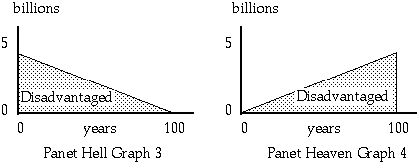
Figure 5.1 - 20 100-year comparison of hardship of two planets
Graph 3 and Graph 1 both show most people in the first year will be disadvantaged if there is no intervention. During the lives of the analysis team and you the judge, most of the people on planet Hell will be disadvantaged.
For planet Heaven the temporal thinkers report that almost no one currently is disadvantaged. In addition they report that there is a very slow trend converting a few of the advantaged people to disadvantaged each year. The trend is very slow and in the first few years will affect only a small percentage of the five billion currently advantaged Heavenites. The shaded area of the Graph 4 shows how many people will be disadvantaged each successive year:
The temporal thinkers using only Graphs 3 and 4 propose you, the judge, can choose either planet and produce the same good. The shaded area in each graph, which will disappear after the intervention, is the same.
Of course this one hundred-year period is only 1/50th of the total time period for which the intervention will affect change on the planet and upon which the team will be graded. So the temporal thinkers in their analysis draw Graphs 5 and 6 Figure 5.1 -30 to show the number of people on each planet who will live disadvantaged lives if there is no intervention for the entire 5,000 years.
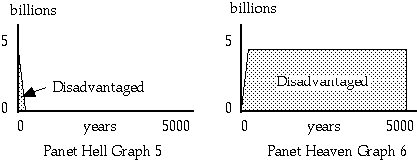
Figure 5.1 - 30 5000-year comparison of hardship of two planets
From comparing the shaded areas in graphs 5 and 6 it is obvious that there is 100 times as much shaded area in the planet Heaven graph as in the planet Hell graph. This means that an intervention in Heaven will do 100 times more good as an intervention on Hell. The temporal thinker’s team recommends sending resources to planet Heaven and letting planet Hell follow its natural course.
While all six graphs are correct they guide the decision-maker to different choices, Graphs 1 and 2, reflecting no temporal information, encourage sending the resources to Hell. Graphs 3 and 4 containing temporal information for 100 years make the two planets appear equal in need. And graphs 5 and 6 depicting the needs of each planet for 5,000 years show that Heaven has 100 times the need for intervention than Hell.
Thus even though the trends were very small, the temporal information and analysis shows the normal thinker’s information and analysis leads to a decision that "under–performs" the possible good by a factor of 100.
You as the final judge will have to choose. If you send the resources to Heaven, the existing residents of Hell (that both sets of scouts have photographed and presented in their report) will live in misery all of their lives and all of your life.
Normal Thinking scouts who, had made friends with people on planet Hell and promised to return with help, will feel betrayed by what they feel was an inhumane analysis. They argue that:
"The screams of the people on Hell you hear today. The laughter of the saved people on Heaven will come long after you are dead. You must act to help those in need today. Let those who live in the future worry about the future. Besides the future is uncertain. Things will work out fine for planet Heaven. Who knows what new technology will bring? How can you in good faith deny the people on Hell the help that we can give them today."
Today we face a similar challenge. How do we think? Are we like the temporal thinkers or the normal thinkers? Most of us are normal thinkers. We know what we feel in our hearts. We know how we made our analysis. We think the temporal analysis is intellectually interesting but when it is time to act our hearts side with the faces that we met today. We can not in good faith, even for a factor of 100 to 1, live with daily-presented images of their suffering.
So not only do we not gather the temporal information, not only do we not do temporal analysis, but when the analysis shows 100 times the benefits if we apply our resources to people in the future rather then the people in the present, we turn our backs on those who live in the future because our thinking capacity can not give their suffering meaning.
-spaceship destinations 3/6
The next example is similar to the heaven and hell example except for a change in point of view of the decision-maker. Instead of being a judge deciding other people’s fate, you yourself share the direct consequence of your decisions. These include both the physical condition of your life but also the joy or pangs of responsibility for conditions your choices bestowed on others.
Place yourself on a spaceship. You have escaped the tragic termination of life on the earth and know its history well. You have traveled several years through space and have consumed much of your spaceship’s resources. You must land soon or perish in space. You have identified only two planets that your ship can reach. You must now adjust course and commit to land on one of the two planets. This action also commits your ancestors to live there for a 1,000 years. It will take that long before they can recreate the technology that facilitates space travel.
Scanners can view the distant planets. You know one planet is like "Heaven" and the other planet is like "Hell." "Heaven" will ensure a happy and beautiful life for your family and friends on the spaceship for all of their lives. "Hell" condemns them to scarcity, social conflict and a degraded environment. Some will experience an early and painful death.
The scanners detect trends that allow predicting the conditions on the two planets for a 1000 years. "Heaven" will insure hardship and early death for 27 generations beyond your grandchild. "Hell" will ensure beautiful lives for 27 generations beyond your grandchild,.
The sum of the hardships for a 1000 years is 10 times bigger on planet "heaven" than on planet "Hell. However, to get the larger benefits you have to pick and live with the harsh beginning. Your only motivation to do this are the benefits you derive from abstract view of the beautiful lives of the 27 generations that will live after you are buried.
If your temporal thinking skills are weak you will not have the capacity to value the conditions predicted by the trends. There will be little reason to choose the large future benefits offered by planet Hell over the small yet immediate benefits offered by planet Heaven.
The choice, small and immediate vs. large and distant future describes our morality. The choice, reflects the value we created for these two options. These values reflect a the level to which we have developed our temporal sight. Thus our temporal sight determines the level to which we have developed our morality.
Today we on earth live on a planet equivalent to "heaven" and are headed toward ever worsening violence, famine, and pollution. Trends determine future conditions. Our temporal cognitive capacities choose immediate and small benefits every time.
A new generation without our limitations will understand and choose to pay in the present for the larger benefits in the future. We must develop a learning process to provide these thinking abilities to our unborn children.
5.2. A culture’s "temporally immoral" morality 3/5
Thus far we have investigated distortions of morality as they apply to the decisions of an individual. Next I look at these distortions as they reflect in decisions that require many behaviors to create their consequences.
Environmental immorality 3/5
Another way to view the temporal distortions in accepted moralities is to analyze the behaviors recommended by the environmental movement. For example, look at the environmental practices and perceptions of four families in Middle American.
They live in four similar houses next door to one another. Each family is concerned about the overload created by humans on the environment and have adopted new behaviors as their contribution to its reduction. Each family is proud of the changes they have made. These four families are invited to a meeting where each describes their behaviors.
The first family, a couple with two children, describes a complicated recycling program, which includes, careful purchasing, reuse, and disposal of household containers. Furthermore, they will not have a third child they had planned to have. This is a complete description of the change in their behaviors to reduce the human burden on the environment.
The second family, a couple with two children, describes a sophisticated conservation program. They drive a fuel-efficient car, which gets 50 miles per gallon, and they have insulated the roof, walls, windows, and hot water systems in their home. Furthermore, they will not have a third child they planned to have. This is a complete description of the changes in their behaviors to reduce the human burden on the environment.
The third family, a couple with two children, easily shows its superiority over the first two families by reporting that they have implemented both the recycling program of the first family and the conservation program of the second. They too will not have a third child they had planned to have. This is a complete description of the change in their behaviors to reduce the human burden on the environment.
The forth family is a couple with one child. This family confirms that it has not changed any daily behaviors to conserve or to recycle. They drive a car that gets eight miles to the gallon, their house is not insulated and they throw everything in the trash which ends up in the land fill. However, they are not going to have the second child they had planned to have.
The question now posed to each family is, "Which of the four families has made the largest contribution to reducing the human load on the environment?"
If these families follow non-temporal analysis they will award the prize for the best efforts to limit the load on the environment to the family whom both recycles and conserves. The family that neither recycles nor conserves gets last place.
However, this normal analysis does not take into account the resources not consumed (conserved) by future generations of each family. With these considerations family four with only one child instead of two is the winner. The superiority of their contribution grows with each generation until the contributions of the first three families appear insignificantly small.
Almost no one would call the environmental movement and the three families who take their recycling and conservation seriously "immoral. The people in the environmental movement would almost certainly call the non-conserving and non-recycling family immoral. However, the practices encouraged by the environmental movement do not in an absolute sense reduce the human load on the system. The practices at best only slow down its growth. While the actions of the single child family actually do accomplish reductions, through reductions in population.
The immoral family, by the environmentalist’s standards turns out to be the most moral by "reduction in human load on the environment standards." The environmentalist’s morality is temporally immoral. Those that take their recycling seriously, and not their procreative behavior, are doing little more than falling in line with society’s temporal immorality.
A failure to honor 3/6
I was in Israel during Yom Hasmuot. It is the day on which Israelis honor those individuals who gave their lives for national survival. Israelis feel that everyone who is alive today (and all future generations) should know that these men and women gave so that the remembers, could have freedom.
It is a somber event. Three times during the day the sirens sound and for several minutes no human being within an entire nation moves. They don’t clear the freeways. Every vehicle just comes to a stop right where it is, every engine is turned off. Everyone stands. No one speaks. This is very serious business; this honoring of those who have sacrificed their lives. There is a realization that if the "sacrificers" had been selfish there would be no life and no freedom.
I don’t wish to minimize these acts of remembrance or the acts of those being remembered by what I relate in the next paragraphs. I wish to illuminate that lessor honor is given individuals that provide greater contributions to peace at no lessor self-sacrifice.
I am referring to a couple who denies itself a wanted second child. This couple creates future peace through the mechanism of declining population. This couple and others like them are not remembered for their generous acts toward their progeny, their nation, and world.
Why do they go not honored? Isn't their sacrifice as large? Isn't the enjoyment of peace they procure as sweet?
The answer is that peace in the future has lessor value than the peace that was won in a past war. We give less value to sacrificing the unborn, than we give to sacrificing the living.
Consider the possibility that these differences in value are only a matter of perception. With the cognitive tools we have, the past, and the present has more meaning than the future. The moral code, that includes Yom Hasmout, and omits honoring the sacrifices created by unborn children, reflects our temporal blindness.
It is only in this blindness that the morality of honoring dead soldiers seems so natural. The morality of honoring the parents that sacrificed by limiting themselves to a single child seems strange.
Even thought these parents (with only one child) may have contributed by their acts more to future peace and freedom than their martyred brethren our hearts feel no pain for them. Our codes have no rules about respect due their self-sacrifices. Our codes understand no price paid by parents that deny themselves the joy of the life of second child. Our codes see no benefit in a future free from scarcity, social violence and environmental destruction.
We, with our temporally blind morality, don’t know who to thank and who to blame for the disorder in our society. A more temporal morality might find it more fitting for us to have a Remembrance Day to honor all those parents who did not have their second child. It might be more fitting to honor all the unborn souls for they are the true heroes of a prosperous, peaceful and clean environment.
Moral behavior changes over time. It changes because conditions change. If I can show that these changing conditions are the result of temporal blindness, I can show that temporal blindness is responsible for a migrating morality. For example, it is immoral to kill. However, if there is a war then it is moral to kill. If temporal blindness created the conditions of war, then temporal blindness causes a change in morality. While this change, changes back after the war, in other cases temporal blindness may cause successive changes in morality. In these cases existing cognition induces a migrating morality.
Past violence changed morality
In the past many wars were fought without the killing of woman and children who were then made slaves. However, resources become more scarce, slaves of less value. Genocide becomes a part of the war’s objective because it facilitates the taking of resources.
Europeans slaughtered native Americans, Hutu slaughtered Tutsi and Serbian slaughtered Bosnians. The Germans called WWII their war for " lebensraum" living space. They killed millions to make space for themselves. Mass murder was their way of undoing scarcity. Thus if scarcity was itself induced by temporal blindness then temporal blindness made "immoral behavior" moral.
World War II even changed morality for the allies. While they universally condemned the Germans as morally bankrupt, they responded with a previously immoral act.... the bombing of civilian populations.
Present violence changes morality
Will the Tokyo subway gassing or the Oklahoma City federal building bombing change our morality?
April 1995 has been a bad month for civilization. Two cities, known for their distance from chaos have been rocked by terrorist attack. A subway has been turned into a gas chamber and an office building into concrete coffins.
Now, a ride on mass transit, or a day at your office has become no less terrifying than running a sniper's gauntlet in Sarajevo. When Tokyo and Oklahoma City experience violence; when the attacker remains invisible; when the violence is unleashed on thousands; when the threat of violence can keep millions off balance, we get a glimpse of what tomorrow will be like in every city.
What will be the official response to this potential disruption of city life? Will they put guards at the entrance of every service provider and living space? Will they scrutinize electronically every object that enters? Can they make even parts of cities as safe as airport concourses? Sure they can. However, what will be the cost. What immoral acts will become moral to create a secure society.
Will groups be treated differently? Anyone on the fringe will be treated with a more strict code of questioning and inspection. Anyone connected by religion or race to a cause will be treated by stricter moral rules.
As urban terrorism grows, unthinkable behaviors will become moral. For most of us killing someone to take his or her space and de-pressurize our system and normalize life is still unthinkable behavior. However, how many poison gassed subways, how many bombed buildings does it take before a person can justify previously unthinkable injustice.
Future violence will change morality
Martin Eberhard has been the chief hardware engineer at one Silicon Valley start up and the CEO of a second. Both were in the halloed category of being successful. He is a strict rationalist, a true logician at the "1’s" and "0’s" level, and without a doubt one of the most compassionate humanists I have ever met.
Martin was speaking with a biochemist and when the conversation turned to "Couples should limit themselves to a single child," the biochemist not only had a concurring opinion; he took the conversation a step farther. The biochemist was familiar with the mechanisms of the French contraceptive RU486.
In a purely hypothetical conversation, he informed Martin that there exists in the RU486 biochemical process the possibility of creating a new drug, which would ultimately render a woman who just delivered a baby sterile. Furthermore, this mechanism might be implemented by putting the dose in the water supply. The conversation implied that government implementation of a one child per family program was technically feasible. I can not verify the science but for this discussion lets assume that it is true.
Sometime later, Martin had a second conversation with a philosopher whose specialty is ethics. Martin related the mechanics of implementing a one child per family society by putting bio-chemicals in the water supply. The ethics philosopher immediately concluded that the act was immoral. It infringed on the rights of present individuals.
Martin did not argue the matter further but upon a second visit the ethicist pulled Martin aside and in a very somber voice told Martin that he had changed his mind. That it is actually more immoral not to put the chemical in the water supply.
What could have caused the ethicist's reversal? Did he realize that the act of having the second child in each family was more immoral, (more evil) than the act of inflicting the limit of one birth on each woman.
I did not meet and discuss the process with the ethicist. I can not relate how he made his transition. However, his second conversation clearly shows a transition of belief and action. Something he thought moral became immoral. If this kind of transition could be implemented through an upgrade in temporal thinking then moral behaviors could in the future become immoral. Instead of having our morals deteriorate overtime it is also possible to have our morals migrate toward improvement.
Chapter 6. Retention of a culture's false transmissions 4/4
When an individual uses false predictions to choose behavior the results are unexpected and possibly undesired. For example, a person who stands in front of an on coming train, "rabbit’s foot in hand," will not receive the expected protection.
At first analysis, the injury can be attributed to the culture that transmitted the false relationship. However, the injury also could be attributed to the individual's inadequate cognitive development that kept the relationship from being expunged.
Many of our culture's false relationships are expunged - others are not. Some false relationships would be expunged if we were more sensitive to available information and had or were motivated to use better analysis tools. This sensitivity and motivation are dependent on our "level of cognitive development." This level determines which false transmissions maintain residency and which are expunged.
In this chapter I describe examples where we do not expunge false relationships given to us by our culture and thus our behavior takes us and our society to unexpected future conditions.
6.1. False transmissions about numbers 4/4
Fore most young child "One, two, three, four...." is presented as a sequence of sounds. "Mary had a little lamb" is also presented the same way. "Had" might be the second word in "Mary had a little lamb." but it is not twice as big as "Mary." For a small child with ordinal but not scalar cognition "two" is not twice as big as "one." It is just the sound that comes after "one."
As the child's level of cognition develops, "two" means twice the size of "one." "Four" means four times the size of "one," and twice the size of "two." These scalar meanings for the term "two," cause different behavior than the ordinal meanings. The cognitive developed from ordinal to scalar changes a child’s behavior. He or she acts differently if the first person in line receives one cookie and second person receives five.
Cognitive development does not stop with the transition from ordinal to scalar meanings of terms. Behavior is affected further when a person develops meaning for fractions and negative numbers. Still further when magnitude is described by integrated terms like area, volume, and rate. For some adults the meaning for numbers extends to correlation’s, probabilities, differentials, and integrals. Each of these changes in cognition affect the meaning given to an environment’s condition as described by the number. This difference in meaning changes the behavior which is chosen.
I can win at casino slots 3/22
Once a person understands probability it is harder for him or her to put money into a casino slot machine knowing the machine is giving back 90 cents for every dollar put in. It seems a little foolish to put in 100 silver dollars, if it is known that the machine will give back in winnings only $90.
It seems even more foolish to put in these won $90 when the "win back" will be only $81. Most people are fooled by the fact that the machine jingled out $171 in total winnings for the two rounds. They fail to realize that they paid $190 to win it.
If they stay and put in the $81, their total winnings for three rounds will be $244. However, when subtracting the $271 they put in, they will leave the casino with only $73 of the $100 they came with. With their level of cognitive development they never figure out that they lost ten cents of every dollar they played.
I am a pretty safe driver 4/4
Most of us think the relation between speed and injury is linear. Most adults think 70 MPH is twice as dangerous as 35MPH. However, this conclusion is wrong. Injury is related to energy not speed. Energy increases as the square of the velocity. Twice the speed equals four times the energy or injury. If a driver’s attention is related to the danger exposure they should be 4 times as attentive at 70 MPH than they are at 35.

6.1-05 Speed vs. injury potential
This can be seen in Figure 6.1–05 which graphs velocity against momentum (mass times velocity.) While the momentum is twice as high at 70 MPH as it is at 35 MPH, the area under the line (energy or injury potential) is 4 times a great. That is there are 4 triangles under the curve at 70 and only one triangle under the curve at 35. A crash at 70 MPH is four times as dangerous as a crash at 35 MPH. Yet few if any adults drive with four times the respect for 70 MPH than they do for 35 MPH.
I want the "Greatest good for the greatest number" 3/26
Consider a colony of rabbits that live on an island. Assume there are no rabbit -predators. Assume, there are no other animals that compete for the grass. If the "more grass per rabbit" is the "more good per rabbit," then the maximum good per rabbit occurs when the rabbits are spaced out on the island to the extent that what grass each rabbit wants does not overlap the grass that another rabbit wants. In theory if one rabbit could want all the grass on the island, then the greatest good per rabbit would exist when the population was one.
In contrast, the greatest number of rabbits on the island exists when its grass is feeding the largest colony possible. That is each rabbit is eating the smallest portion of grass that will keep him or her from starving to death. Thus when the greatest number of rabbits exist they also exist at the least good per rabbit.
Any behavior that changes the population moves the system toward one goal or the other. It is impossible to increase and decrease the population at the same time. Thus it is impossible to move the system toward the greatest good and the greatest number at the same time.
Most individuals and groups believe they are trying to accomplish "The greatest good for the greatest number." There actions work to produce each goal. What they do not realize is that in being successful in achieving one goal they are undoing the other. They seem incapable of realizing that their behaviors are working at cross purposes. They seem to be incapable of creating the meaning of the simultaneity of the two sets of behaviors. It is a manifestation of our temporal blindness that we can not expunge the greatest good for the greatest number belief .
"A constant population (ZPG) will stop the growth of human burden on the environment." 3/26
In Chapter 4. I showed that "2 kids per-family," will not create a society that moves closer to peace. Here I show that behavior will not prevent the increase of human burden on the environment. While ZPG will stop the growth of human numbers, it will not reduce the overuse of public utilities like roads airports, museums and parks,. It will not stop depletion of forests, fossil fuel reserves, water aquifers, or fisheries. It will not reduce the flow of wastes into our air, water, and land. The following analysis shows that after we attain ZPG these problems will intensify by at least a factor of four -- even under the most conservative assumptions.
Next I provide an analysis that shows ZPG will produce a four fold increase in human burden on the environment. In this analysis, summarized in Figure 6.1-10, I assume that through some combination of changes in birthrate and death rate, the population stabilizes. I will use a stabilized global population of 5 billion people. (I use five instead of six billion people, because the population was closer to 5 billion when I started writing this book and 5 billion is a round number that makes the diagram easier to read.)
To increase the conservatism of the analysis I impose some additional restrictions.
I further assume:
From this I derive that:
As part of my burden analysis, I allow the consumption of each of the four billion poor consumers to rise 16 times to that of a middle class American. The additional burden (of the "have nots" rising to the status of haves) is shown in Figure 6.1-10 as 60 small ovals with downward-to–the-right slashes.
These 60 small ovals are equal to three times the current global burden of 20. (Also shown as three additional pies top right of figure.) Four pies are four times as big as one. Therefore the burden on the system will be four times greater.
This factor of four means, we will consume the remaining oil reserves at four times the rate we are now. We will take fish from the sea at four times the rate we do now. We will cut down the rain forest four times faster. And we will fill the environment with wastes four times more quickly.
Why, outside of a small group of scientists, policy analysts, and environmentalists, is ZPG assumed to be the Holy Grail that if attained will stop the growth of many nasty abominations? Why does an individual feel their "two-child per family" behavior solves these problems if only everyone would implement it?
The answer is similar to the one suggested in the discussion of learning to recover from car skids. Our seat of the pants experience leads to false predictions/behavior that are stronger than anything we can conceptualize within our rational minds. Our experiences are stronger than anything revealed to us through verbal or graphic transmissions. With our cognitive abilities, the numbers displayed in Figure 6.1 10. can not take on their full meaning. Few if any readers will change their procreative behaviors from two children to one.
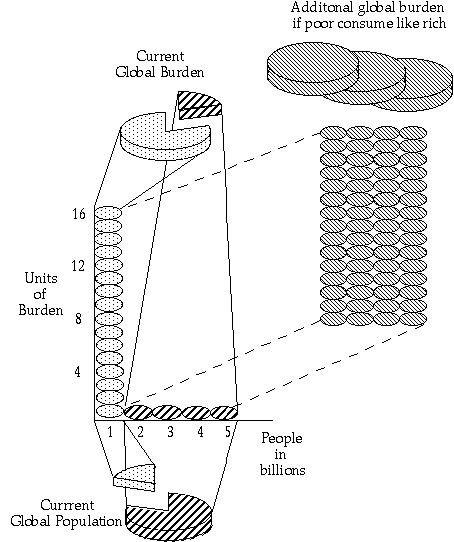
Figure 6.1-10 Four times the current load
In our temporally defective cognition numerical rates, cannot register that "over population" problems as experienced are far different than over population problems based on the two vs. one children per family. The later view will be no more influential than the "sign of the horizon movement" should be the dominant indicator to use in creating behavior to extract one from a car skid.
Try as we will to understand the causal model in Figure 6.1-10, our cognitive tools will maintain the false adopted assumption, "Two kids in each family (ZPG) is good." We will continue to believe that we can best control our contributions to over population with the 2 child per family.
Change toward a solution is good 3/30
Isacc Asimov had a way to describe these temporal limitations in American thinking:
A man has jumped off the roof of a 100-story skyscraper, and as he falls past the 10th floor some one yells out through a window, "How are you doing?" The falling man yells back. "Just fine, I have fallen 90 stories and nothing bad has happened yet!"
While his analogy shows limitations in direct experience, it also can be used to show limitations in our temporal abstract cognition. Dropping from "six kids per family" to "two kids per family" is like Asimov's faller opening his shirt to slow his decent from 120 to 90-MPH, the inevitable tragedy is not avoided it is only delayed.
Changing the procreation rate "one unit" does not always have the same affect on outcome. For example changing the rate from "three to two" children per couple is not the same as changing the rate from "two to one." The former slows the fall while "two to one" changes the faller's trajectory from down to up.
Most of us understand the change in rate is the same size in both cases. Yet, we fail to understand that the two resulting rates produce completely different results. Our temporal blindness prevented us from seeing the difference just as it prevented us from discovering the usefulness of the "sign of horizon movement" in controlling skidding cars. It explains why even after 50 years of driving experience we never find the right information to describe skids and we never find the right behavior to control them. In our present state of cognitive development, why should it let us understand the difference between the one child and two child procreation rates?
The misallocation of meaning to numbers which describe rates means we are constantly choosing behavior which does not get us the outcome we want. Part of this misallocation is due to our temporal blindness. And it is this part that drives us toward scarcity, violence and environmental destruction.
6.2. False transmissions about government 3/26
There are two false beliefs about government that are not expunged because of temporal limitations in cognition. The first is a belief that governments exist independent of individual behavior. The second is a belief that governments can succeed in preventing scarcity or conflict.
Governments exist independent of individual behavior 4/4
Governments are often formed to address problems. For example, if a city needs garbage collection it forms an agency. If these conditions do not exist, if everyone carefully composts garbage, no agency would be created.
Consider a world with only one person living on each continent. Each person does not know of the other’s existence. What reason would these individuals have to form governments? What services would these seven governments provide these seven people? None.
Compare this world with a world where two families live on the opposite coasts of an otherwise unpopulated island. Initially each never sees the another. The families are like the constituents of the seven continents above. While initially no conditions exist that encourage the creation of government, overtime each family increases its needs for the interior’s resources. Eventually the families require the same resources. They create "overlapping needs." One or two governments are created to address this overlap. A government of one group, for example, takes control over interior resources (e.g. preventing access by the other family.) The other group can create a government to produce counter forces to prevent such confiscation. Or a government can be formed by both families together to redistribute resources to preserve harmony.
On this island the need for government services was created by behaviors that created overlapping needs. The need was created by the collective individual behaviors within each family. Individuals behaved to increase either or both per capita consumption or population. It follows that collective personal behavior brought governments into being by creating overlap. The island’s individuals created the conditions their governments were created to address.
Let me provide an argument closer to our own conditions. Our culture has lead us to believe that our governments create themselves. Or at least we as individuals play no part in their creation. However a review the arms race in Figure 4.1-35 shows it is the actions of the constituency that drive the system to create governments.
When our analysis fails to create this view of governments or our role in creating them it reflects our low levels of temporal cognition. It shows that our cognition is too impoverished to create a structural view of our system. It is our level of cognition that prevents us from expunging our culture’s transmission that "personal behaviors have nothing to do with the creation or behaviors of governments.
Governments can prevent scarcity and conflict 3/30
Our culture leads us to believe, "if the right government is in place it will have the power to make peace and prevent war. It will have the power to create abundance and prevent scarcity." These beliefs may be similar to the belief that "a rabbits foot will keep you safe." They may remain our beliefs only because our temporal cognitive abilities are too impoverished to expunge them.
Consider, that our government picks up garbage, makes roads, and maintains schools. It creates these services as they arise and affect the community. If they don’t arise our government would take no action. As the problems get bigger our government takes more action. Two things are clear. First, as long as the system expands any solution is only momentarily. Second, governments have little control over the expansion (or contraction of) the condition to be addressed. The control of how much garbage needs to be picked up and how many children need to be educated lies elsewhere in the system.
A condition of scarcity or conflict, is addressed by our government’s actions to promote technological advancement, and searches for additional resources. Our government also addresses scarcity by creating conflict. That is it implements wars of resource acquisition. Our government has little control over how much goods and services we need.
This relationship between governments and their constituents I call a causal chain. At the beginning of the chain is the community that creates the need, at the end of the chain is the government charged with solving the scarcity created by the need. Governments have only weak if any control over the beginning elements in the chain. For example, they have very limited control over the number of people creating needs or the actual needs of each person.
Most is will find it very difficult to accept an analysis, that suggests that behaviors to reduce scarcity and thus conflict belong to the actors at the beginning of the chain. However as long as individuals, collectively control the growth in population and group needs, they control the growth of overlap that is scarcity and conflict. Government actions should be considered a minor portion of the control of expansive growth.
In summary, the hidden structure of the social system allows individuals and their governments to unintentionally produce the results of scarcity and conflict. It is a little like the greatest good for the greatest number example. Our idyllic government has two goals which push the same variable in opposite directions. Promoting the general welfare can not help but increase overlap, while creating peace requires a decrease in overlap. Just because a government has acts that both increase and decrease overlap does not mean both goals can be achieved. It is only due to a limitation in our temporal sight that we think we can promote the general welfare and keep scarcity and conflict at a distance. It is only our limited cognition that allows us to believe, that "governments can prevent scarcity and conflict."
6.3. False transmissions about leadership 4/5
Politicians in Washington are like the ants on a log floating down the river. Each thinks he is steering.
Mark Twain
In spite of what Mark Twain told us 100 years ago, the concept that "Leaders have control over future conditions." remains part of our belief system. It is not expunged because of limitations in cognitive temporal development.
Leaders create wars 4/5
Hitler was the leader of Germany during World War II. It was a period of social injustice unparalleled in modern history. However, it is unclear if Hitler had never been born, Germany’s aggression and ethnic cleansing would never have occurred. Let's investigate the German social community to see if Hitler was the driving force or merely an ant on its log.
Hitler came to power through a popular election even though; His "by force" operational tactics were well known; His racial and nationalistic position had been published in Mien Kampf; and his speeches foretold the Nuremberg laws: that is: "I of "X" properties have more rights to goods and services than you of "Y" properties. Thus "X" can take goods from "Y" through practices that would be consider unfair if applied to "X."
This does not mean that every German wanted to go to war. This does not mean that everyone wanted to throw their Jewish, gypsy, communist, or imperfect neighbor in the gas chamber. Just that most Germans were desperate to overcome the expanding difference between "needs for" and "delivery of" goods and services.
WW I left millions of individual Germans experiencing increasing scarcity. Their needs created ever increasing overlap on each other and on their foreign neighbors. The poor became destitute, the middle classes slipped down in well being, and the rich could not increase their wealth.
Someone must be Hitler's Y's. Someone had to be the inappropriate competitors who took the wellbeing of the "X’s" away. Someone had to be the persons who prevented "X’s" from achieving their due well being.
For Germans, space acquisition was called the "the war for Lebensraum" (living space). Resource acquisition was called race, religious, political, or gene purification. Today it would be called ethnic cleansing.
If the above information is modeled it forms a causal chain. Constituents on the front end creating scarcity and leaders on the back end trying to deal with it. If the model is correct, constituents force leaders to take their "wars of expansion" and their "ethnic cleansing" positions.
The implementation of the "final solution" may have been more mechanized than other ethnic cleansing but this does not change the model that suggests leaders were not the cause of the atrocities. I don’t think German leadership could have implemented, the Nuremberg Laws or Crystal Night, let alone the extermination camps, if the social conditions did not contain scarcity. The social/physical river in Germany was flowing in the direction of social conflict. The leader's roles could have been played by any ant on the log.
Our willingness to believe that Hitler (Hirohito, Melosivich, or Hussein) created these atrocities by themselves is based on limitations in our cognitive development. If we had better cognition we would expunge this belief. In its place we would place a belief in distributed constituent control.
Leaders can save the environment 4/12 ***
Our belief that leaders can save our environment is as untrue as our belief that leaders have control over social conflict. The same model shows that control over the demise of the environment also lies in the collected behaviors of the constituency. All that is required is to show three links: 1) how temporal cognitive limitations shape individual rationality. 2) How this rationality shapes government actions. 3) How leadership behavior different from this constituent determined government rationality can not steer an alternate course for very long.
Link 1
Rational action has two requirements. First, perceived benefits from a behavior must exceed its costs. Second, expected return on investment for a project must exceed returns for any alternative investment.
To implement cost benefit analysis requires identifying and creating a value for future conditions. These processes depend on a decision maker’s level of temporal cognitive development. First because at low levels of cognitive development, some benefits or liabilities are left out of the analysis all together. Second, because, visible future benefits or liabilities appear smaller at decision time than they do when they actually occur.
These omissions and discounting distort behavior that would be taken with a better temporal cognition. For example, if a person is given a choice between receiving 100 dollars today or 100 dollars in one year the person will take the 100 dollars today. There is no motivation to wait. However if the amount offered immediately is a $1, most will wait and take the $100 at the end of the year. Somewhere between $1 today and $100 today there is an amount, for each person, where taking a lessor amount immediately appears equal to waiting and taking $100 in a year.
For each person, what determines this lessor amount? The most common answer, and the one given by economists, is "The rate of return made available by alternative investments." How may dollars need to be invested in one of these alternatives to provide $100 at year end. However, this is an evasion of the primary question. Using "market created returns" reflects the average expected return of a group of people making an investment without answering the question how each one of them arrived at their personal rate of return.
A more primary answer is that each individual’s temporal capacities give the future condition "value." If a person is temporally blind, the future condition (in this case the purchasing power of $100 in a year) seems smaller than if temporal sight is more robust.
Let's see how this number, or more correctly how, the number stated as a discount rate shapes individual behavior. Consider, that if $100 in a year is equal to taking $75 today the discount rate is 25% per year. This 25% can be used to calculate the present value (how much the individual should pay today) to achieve a benefit that will occur in the future.
For example, what should person pay today to receive a $100 in two years? This can be calculated by taking $75 the value after discounting it for one year and taking off an additional 25%. This equals $56. This means for a person with a discount rate of 25%, should be willing to pay $56 dollars today to receive $100 dollars in two years.
Using this calculation shows the value today of receiving $100 for various times in the future.
|
Time waiting |
Present value of 100 future dollars |
|
3 years |
$41 |
|
10 years |
$10 |
|
30 years |
$.12 |
|
60 years |
$<.01 |
"Present value" is the dollar value the person is be willing to pay to get a one hundred-dollar benefit in the future. This person would not pay even one penny to provide 100 dollars worth of benefits to his or her great grandchildren 60 years in the future.
Link 2
Of course, not all people have this discount rate. Some people have a smaller rate than 25% percent. Some have a higher rate. Governments that follow the will of the people, that is they make decisions about what to pay for future benefits do so by averaging the discount rates of all members of the group. Thus government behavior reflects the temporal capacities of its constituents. The discount rate determines if we keep a wilderness for future generations or use it for a parking lot to meet today’s needs.
Link 3
The third link required to show that leadership does not control the devastation of the environment is to show that if a leader has a higher level of temporal cognition and wants to pay more for the preservation of a future benefit than the constituency, he or she will not appear to be acting in their best interest and they will pick a new leader who will. For example if President Clinton was an environmentalist and elected to not drill in the Alaskan wilderness for oil and energy prices rose in while people in the US bought SUV’s, then he would be replace in the next election by someone with values for cheaper gasoline and less Alaskan wilderness, like. For example, President Bush.
These three links should prove to any person with reasonable temporal cognition that constituency not leadership have control over environmental destruction. The fact that this argument falls on deaf ears, and that most people still believe in the power of leadership to effect the production of the environment describes our inability to expunge a false belief.
Individual behavior is shaped by leadership 4/12
If today’s pope said, "All Catholics must enslave non-Catholics because they are heathens." Do you think your Catholic neighbor would be knocking at your door with a cross in one-hand leg irons in the other? Of course not, it would seem to your neighbor to be unacceptable.
However, if the world was in a state of chaos and you and your neighbor were challenging each other for the last bits of food and water to keep your families alive and the pope said "Enslave the heathen." You had better believe that your catholic neighbor would heed his call.
The difference is not the strength of the pope. The difference is the human condition. Without scarcity, people want the respect of their neighbor more then they want their neighbor’s resources. With scarcity, they need their neighbor’s resources to survive. The neighbor’s respect becomes a secondary consideration.
Social conditions are so powerful that if a pope, king, dictator did not exist he would be created anew and given the power to order and justify the survival actions for the group's constituents. The history of the Balkans is but one an example.
Scarcity facilitates the division of a group into "entitled" and "non entitled." Creating your own leader who blesses violence against your neighbor should be the expected outgrowth of scarcity.
Our culture's transmissions that "leaders are responsible for a constituent’s deviant behavior" is believed because we do not have the required temporal capacity to assemble the information that describes an alternative and more powerful explanation.
6.4. False transmissions about doctrine 4/12
Rules governing behavior are cultural transmissions. We believe the transmitted rules to perfect. That is the problems we have are caused by people not following the rules. However, the approved behaviors sometimes create unintended and undesired conditions. What follows are examples where these rules governing behavior are never identified as flawed. Limitations in our temporal cognition never creates correct connections between cause and effect that would expunge the counter productive parts of the rules.
My religious doctrine can be implemented 11/25
Few of us believe that some of our most cherished moral objectives can never be implemented. For example, most religions contain two tenants which can not simultaneously be implemented. For example
"Be fruitful and multiply" and
"Thou shall not kill."
To prove these two are "simultaneously impossible to achieve," reconsider the society of rabbits presented earlier in this chapter. If a rabbit society attempts to be fruitful, its population will increase until the rabbit community eats the grass on the island faster than it is being grown. The scarcity will cause the weakest rabbits to die of starvation.
Since the "be fruitful and multiply" behavior caused rabbits to be killed through starvation, it is impossible for the rabbits to be both fruitful and to not kill each other. If they limit population growth by "not being so fruitful," then the "being fruitful" tenant is violated. Thus the combined doctrine is impossible to implement
Human society is like the rabbit society except humankind has both analytical process and experience to help understand the flawed doctrine. However, somewhere along the path of creating an image that would expunge part of the cultural transmission something fails and the rabbit and human communities share the same future conditions.
For example, humans don't realize that having a second child takes half the resources we would allocate to one child and gives them to the second child. When we try to attain a second group of resources so the second child does not diminish the services given to the first, we increase our demand on the world's already scarce resources. If we are successful we increase the load on other human beings and also on the environment. This increases the scarcity and conflict in the social system and we end up killing people just as in the rabbit society.
Western European doctrine is better than Native American doctrine 4/12
Our culture would have us believe that the Native Americans lived in more harmony with their environment than their European competitors. They loved the land and animals more and lived in a sustainable fashion with it. This is based on a record that shows the plains Native Americans had a recurring summer/winter migration between hunting grounds hundreds miles apart for 10’s of generations. This life in balance was upset by European invaders with lessor morality and stability.
If this cultural transmission is not true it should be clear that our cognitive abilities don't gather and process the data that would prove otherwise. Consider that this view of Native American stability is based on a 200-year period. If their history is viewed over a larger time frame, it reveals that the summer winter migrations were small yearly oscillations superimposed on a ten thousand mile migration that lasted 19,000 years. That migration started in Asia and moved from West to East. It crossed the Bearing Strait on the land bridge that existed 15,000 years ago. It took 1000’s of years to migrate south down the pacific coast to Chile and southeast to what is now the Atlantic states.
This migration, thought different in miles and time, was similar to that of their European counter parts. The same forces that drove the ancestors of the Native American community eastward also drove the ancestors of the European community westward. There was a time when both pieces of land were inhabited by hunters and gathers ever migrating to meet their expanding needs. Population growth and per capita consumption explains both migrations.
Each hunted and gathered (and some times farmed.) When the game became scarce, the circle, traveled by the hunters, grew larger and larger. When hungry hunting parties met, there was conflict over rights to game. Without dispersion of the human population, people would starve, and communities would erupt in violence.
The weaker or perhaps the smarter community would travel away from the confrontation. They would travel until they got to a more plentiful hunting ground with less competition for game.
In these new hunting grounds, the cycle would repeat. The group’s use of resources would expand, exceeding the local carrying capacity. This would cause extensions outward from the local domain, create conflict with formerly distant neighbors and spur the next move.
Both eastbound and westbound cultures developed technology for transport, defense/aggression, and utilization of resources. The Europeans and Chinese developed technology commensurate with their population density. The fringe communities became farmers, and those outside the fringe remained hunter and gathers.
As long as there was space to expand into, the hunters and gathers maintained their levels of technology. This may explain why the Europeans advanced their technology further sooner. They ran out of space sooner. The eastward migrating North Americans remained hunters and gathers for an additional several thousand years. Long after Europeans filled up Europe, Native Americans were spreading over uninhabited hunting grounds of North and South America.
Native Americans developed technology more slowly because their existing technology was adequate given the almost unlimited space into which they had to expand. Native Americans even developed different diseases because they never had the population density and pollution of European cities.
Thus when the Native American and European communities collided in the 15th century, the Europeans, with advanced disease and technology, destroyed the eastward moving Native Americans.
It could have been different
Because the two eastward and western moving communities contained the same motive forces, it was only a fluke of geography that caused the Europeans to "develop" more quickly. Let me create a hypothetical reenactment of history where I artificially make the space/person in Europe bigger than the space/person experienced by eastern moving Native Americans.
Assume the European ancestors, (Rome, Greece, Babylonian Egypt and the Huns) all had very high and continuing infant mortality. With a very small population in Europe in the 14th century , there would have been more space/person than space/person in North America and thus easier hunting and gathering and less motivation for expansion toward the West. There would have been less motivation to develop technology. Assume this delayed their development and thus their western movement by 3-4 thousand years. Assume they did not start looking for sea routes to china until 2300 or 2400 AD
Assume that Native Americans continued the course of expansion that they had followed for 19,000 years until 2100 or 2200 AD. During this additional period they filled the North American continent to the density of 15th century Europe. Assume they developed agriculture and technology and the growing need for resources beyond those supplied by North American borders. North Americans experienced a life similar to 15th century Europeans.
Assume Native Americans sent ships eastward to find new resources. Finding a low density, low technology people in a Europe rich in resources, they claimed the land in the name of their Queen Pocahontas. They enslaved, or put on reservations, the remaining English, French, Spanish and Germanic noble savages that were not decimated by North American diseases or in technologically one sided wars.
Using this scenario I suggest that it was only a geographic anomaly that gives rise to our belief that Native Americans had a more moral code than did Europeans. Both groups had the same morality. Both had a morality that adjusted to the carrying capacity conditions they faced each millennium.
Had the Europeans been delayed in their westward movements the eastward moving Native Americans could have improperly been accused of having the lessor moral code.
Native American doctrine gives a higher value to the future 4/12
" A behavior is good if it is good to the next seven generations."
The dictum, sometimes ascribed to the Iroquios some times to Hopi, while beautiful, was seldom if ever followed for their entire 19,000-year pre-history. If the dictum had any impact it was for the short period of time before Native Americans encounter Europeans and were destroyed.
I have not uncovered any records of the approved list of decisions by individuals or institutions that reflect how the Native Americans implemented the dictum. Native Americans (similar to other groups) never developed the temporal cognition to predict the near term future effects resulting from most human behaviors, let alone the affects of any behavior on the seventh generation.
Native Americans, in terms of the trends their behaviors produced, are very similar to every one else. Native Americans had no more understanding of which behaviors would set the trends toward a world without scarcity, social violence or environmental destruction, than their forefathers for 19,000 years.
Thus I conclude, that in terms of their temporal blindness they are identical to everyone else. It may be little more than our cultures false assumption that the Native American community, protected from intrusion from outsiders and given a long enough period of time would create a world that looked any different from the conditions we have today.
6.5. Summary of false retention's 4/14 ***
It is not that our culture continues to transmit false relationships that is a problem. The problem is that we don't have the intellectual power at the individual level to expunge them. We believe that our culture gave us correct guide lines for behavior. We behave accordingly and we continue to collect unwanted results. We "multiply" and then "kill or are killed." Or worse kill our environment.
Chapter 7. Dysfunctional educational designs 5/6
Most of us think of parent and public education as beneficial to the child, the family, and the social system. When a child’s behavior is a disservice, relative to his peer’s, we think that the educational process failed.
However, when the educational processes created the desired behavior, and that behavior has both intended and unintended outcomes, and the unintended outcomes are a disservice, then more success in this educational process is dysfunctional. We have already seen such an example in the introduction where the experiential learning processes created the "hold back behavior. Yes, the learned behavior prevented some injuries but it also created a lot of death and mayhem. In these cases the educational process is defective in its effectiveness not its impotence.
In the next four sections I show how social institutions may create their own demise through being successful in their educational processes. The sections describe dysfunction in our educational design.
Institutions have objectives. In Figure 7.1-05 they are labeled "intended conditions." Some "intended conditions" result from the collected behaviors of individuals. These behaviors are influenced by the institution’s educational design.

7.1 -05 Intended conditions
These same behaviors however, also create scarcity, conflict, and pollution. They are labeled "unintended conditions" in Figure 7.1-10. The "unintended conditions" cause expansion of social institutions. This creates a loop where all variables in the loop constantly expand. If they stop expanding, the need for increasing "intended conditions" restart the expansion.
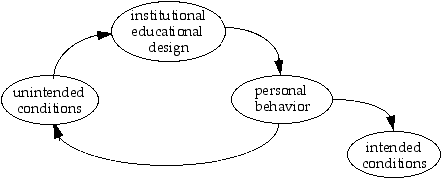
7.1 -10 Dysfunctional education loop
Educational designers do see "untended conditions." They even train leaders to address these conditions. However, designers often do not connect "unintended conditions" to the collected personal behaviors that create them.
Without such a vision, there is no motivation to expand the educational objective to include; for example, "that each student should have the capacity to manage his or her contributions to "unintended conditions."
These designers, are caught behind a veil of false cultural assumptions, because of their own temporal blindness can not be expunged. These false assumptions gave been described in the previous chapter and include:
We can live with the species’ cognitive imperfections.
We do not have to change common individual behaviors to get a good future.
Conserving, recycling, and being less greedy, when combined with coercing
government, industry, and individuals is enough to make scarcity,
social violence, and environmental destruction stop encroaching on our lives.
Governments have control.
Responsibility for our bad situation lies with others.
Educational designers can not expunge them because they lack temporally adequate sensitivity to condition, causality, and morality. The result is they can not make a compelling argument to redesign the educational process so it creates temporal sight in students and thus temporally enlighten behavior.
7.2. Control stability 4/23
A system that moves slowly and repetitiously like a rowboat can rely on trial and error learning and on transmitted rule of thumb learning to create safe control behaviors. In most row boats the motion is so predictable that the rower faces backwards, not because he can see better where he or she is going, but because he or she can row better. His experience is that his backward view is enough to safely steer the boat.
However, no one would try to drive on a freeway facing backwards. The information from behind is just not good enough to provide the precise control required for navigating through the lanes of traffic and ramps. If an experienced rower got into a car and sat facing backward we would understand that he or she just did not know enough about the car system to provide safe control.
We live in a world that is more like a car than a rowboat. However, when we gather information from history to control our future, we act like rowers.
It is not so easy to change. If we think like rowers, how would we know that our world is not like a rowboat? How would we know that it has always been a car and our rower’s thinking has induced many of the world’s crashes (scarcities, social conflicts and environmental disasters)? How would we know that our world, like a car, has been going faster and faster and the crashes have been getting bigger and bigger?
The answer to these questions is that those of us who are temporally blind will never know. We will use our trial and error (experiential) learning and our rules of thumb (transmission) learning to choose behavior until we die.
However, we, the temporally blind, can realize that making better rowers, will make the boat go faster not steer better. We, the temporally blind, can realize that improving trial and error, and rule of thumb learning in our educational process is a recipe for tragedy.
Success in making better rowers is not success. Raising the SAT scores is not success. Better history grades, or better artists, or better chemists or better physicists or better engineers, who remain temporally blind and thus contribute like rowers, will enhance our social system’s capacity for even greater crashes.
The world that is made to go faster also will be made harder to steer. The rower’s views and the rower’s controls will be over taxed that much sooner. The crash will be that much bigger.
Better that we should remain lower quality rowers and the boat goes slower and the crashes remain species non- fatal until we learn that the world is more like a car than a row boat.
If human beings must be more like drivers than rowers, then our educational designs will remain dysfunctional, until they change from making rowers to making drivers. Our educational designs will remain dysfunctional until they stop making people temporally blind and start making them temporally sighted. Only then will individuals learn to manage the skidding world, like GM engineers learned to manage skidding cars.
7.3. Global long term results 4/23
If the human community survives it race toward extinction, history will record two segments in the human condition. The war segment and the peace segment –
Recorded in the first segment, will be a continuous progression of ever more violent confrontations with each other and the environment, culminating with a near brush with annihilation. Recorded in the second segment will be a continuous movement away from conflict with each other and the environment.
During the war generations, the human species, like all other species, following biological rules for survival, will propagate for strength, consume the available resources to make oneself strong, and leave nothing to sustain competitors.
During the peace generations, the human species will behave to contain total consumption far below carrying capacity, and reduce the number of consumers as per capita demands increase. It will accomplish this through a temporal cognition not currently present.
We are in the first segment, and we don’t yet fully understand that we must make the transition to the second. We must implement this transition or our species may not survive.
This predicament is the result of a dysfunctional educational design. Our perception of what is happening, our understanding of causality, and our construction of values, are all trend blind and lead to behaviors, which are dangerous to our survival. New learning designs must produce a person who will choose behavior we find unacceptable and reject behavior we find acceptable.
These behaviors can not be taught using educational designs which are dominated by transmission and trial an error. No one can teach what he or she has not learned. No one can learn by trial and error what can not be experienced. Existing educational designs are not equipped to teach what future generations must learn.
How will this future person learn to take these strange behaviors? They will have to have developed new forms of thinking. He or she must develop new ways of gathering, processing, and valuing information. Then using this new form of thinking the individual will arrive at these new behaviors. The designs that currently dominate our educational activities cannot accomplish this new objective. Until we fully realize their dysfunction we will continue to use them.
7.4. Constructionist vs. rote learning 4/24
Careful, unhurried, one on one mentors allow a student to build new relationships from small components that already exist within the student’s model of the world. Using this constructivist approach, new knowledge is already integrated with the old. The problems of contradiction caused by rote or spurious learning are eliminated.
A constructivist process of learning is much closer to the process the student would have to use in daily life without when the mentor is not present. This process can solve problems which have not been discussed or experienced during mentoring. Finally the constructivist learning process does not have to pay the costs of trial and error learning.
These benefits aside, in most group learning situations, this extreme form of constructivism is viewed as a luxury too resource intensive to be used. Institutional education (with some exceptions) is rote or experience based. These designs have appeared to get the best test results from the widest group of students for the least use of teaching resources. They are a proven designs and are used from kindergarten through medical school.
Rote, experience, and constructive learning processes have different success in acquiring different types of knowledge. Learning language idioms are best served by rote and experience. There is no way to learn them by construction. However, research or theory building are better served by the constructivist approach.
One would hope that the choice of educational design would depend on the subject material. However, in most schools the choice is shaped by efficiency. And topics best served by a resource intensive learning process are taught by the second best process or left out altogether.
If our social system was on course to a beautiful future this educational design could be considered adequate. However, given the destinations of past social systems and their similarity to destinations of present social systems, these educational accommodations can be considered dysfunctional.
For example, behaviors that are rote learned may not produce the expected result. Behaviors that have been learned from spurious experience may not produce the expected result. However, if the result is delayed from the behavior, if the behavior and its result are not experienced many times, these errors are not discoverable. In these cases, especially in cases where it is important to come up with the correct behavior with zero trials, the constructivist form of learning becomes an essential part of personal and social survival.
When the Kansas board of education deemed creationism to be on a similar intellectual footing with evolutionary theories of human development, they show their insensitivity to the differences between rote knowledge and constructed knowledge. While their distorted common sense seems obvious to most, the defect in the board members' thinking shows the success (and thus dysfunction) of rote learning processes in the classrooms they must have experienced.
-----
Learning by rote and experience attains a higher efficiency at achieving the behavior that creates the "intended (visible, short term) conditions." It is an unfortunate by product that we must pay for this efficiency with a blindness to the affects of those behaviors on conditions in the future.
The dysfunction of this educational design is visible in the histories of Russia and Nazi Germany. However, we seem to have not learned from these and hundreds of similar experiences. Our existing educational design still clings to the efficiency of rote transmission. We have not learned that rote behavior has produced a continuous stream of famines, social conflicts and polluted environments.
Our educational-design is further dysfunctional because our world has grown closer to limits for which coerced behavior no longer achieves a measure of success. To achieve any progress in the face of these new limits educational activities may have to be driven by the causal sciences not rules of thumb – constructivist learning may have to replace rote.
The develop of a cognition that supports the learning of causal science may have to be the central part of the new design. New educational activities may have to encourage a cognition that allows causal relationships to become the dominant arbiter of behavior.
Education’s new design may have to focus on the development of cognitive tools capable of acquiring the temporal aspects of the incoming information. Education must provide tools, which give abstract predictions, made from that information, the same, or greater strength in motivating behaviors as the rote coercion. The cognitive skills must give these predicted conditions the same influence as if they had just happened. Anything else may be dysfunctional from a species survival point of view.
Summary of Part 2 5/26
Evil is the lack of empathy.
Evil is the inability to put yourself in the position of the person getting the unpleasant output of your behavior. The Germans in WWII lacked the ability to put themselves in the position of their victims. A failure in their thinking blinded them so they could not see their victims as human beings. This failure occurred even though their victims were up close and personal.
In the last chapters, I have suggested that we today are as blind and thus as evil as WWII Germans. We can not put ourselves in the position of people whose lives we change with our behavior. We can not see the changes we create in the goods and services that will support the lives of our grand children's children. Thus we have no empathy for their hardship.
Temporal blindness prevents us from seeing trends. Temporal blindness prevents us from seeing the destinations of trends. It prevents us from seeing that our behaviors cause trends. Each day we take billions of seemingly benign individual behaviors because their unwanted and unintended outcomes (scarcity, social violence, and environmental destruction) fall outside of our purview. Each day we fail to perform the analysis that would discover these trends, and future conditions. If we see them we fail to create value for them. And finally if we see and value them, we fail to find the behaviors that would prevent them. Instead we take actions that make small improvements in our own immediate lives and at the same time largely degrade the quality of life of future generations.
Moral codes have been created to inhibit our destructive natural behavior. However, existing codes are defective because they were formed or were recorded with temporally defective minds. These guides to behavior do not protect future generations.
Temporal blindness prevents us from seeing that these codes are limited. We do have some abilities to test moral codes. Otherwise we would still have slaves and women would still not vote. However, our temporal blindness leaves the tool box for testing the consistency of our morality, across generations, too impoverished to guide the behaviors that shape the conditions in which those future generations must live.
Temporal blindness prevents us from seeing that our codes are fluid. That is as conditions change our codes change to accommodate them. New conditions make previously unacceptable behavior acceptable. Oops! That's a loop. Codes shape behavior, that shape conditions, that shape codes. That system has a life of its own. It creates trends toward conditions none of us intended.
Most frighteningly of all, we have institutionalized educational processes that ensure future generations achieve the same levels of temporal blindness. We have institutionalized a dysfunctional educational design that insures that we will not break out of this death spiral.
Our prospects 5/26
Our skills to steer our society within the physical constrains of our environment are about as developed as our skills to steer our cars in skids. When our society skids, the behaviors we use are about as likely to make things worse as better.
When our societies crash our thinking can not recognize the crash was of our own making. We can not tease out of the existing data, which culturally transmitted recommended behaviors (that most of us took) created the crash.
Our thinking can't determine that the system momentum was beyond our chosen corrective behavior’s capacity to control it. Our thinking can't determine which of our behaviors created all this momentum. In terms of alleviating scarcity, social violence, and environmental destruction our behaviors are going to produce the same tragic results in the future as they have in the past.
With our temporal blindness, we have muddled through our problems for millions of years. We made mistakes and many people needlessly died. According to Darwin that is what makes the species’ gene pool better. However, these improvements can only occur if some have better temporal sight and this sight gives them a higher chance for survival. If the survival advantage in the short run is given to those with temporal blindness then selection works to diminish the temporal sight capacity.
The back up system for our survival is that our cultures, our governments, and our religions compensate for a constituency's temporal blindness. These institutions provide the correct behavior when instinctual behavior is wrong. Unfortunately, behaviors resulting from culture's transmissions, government's laws and religion's codes were all designed by, or in the case of religion recorded by, "temporally blind humans." The behaviors in these codes do not reflect temporal sight. If anything they ensure the problems of temporal blindness.
We hope that our ever growing technological capacities will overcome limitations in our temporal blindness. However, with societies directing their ever growing powers against one another and the environment, technology promotes "less" rather than "greater" viability.
Extinction is not an event that facilitates learning. We should stop considering the "muddling through" solution to our viability as an acceptable alternative. Our temporal cognitive development should be induced rather than the result of selection. We need models of thinking and learning that create a more temporally sighted individual.
Part 3 - Temporal sight as a human objective 5/25
I have created an alternative view of the causes of our global problems. Scarcity, social violence, and environmental destruction are the unintended by products of individuals taking actions to achieve other objectives. Six billion people, seeing no connection between their behaviors and global problems, create them.
This view of human behavior creates an opportunity which has never been exploited to solve humankind’s most intractable problems. The opportunity - create a global population unfettered by the described cognitive limitations.
If individuals could see clearly the connections between past behaviors and present conditions. If individuals could see clearly the future as determined by their (collective) present actions. And if they could create fair value for these conditions, then individual behavior, assuming universal accession, would begin a continuous trend toward abundance, peace, and natural environment.
Improving temporal inference skills is tough. Doing it universally for six million people is tougher. No one would even consider the task, unless today’s processes create behaviors that have no chance at solution.
For example today’s level of cognition can produce acts of recycling and conserving that only slow the destruction of our environment. They can not maintain or repair it. Reducing the human load on the environment would require a greatly reduced population and that would require universal acts of "one child per family. " This act can also reverse trends in scarcity, and social conflict.
I have not written this book to create for the reader a sense of guilt about past procreative behaviors. I have not written to coerce the reader to perform an alternative procreative behavior today. Instead I wrote it to demonstrate our cognitive capacity is adequate to produce recycling and conservation behaviors, but not "one child per family" behaviors. I wrote to demonstrate that our cognition has the capacity to create value for one outcome and not the other.
Our cognition fails to gather, assemble, and value temporal information. May goal is to motivate the reader to:
"encourage the development of a more advanced temporal cognition."
Changing cognitive abilities, thought changing cognitive development environments will take years of hard work. The first portions of the founding theory are contained in Time Blind - The development of temporal though. However, before proceeding let me sketch the destination of this research effort. Let me describe how we, the temporally blind, will motivate ourselves to support something that each of us can not fully understand and value.
Chapter 8. Temporal sight – what is enough? 2/5
I have proposed a theory of social control based on: all members of a constituency attaining a minimum level of temporal cognition. How high do we set the bar? This chapter describes a level of temporal sight that has to be developed to achieve a reversal in society’s directions. This level is defined in terms of Emanuel Kant's definition of right, John Rawls' definition of justice, and Garret Hardin’s description of a commons.
8.1. Immanuel Kant’s definition of right 12/01/00
Immanuel Kant - German philosopher 1724 - 1804.
Kant proposed a definition of moral behavior, which he named the categorical imperative. I interpret his formulation to mean:
a behavior is good if good results occur when the behavior is universally taken by all members of society.
Kant gives the example of someone that borrows money, promises to repay it, but has no intention of doing so. If this behavior became universal, promises would be meaningless, and no one would lend money to anyone.
Level of cognition has impact on an individual’s application of the categorical imperative. An individual must be able to imagine the results of his action being taken by everyone. If there are bad results. If the bad results are hidden for lack of cognitive capacity, then the application of the categorical imperative leaves the door open to believing bad behavior is good.
Given the temporal blindness described in this book, there are several behaviors today deemed moral when in fact they do not qualify as moral under Kant’s categorical imperative.
For example, in our world’s overloaded state, the universal behavior of "having two children per family" moves society toward scarcity, social violence, and environmental destruction. However, our universally low level of temporal sight allows these bad results of behavior to remain invisible.
At a minimum the common level of cognition (the minimum level of temporal sight of six billion individuals) must be able to image future results of a personal behavior as if it was universally taken. Kant’s definition of moral behavior will be able to govern an individual’s behavior only if the consequences are visible and valued.
8.2. John Rawls’ definition of justice 11/30/00
John Rawls, is an American philosopher and educator (1921-). In his, A Theory of Justice (1971) he describes how an individual could create a system of justice independent of his or her cultural conventions. According to Rawls, all that was required was for an individual to design the justice system (the guides for individual behavior within a society) without knowledge of which role he or she will play.
For example, making slavery just behavior in the new system, when the designer does not know if his role will be that of slave will certainly bias the designer to not consider "slavery" just behavior.
In a temporal sense, if the designer does not know when he will play his or her role in the system – now or in 100 years – the designer will not make behaviors that pollute the system for future generations "just."
It follows that Rawls’ hypothetical individuals can make a just-system only so far as his temporal sight allows a clear prediction of the conditions which result from his or her "determined just behavior" – that is the conditions in which he or she might have to live. If any results of allowed behaviors are invisible, the system the individual will create will fail to be just.
From this we can see that at a minimum, we have to achieve a level of temporal sight that connects results to the actions which cause them. At a minimum, we have to achieve a level of temporal sight that places similar value on conditions no matter when they happen in time. At a minimum we need a temporal sight that connects an individual’s procreation behaviors to scarcity, social conflict and environmental destruction.
8.3. Garret Hardin’s tragedy of the commons 5/25
In 1968 Garret Hardin, a biologist and one of the grand old men of ecology wrote a classic article in Science magazine (vol. 162 pp. 1243). The article was titled "The tragedy of the commons." It showed how an individual's action to improve his or her wellbeing ultimately degraded the environment he shared with others.
Let me represent Hardin’s argument to show how temporal blindness plays a role in it. Ten dairy farmers share a 100-acre pasture. The cows from each farmer graze on the same 100 acres of grass. Assume that if a cow has one full acre of grass on which to graze, each cow can produce 1 gallon of milk per day. The one hundred-acre pasture can fully support 100 cows and thus the pasture can produce 100 gallons of milk daily. However, if the cow has only a fraction of an acre of grass it can produce only that fraction of a gallon of milk each day.
For example if there are 101 cows in the pasture, and each cow gets an equal amount of the pasture’s grass, all the cows together would still produce 100 gallons of milk. Each cow would produce slightly less than a gallon (100 gals. divided by 101 cows or ~.99 gals/cow.)
Initially each farmer is milking ten cows to get 10 gallons of milk. If a farmer wants to improve his milk production he can add an eleventh cow to his herd. Then he will receive the milk from eleven cows. Given that the pasture is still producing 100 gallons and that now all his cows are producing .99 gallons, he has improved his production from 10 to 10.89 gallons of milk.
The decision to add or not to add an eleventh cow to a farmer’s heard is based on his or her knowledge and thinking capacities. Different knowledge or thinking capacities produce different decisions.
Next I will show that three levels of thinking capacity, specifically three levels of temporal sight, combined with the knowledge about the distribution of these three levels among the ten farmers, will lead individual farmers to different behaviors.
The three levels of temporal cognition are listed below.
Level 1 farmer:
Level 2 farmer
Level 3 farmer:
Next let me describe several different distributions of "temporal sight levels" among the ten farmers.
Distribution 1: When all of the ten farmers have a Level 1 cognition, then no farmer will add an extra cow to the commons.
Distribution 2: If some or all of the farmers have Level 2 cognition then the community will be subject to continuous rounds of cow additions.
Distribution 3: If some of the farmers have Level 3 cognition. Then either
a) they do not have the power to impose behaviors they deem appropriate and the results are the same as level 2, or
b) Level 3 farmers can create a government of coercion to limit the actions of the Level 2 farmers.
Distribution 4: If all farmers are of Level 3, the community will not have additonal cows added to the pasture. Each farmer may want to add an extra cow to his herd, however, he knows that the other farmers are watching and will immediately add an eleventh cow to their herds. This will result in 110 cows in the commons. One tenth of these cows are the farmer’s. Since he will be obtaining one tenth of the milk production, he and everyone else will be milking 11 cows instead of ten to get ten gallons of milk. Understanding there is no advantage in adding the eleventh cow. The decision to add a cow is a negative benefit and will be rejected.
This sub view of Hardin’s tragedy describes how "successful" cognitive scientists must be in advancing the temporal sight of an entire generation. Each procreating individual of our global society, must reach Level 3.
Each must be able to transform his or her behavior into future conditions. Each individual must give these future conditions equal meaning as if they occurred today and to them. Each one must know that the other people in the system are equally capable of these transformations and valuations. Each must know the others will give the same huge value to abstract images of peace, abundance and purity of environment.
It may seem like an exceptional request to require that 10 billion people to have a higher level of cognition than is universally in residence today. However, we don’t think it exceptional for 6 billion people to have a level of cognition that prevents each one of them from stepping in front of a moving bus, when trillions of other living things on the planet do not have such cognitive capabilities.
Each of us was not born with the bus avoidance cognitive skills. We developed them. We developed them so we could survive in an environment with busses. It is again time for us to raise the cognition bar so human beings can live universally in peace, and abundance, without destroying their environment.
Chapter 9. Action 5/25
Never doubt that a small group of thoughtful, committed citizens can change the world; indeed it’s the only thing that ever does.
--- Margaret Mead
Today each of us experiences scarcity, social conflict, and environmental destruction. Each day these evils encroach further into our lives. Past and current efforts have been able to reverse these trends for small fractions of the global population and for short periods of time. An example is the immigrant experience where people have picked up and left one scarcity for a lessor scarcity. However, for natives of the immigrant's destination and most other global inhabitants, these trends have been increasing since Adam and Eve left the garden of Eden.
The cause of these trends is people do not have the thinking capacity to comprehend and value the non-immediate and non-intimate results of behaviors that promote them. The task of changing this aspect of human nature appears so impossible, most people have given up hope of finding the change process. As a society we rely on moral and physical coercion to get our constituents to behave in a way contrary to their nature. As individuals, we hold the evils at bay using our strength, cunning, and possibly previously ill gotten resources.
It may be impossible to adequately change the thinking processes of fully developed individuals. Maybe people with normally developed thinking capabilities can only learn from terrible experiences or respond to harsh coercion.
While this may be the best we can do with present individuals, it may not be the best we can do with the thinking capacities of future generations. We may be able to develop a new generation of individuals who have the cognitive capacities to appreciate the existence, meaning and cause of trends. We maybe able to develop the cognitive skills to create enough value for the conditions predicted by trends that those feelings alter behavior enough change trends.
This new generation might be able to address the trends where we can not. They might reverse the trend that increases the human load on the environment. They might be able to choose behavior that will rapidly reduce population. They might choose behavior to half the population each generation; that is to have one child per family.
The problem cognitive scientists must solve is that today’s individuals do not see trends or use trends in their analysis. Nor can they give value to the future results that trends predict. Cognitive scientists must find a way to develop a human mind such that it sees, for example, "the trend in collective human load" as a "trend toward scarcity, social violence and environmental destruction."
The reader's motivation for putting cognitive scientists to work on this problem is that "reversing the trend of ever increasing human load on the environment" is not on the agendas of government, religion, or industry. These institutions only attend to the created load. The load trend results from "population" and "per capita consumption" trends over which institutions have no control. Instead these trends are the result of the sum of six billion sets of "child-bearing-decisions" and six billion sets of decisions to improve life.
The cognitive science solution to humanity’s trend toward chaos is not a simple project. It is as abstract as atomic physics. It is as labor intensive as the Roman aqueducts. It is longer in duration than the building of the great cathedrals and maybe as costly as the arms race.
The project has two phases. The first phase is a Manhattan-Project-style technical effort that identifies the processes that develop the temporal capabilities of the mind. That is the capabilities that facilitate gathering and utilizing temporal information to control trends though choice of individual behavior. The project’s product is a mind that is better equipped then yours and mine in the temporal domain. The first phase is a group of cognitive scientists mounting an effort to learn the process for developing such a mind. Phase II is creating these minds universally in each successive generation.
The people who fund Phase I will not understand all of the cognitive science any more than Roosevelt and Truman understood the physics of the Manhattan Project. However, like Truman and Roosevelt, they will understand the problem of deteriorating world conditions. They will appreciate that the trend is turning the world into Lebanons, Bosnia Herzegevenas, Oklahoma Cities, Kosovos, and Chechnyas. They will know we need to find new and more powerful ways to reverse that trend.
In January of 1993 Stanford Knowledge Integration Laboratory (SKIL) became a non profit foundation that will lead Phase I. SKIL raises and channels funds to cognitive scientists defining these processes.
A SKIL newsletter provides more information. If you or those you know who would be interested in cognitive means for dealing with the deteriorating human condition, please let them know about SKIL and please let SKIL know about them.
SKIL – Who else has a plan to improve the life of your great-grand child.
www.skil.org alpert@skil.org SKIL, P.O. Box 20516, Stanford, CA. 94309
When a project spans 25 years, during which the writer has 5 careers, attends 3 universities, has advisors in 8 different departments, and has readers in 20 countries, it is hard to choose who has been influential in shaping these ideas. The ideas have migrated a great distance during their development. Some readers have revisited them many times, some only once. However I wish to thank those listed below and the uncounted hundred’s that go unnamed who listened and contributed to the final result.
Adams, James
Burnell, Roger
Chubb, John
DiSessa, Andy
Fullwieler xxx, Toby
Garet, Michael
Harmon, Willis
Harrison, Howard
Linnvile, Bill
March, Jim
Noddings, Nell
North, Robert
Pacheco, Art
Phillips, Dennis
Walker, Decker
Zwieffel xxx, Leroy
Bradley, Ray
Carey, Susan
Clifton, Rachel
Cohen, Mark
Collins, Alan
Feurzeig, Wally
Gorin, Ralph
Greeno, James
Hardin, Garret
Hirschhorn, Joel
Johnson, JQ
Kay, Alan
Lansky, Amy
Laventhol, Peter
Lesgold, Allen
Martin, Paul
McCarthy, John
Melman Arthur
Ng Yu-Shen
Pak, George
Papert, Seymour
Pribram, Karl
Resnick, Mitch
Roberts, Nancy
Rubin, Steve
Sachs, Joe
Sayed, Hasem
Siegel, Dave
Skinner, Brian K.
Stroik, Tom
Turkle, Sherry
Wilkins, David C.
Winograd, Terry
Young, Oran
Zimmer, Alf
Zuckerman, Ben
Berg, Mark
Chicowski xxx, Bill
Lutkefedder, Norm
Mckibben, Jon
Repphun, Bill
Ruster, Tom
Alpert, Mayer
Alpert, Bernice
Alpert, Eliot
Alpert, Lois
Niemi, Tina
Niemi, Eileen
Niemi, Tim
Alpert, Ray
Barton, Roger
Bizzarri, Maurice
Bosack, Len
Debano, Tony
Duncan, John
Endicott, Michael
Fisher, Scott
Grossman, Dani
Harris, Jay
Alex Huang
Jewel-Larson, Steve
Lerner, Ned
Lerner, Sandy
Ludington-Carmichael, Max
Mazza, Judy
Miller, Cindy and Allen
Morgridge, John and Tasha
Navas, Henry
Osherenko, Gail
Quinn, Brian
Reisman, Ron
Scott, Clair
Scott, Martin
Seelig, Tina
Sher, Vic
Stiggelbout, John
Woolhouse, Chris
Agoff, Edith
Berardi, Gigi
Booser, Stephen
Corse, Sarah
Erlbaum, Larry
Flagle-McClure, Jude
Goodman, Eric
Jacobsohn, Tamar
Kaufmann, William
Prall, Marilyn
Sacks, Ed
Teicher John
Whitmore, Susan
Appendices 1/15
Appendix A – Finding the skid indicator (Steering and car skid control)
The task is to control car skid. However, is a car skid determined by the deviation of the car heading from the road heading. Or is it the change/unit time of the deviation? Actually it is both.
However, in creating the behaviors to maintain a zero deviation, requires first to be able to control the change in deviation/unit time. The forces that control change in deviations are called torque. They are much like braking forces except they work in rotation instead of linearly.

So when a car is skidding and the front wheels (by steering) create torque that oppose the change in deviation. Figure A-10 Shows how torque is created using steering. The left half shows the forces on a car that is sliding down the road sideways. The momentum of the car is dragging it toward the bottom of the page. Four forces one created by each tire oppose this motion.
If the four tire forces are the same then the car should not rotate. However as shown in the right figure, when the front wheels are turned into the direction of travel their forces drop to zero. The tire now rotate rather than skid. They create no force. The remaining two forces when couple with the force created the center of mass (CM) create a large torque.
It is from this analysis that it becomes apparent that the critical variable to be measuring to determine skid control behavior is horizon sweep for it describes the angular momentum of the vehicle. Steering behavior should first reduce angular momentum and second aligning the vehicle with the road.