Introduction
*Time blindness—the two books
*Part I: Thinking about thinking
*Chapter 10. Thinking about changing thinking
*Part 2: Existing models and temporal thinking
*Chapter 12. Dynamic models & temporal thinking
*Part 3: New temporal thinking/learning models
*Chapter 15. A temporal inference learning model
*End Parts
*Acknowledgments
*Before seat belts, drivers made their children sit close to them. That way, when they stepped on the brakes, they could hold them back and prevent them from flying into the dashboard. The behavior prevented a lot of chipped teeth and bloody noses. However, the "hold back" behavior was not perfect. If the car crashed in spite of heavy braking, the "hold back" behavior increased the child’s injuries! During the 50 years before seatbelts, hundreds of thousands of deaths, and millions of sever injuries, could have been avoided if drivers just kept their arms down.
From where did this imperfect behavior come? No one learned the "hold back" behavior from a driver training manual. No one learned it from applying physics. (If they did, rocket scientists would have chosen a different behavior from fruit pickers.) Instead everyone learned the same behavior from experiencing things sliding forward during abrupt stops. After a couple of spilled grocery bags, arms almost unconsciously pulled back on whatever is on the seat before braking. We, today are still learning the "hold back" behavior from these experiences. We are still putting out our arms during heavy braking. The increase in injuries is avoided only because our kids are wearing seatbelts. If they were not, our normal learning processes would still be adding to the highway death toll.
If you want to understand the physics that explains why holding back children increases their injuries, read the note at the end of this introduction. If you want to understand that learning process and its implications for human wellbeing, read this book. I describe how normal learning results in behavior that causes scarcity, social conflict, and environmental destruction, just as surely and unintentionally as holding back the unrestrained increases their injuries. I show how normal learning fails to accurately predict future conditions, weakens values for predicted conditions, and diminishes ability to connect predicted conditions to behaviors that cause them.
Some of these learning processes are acquired after birth. Each of us learned them from interactions with the environment. Part of this environment was produced by our culture. Therefore, part of six billion sets of imperfect behavior is the unintended by product of cultural activity.
These behaviors might be improved by changing what culture contributes, not to knowledge, but to cognitive development. Finding and implementing these changes might develop a new generation whose thinking and learning takes them to an environmentally balanced, abundant, and peaceful future.
The learning processes on which I focus contain a common thread "time." Our perception of time shapes both our predictions and the values we assign them. When a person fails to use available "temporal information" I call these distortions in prediction and value, "temporal blindness." When an entire society is time blind, and we try to fix social problems by changing the temporal cognitive abilities of all individuals in the next generation, I call the activity "cognition based solutions to global problems."
In the first book I describe the "time blind problem" for the lay reader. I show that our weak abilities to gather, process, and value information, distort our expectations. These distortions cause people to smoke, skid off roads, not wear seat belts, and contribute to global problems. The book's conclusion:
Unless the next generation thinks better than we do they will continue to create conditions of scarcity, violence, and environmental destruction for future generations. Each reader should finish this book convinced that if we raise the level of temporal cognition in most members of a future generation, they, through collective action, would be able to end these unwanted conditions.
The text is not designed to upgrade the reader’s temporal thinking abilities. The text is designed to get each reader to acknowledge: 1) their own thinking limitations; 2) the implications of these limitations in terms of their behavior’s impact on future conditions; and 3) the utility of creating new "thinking development environments" that prevent these limitations from being a part of a future generation’s cognitive tools.
In the second book I outline a solution to the time blind problem. I connect "behavior selection" to "thought processes," and "thought processes" to "learning environments." I show the ability, to predict and value outcomes of behavior partly results from nurture and partly from nature. Some of our global problems occur because "nurtured cognitive abilities" produce predictions or values that are too weak to compete with those produced by our animal nature. Or they are too weak to compete with the incorrect predictions, and shortsighted values we obtained through rote learning.
I show, using graphs of information flow, how existing development environments unintentionally induce temporal blindness. I hypothesize how alternative learning environments may prevent it. The conclusion:
We use experience, transmission, and inference thought processes to shape our behavior. Each process can be enhanced by developmental environments. Here is a framework of how we learn and use temporal inference. Use it as a basis to develop cognition based solutions to global problems.
Let me provide an overview of the problem outlined in the first text.
Time Blindness—the social problem
"Time Blindness" Topples Trade Towers
No one will receive additional goods, services, land, jobs, health, or freedom from a terrorist act. At best the act gets the attention of people whom the terrorist feels "have taken" these from his people. The important word is "taken." It is not being poor that motivates an individual to become a terrorist. It is the loss of wellbeing. For a dirt farmer, it is not the absence of a flush toilet or an electric light that promotes extreme action. It is the loss of land or water, and thus dignity. If this analysis is correct, to rid ourselves of terrorism we have to change the behaviors that cause "taking."
For most of us the world appears too complex or uncertain to connect our personal behaviors to the "taking from others." Even if we realize the underlying importance of "takings," in the creation of terrorism, we assume institutions do the taking. We fail to realize that "institutional taking" is driven by the taking behaviors of its constituents. We fail to realize that individuals, creating their families and lifting them to a better life, drive political or economic taking. Our benign personal behaviors are seldom seen as responsible for the "takings" that result in social conflict, or terrorism.
The connection between individual action and "takings" is easily seen in the case of our forefather settlers. Their benign acts (providing for their families) took enough from the existing tribes to provide today's Native Americans reason to be terrorists. Today, still performing the same "family providing behaviors" we are still taking from someone on the globe. These people or their children experience losses that could make them terrorists. The problem is that we often do not realize and cannot internalize the actual consequences of our behavior when those consequences are remote either in time or geography.
I call this failure to connect behavior and results accurately and to give adequate meaning to results at the time of choosing behavior "time blindness." Individuals’ time blindness has been creating terrorists from the beginning of civilization. It will continue making terrorists until people overcome time blindness. And therein lies the problem. Time blindness in not another word for selfishness or ethnocentrism. It is the result of the way we have been trained from birth to analyze and understand the consequences of actions.People who suffer from it cannot personally overcome it. However they can understand its meaning and structure, decide that life with terrorism is too big a price to pay, and work toward preventing that thinking limitation from becoming part of the next generation’s cognition.
In order to understand temporal blindness you must first understand what is meant by a thinking limitation. A thinking limitation can be described in the abstract, or though examples, such as a 15-year old’s decision to smoke, the ugliness of a simple social system, or the structure of our global community which has as a hidden integral part, the nurturing of terrorists.
What is a thinking limitation? A house cat sitting in your living room makes the same size image on your retina as a tiger at the end of a football field. A cognitive process converts one of the two images into a serious danger. If the process did not correctly use the "distance to the tiger" in calculating its size we could call ourselves "space blind." Time blindness is a similar limitation in cognitive process. It miss uses "time to event" in assigning the event’s meaning. As a result, a loss expected to happen next year looks smaller than that same loss happening next week. An expectation of your son being killed next year brings you less anxiety than an expectation of your son being killed next week?
Let me use a young person’s decision to smoke to demonstrate the immense bias created by "time blindness." Each smoked cigarette robs an individual of about 5 minutes of life (1)(2). On average, smokers die nearly seven years earlier than nonsmokers (3). As a result, each smoker loses three times the vacation in retirement than he or she has enjoyed during his or her entire working life. Furthermore smoking causes major capital losses that diminish retirement conditions. Taking grand kids on trips in a motor home and up to a cottage on the lake are prevented, because the pack a day smoker bought 18,000 packs of cigarettes at $3 a pack. Without investment, that’s $54,000 not available to purchase the motor home. With investment that’s $341,000 not available to purchase a cottage. If these losses were not enough, the smoker will also suffer the pain of coughing and shortness of breath. He or she will lose additional retirement vacation in medical treatment.
Which brings us to the crux of a young smoker’s choice "to smoke," — he or she makes the selection early in life. At age 15, retirement at age 65 is 50 years in the future. The above future liabilities, from here, look pretty small. The mental scales filled with "peer pressure to smoke" (translated heavy) on one side and "abstract future liabilities" (translated light) on the other, tip toward smoking.
In this case time blindness successfully inhibits the creation of a future image of oneself suffering. Time blindness inhibits the connect between the smoking behavior and the suffering condition Time blindness inhibits the transference between a parent suffering lung cancer and oneself suffering from lung cancer. Time blindness even discounts a transmission of the connection, for example the Surgeon General’s warning
Now let me turn to the role of time blindness in shaping an individual’s "taking behaviors." Visualize a large ship. The ship never makes port. Getting "on" the ship requires a birth. Getting "off" requires a death. Each couple has around two children. Some people do not have any. The ship’s population is constant.
The ship has limited space and materials. It has energy sources and technology that allows it to create shelter, food, water, healthcare, and recreation. Each person on the top deck gets a large portion of living space and ship’s services. Each person on progressively lower decks gets a smaller portion.
From any deck people can see a better life. There is a constant scramble by each person on the ship to improve his or her conditions on a deck or to move up a deck. The channels of success are achieved either by increasing productivity and efficiency or by redistributing existing resources through social structure, cunning, or violence.
Shipmates welcome increasing productivity and efficiency. However, during redistribution, one person’s success pushes another to a smaller space or to a lower deck. Some people get pushed so low they have too little food and die from starvation. Some die from lack of healthcare. Some die from physical hardship of hard work. Some die in the conflicts that arise from violent acts of redistribution.
Each day just before sundown everyone gathers at the back of the ship for sea burial of the dead. All those who died from old age or natural accident are buried off the sunny side. All those, whose lives were cut short by starvation, inadequate healthcare, hardship, or violence, are buried off the shady side.
If this society wanted to assign responsibility for shady side burials, it might consider the following paragraphs, which describe the consequences of various behaviors.
Which behavior caused the death of a child if the parents had the flow of resources to feed the child when they conceived it, however, after living conditions changed aboard ship they did not? In this case, the child’s death can be attributed to an individual whose behavior consumed additional resources, which were not offset by an increase in productivity. That is, if the individual did not consume these additional resources (and the starving child did) death would have been prevented.
When a person kills or is killed in fights to regain lost resources, people who increased their consumption and first took these resources share responsibility. For if they did not take the resources in the first place there would have been no need to take them back.
If a ship has too few resources to support all its passengers, even no change in distribution produces shady side burials. Anyone who consumes anything helps account for the shady side burials already in place. That is, if any individual ceased to exist, the resources that supported him or her could be used to keep others from shady side burials. Thus, every individual shares some responsibility.
This responsibility might be calculated by taking the total number of shady side deaths viewed during a lifetime and dividing that number by the number of passengers. For example, if half the people were going over the shady side, then each person would be responsible for half a person shady side burial. Every pair of consumers, on average, would be responsible for one shady side death.
Let me propose a behavior that will stop all hardship and conflict due to resource limitations. While it will not sound humane, it will be enlightening. Assume that society commanded each pair of consumers to shoot someone. The released resources would prevent shady side burials that were caused by starvation, lack of medical attention, physical hardship, or social conflict induced by scarcity.
This new social design will produce the same number of shady side burials. The shooting acts would produce the same number as the consumptive acts of the non-shooting system. The only difference between the two social systems is the people in the shooting system can see the connection between behavior and result and in the people in the consumptive system can not.
Because the relationships among the ship's resources and population are simple, they allow one more hypothetical extension. If one individual lowered his or her consumption to alleviate starvation and someone else besides the starving party consumed these relinquished resources, then, responsibility for the starving person’s early death would then be transferred from one consumer to another. The mobility of responsibility suggests that each individual on the ship is not equally responsible for the downward push of people to a lower deck or off the shady side in a burial. Those with larger consumption must take a larger portion of responsibility.
If we allocate responsibility as a function of consumption, the pairs who consume 100 times those that are shooting just one person would have to shoot 100 people. Pairs that consume 100th as much, shoot only one person to fulfill the responsibilities of 100 pairs. If everyone followed this proportional proposal the shady side burial number would be the same.
What does it imply when the shooting behavior and the consumptive behavior have vastly different acceptance among the ship’s company but create the identical results? It may mean each individual’s thinking process can make the connection between the shooting behavior and death but not the connection between the consumptive behavior and death. The difference between the two "behavior/consequence combinations" is the time delay between action and outcome. It may mean, time blindness makes a death due to consumption mean very little in selecting the behaviors that cause it.
Now let me move on to the meaning of our temporal blindness to our social condition. The earth, being physically and socially more complex, has many additional ways to produce shady side deaths. On earth poor people have children they know they can not support. Power hungry leaders cause violence for their own self-aggrandizement. Benevolent parents have as many children as they can support. These behaviors, not present on the ship, on earth cause additional shady side deaths.
However, there is no reason to assign all shady side deaths to these "additional" bad behaviors. If you are not a person who had children you could not support, an evil leader, or the parent of three or more children, do you want to know how many people you kill through your consumptive behavior? Would you like to consider the number you would have to shoot if our global society chose the "proportion to consumption shooting protocol" as a means for eliminating the deaths due directly to scarcity and conflict that arises from scarcity?
My analysis uses two numbers, 75 (the average age at death in developed countries) and 62 (the average age at death in undeveloped counties.) The age difference is 13 years.
The relationships connecting consumption and longevity of these individuals are complex. However, if I assume that there exists a reduction in consumption of a person from a developed country (not large enough to affect a change in his or her longevity), that will release enough resources to help four people in undeveloped countries increase their longevity to 75 years, then, each individual in a developed country, in choosing to maintain his or her consumptive pattern **, takes 13 years from each of four people in an undeveloped country.
Four times 13 is 52 years or 70% of a 75-year life span. Thus, living a developed world life style on average means shortening another human being's life by 70%. Each of us, by living in the developed world, is doing the same harm to our fellow humans, as if we shot someone who was 23 years old to prevent him or her from consuming resources the rest of his potential life. It is like killing 0.7 people.
This analysis overestimates and under-estimates the number. For example it increases the number because it does not adjust for the deaths of children of irresponsible parents. It does not adjust for the deaths due to irresponsible leaders or deaths due to people who have three or more kids. It increases the responsibility of a rich person and decreases the responsibility of a poor person by assigning all of the "shady side" deaths to the top 20% of the consumers even though they account for only 80% of the consumption. The calculations also overestimate an individual’s responsibility because they do not adjust for the deaths caused by our predecessors’ behaviors.
However, the largest error in estimation of an individual's responsibility caused by this computation, an underestimation that may more than compensate for its over-estimation, may be that it does not adjust for the future deaths that result from today’s behavior. Thus the .7 number is probably a conservative estimate of the responsibility of an average person living in the developed world.
If this number does not seem significant in the selection of a terrorist target, consider that this average does not take into account that among the top 20% of the world’s consumers, consumption can vary by more than a hundred fold. Some of us are responsible for killing one and two people every year just by living our normal life style. If a shooting protocol was implemented, that is how many we’d have to shoot.
With our time blindness, most of us did not see our consumptive behavior as this deadly. We did not have to accept responsibility for "shady side burials. We could think that our individual and institutional behaviors that increased production through technology or created safety nets that redistribute goods and services to the weakest group members, were adequate to compensate any people we might have inadvertently pushed aside in our trip to our current well being. But the above description shatters this view. It shows that these behaviors, even when successful, only momentarily stop "shady side burials." Increasing consumption by all individuals from all decks undoes any success.
If we had temporal sight we would see, that in the long term, stopping shady side deaths will require different personal behaviors of all shipmates. To prevent "taking" would require a birthrate that lowers the ship’s population enough to compensate for any expanded consumption of the remaining population (that is expanded consumption not addressed by advances in technology).
However, we are time blind. "Population reduction behaviors" that reduce shady side deaths remain as invisible to us as past consumptive behaviors that contributed to them. Most of us do not see the earth as a large ship. Most of us don't keep track of the difference between a sunny and shady side burial. The harshness of other people's lives in the future does not influence our behavior.
Even those that have a vision of the "taking" problem and are motivated to search for a solution will not immediately find the "population reduction" solution. Even if they did, lowering the birthrate could only be implemented by actions of six billion individuals whose temporal sight causes them all to choose a one child per family behavior.
With our time blindness, we, the six billion people of our earth do not have the abstract cognitive abilities to see our procreative acts as causes of, or potential cures for, the hardship realized by 80% of the earth’s future inhabitants. We do not have the temporal sight to give much value to those future injuries. When we balance the expected benefits that accrue to us as parents of a second child, against the "invisible" or "under valued injuries" that accrue to others, possibly our grandchildren, the scale tips in favor of having the second child every time.
With our time blindness we fail to see that our children will live in a world with even greater pressures pushing them to lower decks. We cannot see that these pressures will increase generation by generation. We fail to see that each generation of children will have to be launched to higher levels than were their parents. Each future generation will have to be brighter than their parents just to live on the same deck. And shamefully, each generation will have to be more ruthless and more indifferent in dealings with their less fortunate earthmates.
Six billion people promote global problems because their abilities to see and value future conditions created by present behavior (to perform temporal inference) are no stronger than those of a 15-year-old potential smoker. If the temporal inference thinking capacities of a future generation could be free of these limitations, then, it would be possible for that generation to see and feel in their gut the future their actions promote. It would be possible for that generation to choose behaviors that we can not choose. It would be possible for that generation to create a world we want but cannot produce.
To overcome time blindness, our challenge is to create a generation that has temporal sight. The challenge is to describe the temporal inference thinking processes that allow behavior to reflect its future outcomes. The challenge is to create the learning environments that develop these thinking processes.
This solution will require an enormous research and development effort. It will be attempted if the losses caused by temporal blindness look equally enormous; that is enormous to people who live today; that is enormous to people who are as time blind as you and me.
The terrorism we now face may be this motivation. Bin Laden may be a deranged diabolical power hungry maniac that should be in a mental institution. However, the people that trained in his camps can not all be that crazy. Many are men who see themselves as victims (and children of victims) no different from Native Americans. Their people had land and resources that were taken away. Some see the supports of their present life still being taken away. As long as our global society creates these men we will have terrorism.
Terrorism may motivate this enormous effort because it shatters the myth that the twenty-first century is a time of wealth, health, and longevity; a time when the smartest will live like kings supported by a peaceful population of 6 billion paid servants. Terrorism speaks for the 40,000 children who die each day die from starvation or its related diseases. Terrorism speaks for those whose average age is 13 years shorter than it could be. It speaks for the people who see themselves losing their wellbeing and dignity.
As these numbers grow, terrorism will grow until it wakes us up and we implement what we thought we could not do — create a community of individuals who allow the future to influence their behaviors.
-----------
1) Centers for Disease Control and Prevention. Office on Smoking and Health, unpublished data, 1994
http://www.cdc.gov/tobacco/mortali.htm2) Every year in the United States, premature deaths from smoking rob more than five million years from the potential life span of those who have died. Centers for Disease Control and Prevention. Smoking-attributable morality and years of potential life lost--United States, 1990. Morbidity and Mortality Weekly Report 1993; 42(33): 645-8.
http://www.cdc.gov/tobacco/mortali.htm3) Smokers in the US consume 500 billion cigarettes a year -- USDA 1993
http://www.cdc.gov/tobacco/mortali.htm.(physics of injury" note)
During a 30-MPH crash both the car and the child must abruptly stop moving. The stop is like landing on the pavement after jumping off a 3rd story balcony. If any of the parents had a choice between landing on a thick cushion or a thin one, they would all pick the thick one. However, the "pull back behavior" is like picking the thin one. "Not holding back" is like picking the thick one.
In such a crash, the car’s front-end crushes 15-inches. This crush acts like a 15 inch cushion for the dashboard and everything that slows down with it. If the child is against the dashboard at the instant of crash, he or she slows down in 15 inches. The dashboard applies a 500-pound force to the child’s body. It seems large. However it causes no severe injury. Seat belts prevent injury because they act like the dashboard. They apply the 500 pound force for the 15-inch stopping distance.
No parent however, can create 500 pounds of restrain with one arm outstretched to the right. The child’s body overpowers the arm and continues moving forward at 30 MPH. Unfortunately, by the time the child moves from the seat to the dash, the dash has already moved 15 inches and has already slowed to zero MPH. When the child collides with it, he or she slows to zero MPH in the 1 inch or so the dash deforms. What could have been a 15-inch cushion is now little more than a one inch cushion. The forces on the child are ten times higher and so are the injuries.
---> This analysis is confirmed by crash data of unbelted car occupants. Sleeping passengers, drunks, and un restrained children, that slid forward during braking, and were "on-the-dashboard" at the time of collision, walk away from accidents only slightly injured. Passengers that hold themselves, or are held like children, away from the dashboard during braking, and then collide with it during collision, get seriously injured or killed.
"knowledge"
À what you know"thinking"
À the processes you used to acquire what you knowWhat you learn in this book will depend on how well you keep the two concepts separated.
The first book in this series may have convinced some readers that our thinking is limited in choosing behavior in temporal situations like driving cars and wearing seat belts. However, knowledge of "limitations in thinking" will not change these readers’ behavior. Most will still put their arms out to restrain their seat belted children before a crash.
The book may have created a understandable argument that to create an abundant, peaceful and non polluted world for our great grand children we would need to limit each family to one child. Yet few if any of these readers will implement the logic.
When the time comes to have the second child, each will revert back to an irrational belief that "if everyone limited themselves to just two children, humankind would have a great solution to present global problems."
Why this regression. Why will the reader not change his or her personal procreative behavior or change his or her advocacy. I suggest that "knowledge of" is not the same as "meaning for" future events.
Meaning depends on, not only creating a view of the future, but also creating a belief that the view will happen and feelings that would be had by the individuals who would exist during the expected conditions. These latter two parts require the conversion of "knowledge of" into the stuff that shapes behavior. And this too is a part of the temporal inference skills for which we search and hope be able to develop in some future generation.
Thus the contents of the first book is but a description of the problem. It is in the following book that I describe thinking, and learning-to-think, in a way that helps the reader find a course of action that does not require changing his or her own procreative behavior. It does not require the reader to change his or her values about procreation. The course of action is to:
create a cognitive development environment for infants that creates temporal sight.
The course of action is to create a new generation that can:
****** edit from here on ****
The constructions in the following book help in the research and development of new learning environments. When a reader is not him or herself such a researcher, the intent is to encourage the science reader to help facilitate this projects. Together, the advocate and the researcher, can create a cognitive development environment, which will create a world full of temporally sighted individuals.
In the chapters I explain:
I do this by building and presenting an expanded model of learning and thinking.
Success depends on overcoming two challenges.
The limitations of our language and our senses are overcome though the use of abstraction.
Language in perspective
Consider: Inuit languages have dozens of words for frozen water. Each word conveys information about which mittens to wear, which sled to take, and the time of day to start a trip to get the best travel conditions. English words for frozen water, for example, "snow, sleet, and hail" don’t begin to convey enough utilitarian meanings.
The reader is about to embark on an adventure to discover missing workings of his or her own thinking. The workings are temporal. Like the failures of English words to describe frozen water, English words also fail to describe the implications of objects "in change" or "in motion." Motions of moving objects which appear stationary to the eye are not easily conveyed by the terms "slow," or "sluggish." These terms do not help us in choosing controlling behaviors any more than the word snow helps Inuits plan trips.
As the reader works to understand how the human mind could "learn-to-connect" the almost invisible societal motions toward tragedy to the seemly harmless personal behaviors that bring them into existence, he or she will have to allow abstraction to do the job of creating the gut feelings of danger. Like those we all get when we look over the roof edge of a tall building. The reader will have to get the "willies" from looking at a signal flow graph when it predicts harm.
The graph themselves are presented only as hypotheses to be tested. There will be no laboratory evidence presented to support their accuracy. However, the abstractions have a special power. They describe in symbols, concepts we can not directly grasp with our senses.
Abstraction as arguement
A man has jumped off the roof of a 100-story skyscraper, and as he falls past the 10th floor some one yells out through a window, "How are you doing?" The falling man yells back. "Just fine, I have fallen 90 stories and nothing bad has happened yet!"
Isacc Asimov
in trying to explain the temporal outlook of Americans!
Like Asimov’s jumper, the reader sees or feels only a portion of the temporal world in which he or she is immersed. Our physiology, optimized over millions of years by natural selection, pays close attention to some temporal aspects of the environment and is indifferent to others.
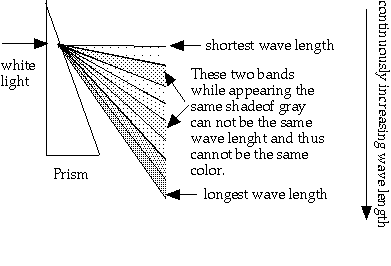
To learn about the missing portion is a challenge. The effort is similar to that of a colorblind person learning that "objects that appear in his or her mind’s eye as identical grays are very different colors of a rainbow." Special types of examples must be used. Because the color blind person can not directly sense different colors, an understanding that they are different must be derived using abstractions.
For example, the locations of the two identical gray bands in a black and white picture of a rainbow formed by a prism can be used to determine that the two bands are different colors, Figure P-10.
Figure P-10 abstractions to overcome limitations in senses
Given that a prism separates white light, light containing all wavelengths of light, into a fan with:
Thus if two non-contiguous bands appear the same shade of gray they can not be the same wavelength. One is longer than the other and thus is a different color.
As I used the prism to show a "color-blind man" that two things that appear the same are different, in this text I use signal flow graphs to present to the reader temporal aspects of the environment that remain equally hidden by physiological limitations. The models are temporal analogs to prisms. They describe our temporal blindness, and developmental activities that may prevent it in future generations.
Thinking about thinking
Wouldn’t it be nice if we were all like Merlin, King Arthur’s advisor.
He could see the future with the same clarity as the past.
Chapter 10. Thinking about changing thinking
When we begin to think about changing thinking. We must answer questions like:
To answer these questions, we must take the thinking that we use everyday; the thinking we use almost unconsciously, and explicitly describe:
10.1. Hidden parts of our thinking
In the southwestern Indian states of Maharasjtra and Karnataka, believers in the Hinduist Deveadasi System, who today number in the hundreds of thousands have been dedicating their daughters to a religiously sanctioned life of prostitution for well over a millennium.
(World Watch Vol. 7 N.4 July Aug. 1994)
The Deveadasi act as they do because some of the liabilities, attributable to their actions remain invisible. Their thinking is not equipped to perform the investigation that would make them visible.
Consider the possibility, that while you may not be forcing your daughters into prostitution, you may be (unknowingly, through your temporal blindness) performing some equally unpleasant behavior. Consider the possibility that your approved behaviors, result in liabilities that remain invisible (or if visible undervalued). Consider the possibility that you, like the Deveadasi, are ill equipped to answer the following questions,
"What is inconsistent or inhumane about my behavior?"
"What is less than it could be with the way I gather, manipulate, and value information?"
After the briefest consideration, most of us will conclude that:
Since we have discovered in Time Blind -the problem that our thinking leads to behaviors that result in conditions we do not want, we are now faced with a challenge to improve our thinking. The first step is to make the invisible visible.
To begin this task, let me compare the invisible parts of our thinking with the invisible parts of our speech. When we realize that thinking is shaped by accents just as our speech is shaped by accents it provides a stepping stone to this understanding.
Consider we can't hear our own speech accent. We probably didn't know what a speech accent was until we heard a person outside of our region speak. Even then we did not assume that we had one. All we knew was that "they" had one.
Once we believe that we have a speech accent, we realize we have no idea how we got it. We don't remember learning our Texas drawl. We don't remember having anyone teach us to roll our R's.
Further, the drawl or the rolled R's remain such an invisible part of our uttered sounds, if we learn to speak French, we unconsciously include the drawl or the rolled R's in speaking the French language.
Our "thinking accent" is much like our speech accent. We do not know if we have a way of gathering and using information, which is different than other people. We do not know if we could have a different way of gathering and using information than we have.
We did not realize that we learned our thinking indirectly. Our thinking accent was given to us, by parents, peers, and teachers. These people didn't know it was part of their agenda to give us a thinking accent. Actually they had the agenda of giving us some knowledge and love and the thinking accent was just thrown in unconsciously by them and subconsciously absorbed by us.
While differences in speech accents merely denote different regional origins, differences in thinking accents shape our behaviors. It determines which information gets sensed, manipulated and valued. It determines what additional knowledge can be constructed from information in memory. And finally, it determines which behaviors our brain can create, compare, and value.
A person who speaks Australian English opens a window by which Americans can perceive that each of us might have a speech accent of our own. Consider the case where all human beings on the globe have the same speech accent. Then, this avenue of discovery would not be available. We would be blind to our accent.
It follows that if we all had the same thinking accent, then a deficiency in our information gathering and using would be a perfect blind spot. We, nor our peers, nor our leaders, nor our teachers could directly perceive it.
However, thinking accents do change over time. We can use history to demonstrate differences in thinking accents and thus provide a window by which we can suggest to ourselves the existence (if not the form) of our own present day thinking accent.
Begin by investigating the behaviors of an individual who existed several 100 years ago and who in that time period was assumed to "Think very well." Then assess his or her use of information and a behavior using today’s thinking accent. If this great figure of history appears incompetent or immoral to us, there are grounds to believe that we will look equally incompetent and immoral to those in the future whose thinking accents have advanced beyond ours.
For example, an investigation of Thomas Jefferson illuminates a man with both extraordinary thinking capabilities and a thinking accent that includes a blind spot. Jefferson could see the injustice of the rule of the English monarchs, which raised them above the men of common standing. Jefferson wrote the constitution of the United States to eliminate these unjust privileges. He did this when most of his countrymen were still paying allegiance to royalty. However, as bright and as free thinking as Jefferson was, his constitution did not extend equal standing to women or slaves.
If Jefferson could treat a man as a horse simply because the fellow had been sold as a horse or diminish the privilege of a woman because of her sex, then it is possible for an individual, to have cognitive limitations superimposed on otherwise exceptional thinking powers.
With this observation it is possible for those living today to postulate the existence of their own thinking accent. It follows that in our state of partial perception; we could be taking actions, which are equally heinous.
For example, our thinking accents could be allowing us to degrade the lives of future individuals just as Jefferson degraded the lives of slaves and women.
If we accept this hypothesis, we can try and outline the temporal aspects of our thinking accent, how we learned our thinking accents and how we might have learned different thinking accents.
For example, Jefferson's thinking accent is different from ours in that he could touch the flesh he abused. We can not touch those we abuse because they exist only in the future. His thinking blindness had to do with allowing the difference in color and sex to justify differences in his behavior. Our thinking blindness has to do with allowing differences in time or space to justify differences in our behavior. That is, a behavior is prohibited if it kills a person who is standing in front of you, and allowed if it kills a person a distance away or in the future.
With our present thinking accent (way of processing information) we conclude that we can have as many children as we can properly nurture. The immoral people are those who have children they can not properly nurture.
This thinking accent is blind-sided because it does not utilize available information, which shows that each additional child (in support of his or her existence), does enormous harm to future individuals. Thus, with this blind-sided accent, six billion decision-making parents are contributing to crimes no less heinous than are those of owning slaves or adopting constitutions that deny equal rights to women.
Like our nation’s founding father, it is our thinking accent that prevents our comprehension of our crime. Our thinking accent fails to appreciate information which connects "having as many people living at one time as we feel a need to father or mother" and "the harm these people create for future generations because of their existence." Our thinking accent hides the future harm of present action and makes the immediate results pristine and beautiful.
In this book I have hypothesized that to prevent an inhumane future requires a decreasing global population rather than a stable or increasing population. To obtain this decreasing trend, each parent would have to limit him or herself to fathering or mothering only one child.
Like Jefferson, who sometimes argued that giving up slaves was like giving up economic well being to gain nothing, most parents would say this giving up a second child is like giving up parenting benefits to gain nothing. However, I suggest, the parent’s reasons for outrage is the result of a thinking accent different but no less blinding than Jefferson's.
While Jefferson's thinking accent, allowed him to disregard information that suggested blacks and women were fit to be free and vote, our thinking accent allows us to disregard predictions of future environment troubles and social injustice. It is thinking, shaped by this accent that approves two child families.
It is clear we need different thinking accents. Accents that would implement trends away from war, famine, and pollution. However, for the same reason it is almost impossible to change the speech accent learned first, it may be almost impossible to change the thinking accent learned first.
It may appear this leaves us without a solution until we consider what a trivial task it was for the child to obtain his or her first speech accent. Possibly, for a child, developing his or her first thinking accent is an equally simple task. The "ease of learning" is facilitated because it is one he or she learns first. This is the solution that I proposed in the book.
In the remaining chapters, I describe the process that developed or nurtured our thinking accent. I focus on the learning activities that shaped our temporal cognition. Then I propose changes to these activities that will create new individuals whose thinking accents do not discount the future liabilities of their present actions.
When an individual fails to develop cognitive skills that others have, differences in capacity are visible. Experiments can measure the difference. Other experiments may show why one group obtained the skills while other did not.
However, when no one develops a cognitive ability, there is no measurable difference. There are no experiments to perform to show how a cognitive ability is developed. Explanations for an absence of skill are at best hypothetical. In this vacuum, two pieces of research may show why some parts of temporal cognitive development remain absent.
The first suggests that humans are born with latent capacities, or latent components of those capacities. Thought interactions with the environment some are activated, and integrated into cognitive abilities. Without these interactions they remain dormant.
The second piece of research suggests there is a window of opportunity in early infancy where these latencies can be easily accessed. Over time this window partially closes and further activation and integration becomes more difficult.
10.2.1. A language model of cognitive development
***Need the original source reference- Janet Werker Vancouver infant studies
It has been shown that the human mouth and vocal cords can make over 100 different sounds. These are called phonemes. Infant research has shown that very young infants, those less than 4 months old, pay equal attention to all 100 sounds. That is, if the parent utters one of the hundred sounds the child will attend to it equally with any of the others.
However, after the child is six months old, he or she attends equally only to the small fraction of the phonemes that are part of the adult communication he or she hears.
For example, if the parent is communicating in English, the 26 phonemes used in English are those the infant has learned to attended to. The remaining 74 are given lessor attention. They are heard just as a door slamming is heard. However, like the door slamming sounds, are not considered speech, the 74
unused phonemes are not considered speech. For example, if I click my lips, you can hear it however, you can not make it part of a word in a sentence. Yet in other languages that click is a part of a word.
Consider the possibility that:
If:
we were born with 100 temporal building blocks with which to construct temporal cognitive abilities.
and
some of these building blocks, because of interactions with the environment are integrated into cognitive abilities.
and
some of these building blocks, because of the temporal impoverishment of the early learning environments, remain not integrated.
Then:
our job, the development of temporal sight, would be defined as:
10.2.2. Roger Sperry’s model of cognitive development
***(NR needs original reference)
Roger Sperry’s experiments at Cal Tech in the 50’s were designed to describe when an infant cat developed its cognition of images. Sperry learned that when kittens first opened their eyes, the eye neurons sense the objects in their field of view correctly. However, the brain could not convert the sense information into meaningful objects. The brain processing that converts senses to objects, the "wiring up" of the cortical neurons, took several days to develop.
He also asked the question, does this cortical wiring process occur throughout the cat’s life or does it happen mostly during this brief development period.
Sperry designed an experiment to test this idea. He presented the infant cat special pictures of objects. These pictures were created so that the object in the picture was constructed with, let's say, only vertical lines. There were no horizontal line segments. The subject cat developed its cortical brain wiring using information the eye neurons transmitted.
Later Sperry presented the same cat a second picture of the same object; however, this picture was constructed with only horizontal lines. The cat could not recognize what should have been a familiar object.
Sperry’s work suggests that the visual cortex proceeds through development using available information during a developmental period. If certain information is not in the cat’s field of view (horizontal lines are omitted) at the time when that part of the brain is developed, there is a chance that, that kind of information would remain unrecognized, even if it was sensed after the developmental period.
The temporal learning model in this text hypothesizes that human brains may also be "temporally" wired up during a development period at infancy. Further, that our learning environments lacked the stimulation, which may have developed our more, advanced temporal skills.
If our brains developed in a temporally impoverished environment, we, like Sperry’s vertical line cats, might be destine to proceed through life with only a subset of our potential temporal cognitive capabilities?
If:
we can identify temporal information missing from our early learning environments
and
introduce that information into the environment at the time an infant brain is developing,
Then:
the infant’s brain may develop a temporal cognition you and I don’t have. That infant’s brain might be temporally sighted for the same reasons a normal cat can see lines in all directions.
It follows that for my temporal learning model to help achieve temporal sight, it must be able to suggest additions to the environment experienced by the infant during brain development.
10.3. Changing thinking vs. changing behavior
Learning to behave better in temporal systems is not the same as
learning to "think" better in temporal systems.
To some color bind people, the red and gold traffic lights appear the same shade of gray. Red and gold look the same because the eye senses both colors using one group of eye neurons instead of two. Or because the output of two different groups of eye neurons are sent to one set of neurons in the brain instead of two. In either case the individual can not undo the errors in wiring.
This does not completely preclude learning to drive safely. For example, colorblind people can learn to infer a light’s meaning from the:
Consider the learning that can take place at an intersection where there is a single flashing light, not in a geometric group of three lights. Assume the driver has no previous experience with, or knowledge of this intersection.
While the colorblind person can not tell if the single light is flashing red or gold, he or she can learn the traffic light’s inference by gathering the movements of other drivers at the intersection. This however only works if there are other drivers present.
Even if there are other drivers present, there is no way for the colorblind person to know if the other drivers are
The correct behavior, at a particular single light intersection, can also be acquired if taught by an advisor. However, this learned behavior too can be incorrect. The teacher could be colorblind. The information he or she transmitted could be a repetition of incorrect information the teacher learned from their teacher.
If the student, the teacher and the teacher’s teacher are all colorblind, and all learned a behavior for the intersection from advise, it is impossible for any of them to know, if:
After we understand that the colorblind student is at the mercy of his teachers, and the idiosyncrasies of his learning environment, we, the temporally blind, might postulate:
the behaviors we learned, to operate in temporal systems are the result of exposure to the same limitations in advise, and environment.
since we can not change our temporal wiring, we can not fully grasp our cognitive limitations or that our behaviors are not those we might otherwise choose if the limitations in wiring were not present.
What does it mean if we know:
It means that:
1) Many experiences of skidding on snowy roads fail to teach how to handle skids on dry pavement.
2) A failure to control a skid on dry pavement (an accident) fails to illuminate the general learning limitation in cognitive skills in the temporal domain.
3) Even when an unpleasant future is correctly predicted and correctly connected to its causing behavior and it is successfully transmitted to us, the temporal aspects of our value structure makes the prediction lack influence. What we learned doe not provide the same influence on our behavior as if the liability happened immediately.
Temporally blind people can be coerced, physically or socially, to perform a behavior that appears second best. However, the goal is to get the best appearing behavior be the one arrive at through temporal sight rather than the one arrived at through temporal blindness.
The book will help the reader recognize the tragedy of being temporally blind. It will help the reader appreciate the need for our society to be made of individuals who have temporal sight. And it should help the reader understand some of the mechanics that could promote the development of temporal sight in future minds.
10.4. Changing the information used in thinking
A man who learns from experience is smart.
A man who learns from another’s experience is a genius.
What do we call the man who learns when there is no experience?
According to the above adage, one difference between a smart person and a genius, is the genius uses more sources of available information. He or she can gather, manipulate and give meaning to a larger variety of information.
Cognitive development can be thought of as a continuum where a person begins with just a few skills to gather, manipulate and give meaning to information and expands these skills. For example, just basic skills are needed to convert physical objects into mental abstractions. Additional skills are required to covering physical symbols of objects into mental abstractions. And a few more skills are required to transform mental images into new images that have never existed as physical objects or symbols.
Advancing one’s cognitive development:
From:
capturing the physical domain
To:
capturing the physical domain and capturing the physical symbols in the domain,
Is probably no more complicated than advancing cognitive development:
From:
physical and symbolic capture
To:
physical symbolic, and imagined capture.
However, teaching as we know it can’t explicitly describe what parents, peers, and teachers did to help a child make the first transition.
The student’s change, in how he or she gathers, processes, and gives meaning to information, is an unconscious by-product of the living experience.
I hypothesize that we are temporally blind because the experiences that would have advanced us to the temporal inference level of cognitive development, or temporal sight, are either absent from our natural living experience or are present but are ignored by our minds after they proceeded through previous learning.
A goal of creating a model that describes a process for the development of temporal sight, is to make explicit the process of cognitive development (meta learning) that is being completed implicitly in the first transition and to extend it to implement the second.
10.5. Making "learning to learn" explicit
Learning to: behave
Learning to: learn to behave
Learning to: learn to learn to behave
.
.
.
When a condition in the world, depends on the existence of a preceding condition, which itself depends on the existence of preceding condition, ... we have a causal chain where a change in any preceding condition changes all the conditions that follow it.
This book is such a study. That is, I focus on,
problems that cause us to feel bad, …then on the
behavior that caused the problems; …then on the
thinking that caused the behavior; …then on the
learning that caused the thinking; …then on the
environments that caused the learning; …then on the
components that caused the environments ...
When we see that the environment’s components are more layers of problems caused by behaviors, caused by thinking, caused by learning, caused by environment, etc. we see that our discussion will span many connected levels.
The words below appear in discussions of many of these levels.
Variable ==>> a descriptor of a system that can assume different values
condition ==>> the instantaneous value of one or more variable that describe a state of a system
relation ==>> two connected conditions
mechanism ==>> a device that can:
system,
pathway,
or process ==>> connected mechanisms that produce
image ==>> a mind's instantaneous view of the
(Note: dog-ear this page so you can reference it)
At all the levels, a word’s definition is held constant. However, the words are used to describe," learning," which is not the same at each level. For example,
.
.
.
If you can keep track of:
you are ready to think about the nurturing of temporal sight.
Chapter 11. Nurturing temporal thinking
My objective is to build a model that describes learning.
On one hand
On the other hand
Even without the complications of the many interdependent learning levels previously described, building this model is a giant step beyond what we commonly think of as a learning model. Consider just two aspects:
1) familiar learning models focus on descriptions of how individuals without ability gain the abilities of individuals with abilities.
2) familiar learning models seldom describe the learning to learn processes that facilitate each learning task.
To know how to change our familiar nurturing environment so it produces temporal sight, we must create a model of learning unlike any we have used in the past. It must describe:
The model must describe why our familiar environments produce temporally impoverished maturation. Finally, the model must be compelling to individuals who themselves are without temporal sight.
For the model to accomplish these goals, it must be of a type most often reserved for mechanical engineering design. This type of model goes by the names "causal," "finite element" or "process model." Engineers use it to design a bridge that must go beyond the limits of previous bridges.
This engineer’s process model has two important properties:
1) the model connects all the bridge’s parts together so that each part:
2) The connected parts can be loaded with
The model predicts if each part will fail or carry the load applied to it. If any part in the model of the bridge fails, the model describes how the load is then redistributed among the remaining parts; one of which may then exceed its limit and fail. The process continues until the "model bridge" remains standing or comes crashing down. The model, not trial and error "building-bridges," predicts if the bridge will provide safe transport or fall down.
If :
we could build a "process model" for thinking and learning,
Then:
We could predict if an environment would produce, or fail to produce, learning and or learning that has never previously existed.
Content and process, never previously learned by anyone, can be described in terms of flows of information transformed by a pathway of mechanisms.
Building a process model of thinking and learning requires finding the analogous components and connections to those used in the process model of bridge building.
To accomplish this task we must:
11.2. Mechanisms vs. rules as basis for models
*** figure needed Rube Goldberg cartoon xxx* a figure of a contraption where the cat is awakened form sleep if the cheese is moved by an intruding mouse.
What is the difference between the learning models "we have" and the learning model "we want?" The temporal learning model we seek must be like the Rube Goldberg contraption in that it should allow us to visualize how changes in a person’s learning environment (beginning at infancy) develop a temporally sighted, rather than a temporally blind, adult.
The unique feature of a Rube Goldberg contraption is that it makes predictions of conditions that have not yet occurred. The model shows that if the cheese is moved, physical objects move and trip one another in series so that the cat is awaked. That is a change at the beginning of a system eventually results in a desired change at the end.
The cat awakening prediction is facilitated by the structure, which is a chain of mechanisms. Each mechanism has an input and an output. The output of each mechanism causes the next mechanism to produce an output until finally the last mechanism produces an output that wakens the cat.
Rube Goldberg became famous and well liked because he made us see that the cat would be wakened without ever having the cheese moved. All the viewer had to do was mentally move the cheese and then mentally trip the movements of each successive mechanism.
While we could all do this visualization with the help of his great graphics, most of us can not see our lives with such mechanistic clarity. For example, the springs and gears of a watch completely baffle most people. Even more difficult to visualize are the mechanisms that under lie our thinking processes.
In our world of objects, the predictions that help us choose behavior normally are not created by tracing the flow of input and output through a chain of mechanisms. Most predictions are not created by a chain of clock like mental mechanisms.
Instead predictions of a behavior’s outcome are based on a rule. For example, in situation "A," behavior "X" causes condition "B." The rule, instead of being based on a mechanism, is based on thinking processes like:
Two models of thinking are emerging. One is rule based. The other is mechanism based.
In rule based Ë experienced information is formed into rules. Then logically manipulated to guide behavior.
In mechanism based Ë experienced information is formed into mechanisms. Then the mechanisms transform real or abstract information to form, among other things, non-experienced conditions from yet untried physical behaviors.
Let me summarize:
1) Models predict what will happen if a behavior is applied to a situation.
2) Predictions can be created by:
3) The Goldberg model uses mechanisms not rules.
For our purpose, to create a temporal learning and thinking model, there are some advantages of using mechanisms and some disadvantages of using rules.
To understand these differences begin with the definition of prediction:
A prediction is ==>> that a second condition will follow the first.
A logical model is a collection of rule based predictions. The rules reflect:
In all logical predictions, the first and second condition had physical existence before the existence of the rule. Conditions not in memory can not be part of a rule. A rule-based model can not predict a condition that has not previously existed. It follows that creation of a rule requires hindsight of the conditions contained within it. With deduction, the connection is new, the relation is new, and the prediction is new, however, the composition of the predicted condition was known.
Process models, on the other hand, do not require explicit hindsight of a second condition to predict the condition. Behaviors, never tried in the real world, can be introduced into a process model and the model’s mechanisms can predict a condition that has never previously occurred. That’s how we know if a dog, a raccoon, a pig, or the wind, moves the cheese in the Rube Goldberg cartoon, the cat will be awakened even though one of these forces never moved the cheese.
This difference between a rule based model and a mechanism-based model is critical in our effort to design learning environments for temporal sight. A rule model for temporal learning would require that at least some people had temporal sight. The rules would have had to have been derived from the experiences of people who have gained temporal sight. Since we know that almost no one has temporal sight (at least at the levels I describe) we can not use their learning experiences to derive these rules and to build a rule model. With the option removed, we are left with no other choice than to build a process model that uses mechanisms not rules.
For engineers to make the jump from rule based to mechanism based model building, they had to change their view of knowledge and process. To create a process model of learning and thinking, we now have to make similar changes.
11.3.1. Expanding our view of knowledge
To get beyond the limitations of a rule model, knowledge must be more than the one to one memory of direct experience or related facts, values, and behaviors transmitted by our culture. The example I use to explain this expanded view of knowledge is taken from an imaginary community that wears brimless hats. For them existing knowledge includes:
"His head is covered by a hat." condition
"Hat shade prevents sun burn." relation
"Always wear a hat." and, behavior
"Not having a sunburned head is good." value
A mechanism model expands existing knowledge. A mechanism varies the size of the hat – increasing or decreasing the size of the hat is equivalent to adding a hat brim. Now, as with the Rube Goldberg model where if we added elements that never existed like the dog, or raccoon, we gain a new results, in this case a mechanism that increases hat size (adding a brim) produces conditions, relations, behaviors, and values that never previously existed.
For example:
Thus the concept of trends in variables (in a world where experience only produced states of variables) creates an additional class of knowledge - mechanism based trend knowledge.
11.3.2. Expanding our view of thinking processes
Our view of thinking processes, like our view of knowledge, also must be changed as we move from a rule-based model to a mechanism-based model. Familiar sensing, manipulating, storing, or retrieving, processes adequate for gathering and manipulating rules must now include processes for:
These thinking processes have the form of the Rube Goldberg contraption. Still calling it a contraption is a denigration. The Rube’s pictures of systems were works of art. Even non-mechanical people could see with clarity how movement percolated through the system obtaining a result distant in time and space from the initial action.

Figure 11.3 -10 Rube’s thinking model
A Rube Goldberg version of thinking looks like Figure 11.3 -10.
If a condition exists, it can be the input to a thinking mechanism. The mechanism’s output is a condition that never existed. Since the new and old condition can be connected there can be in memory a new:

Figure 11.3 -20 Rube’s learning to think model
If Rube had a view of how mechanisms were built and this view became part of an individual’s thinking process it would look in schematic form as shown in Figure 11.3 -20. that is a mechanism operates on a condition to make a mechanism.
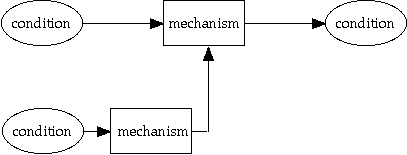
Figure 11.3 -30 Rube’s combined thinking and learning to think model
If an older version of that mechanism is already in place, the mechanism creates a product that is substituted for the existing mechanism. Notice in Figure 11.3 -30 that the output of the mechanism changes the mechanism that is in a learning process.
11.3.3. Summary
With Rube’s view of content and process, that is with:
we can build a process model of thinking and learning. We can understand how mechanisms overcome the temporal limitations of rule models.
At a meta level, Rube’s graph of connections among mechanisms may also show how the mechanisms were acquired and connected. This may allow us to see how we developed existing thinking mechanisms that were temporally limited. It may show what changes in curriculum would result in changes in mechanisms and connections that facilitate temporal sight.
To build a process model of thinking and learning we need to create descriptions of:
These are not simple tasks even for systems like bridges for which we have descriptions of the:
To help create these descriptions I use existing dynamic, behavior, and learning models. Each of these groups of models has something special to offer:
Each of these three groups of models contributes variables, mechanisms and pathways useful in creating three process models of temporal thinking and learning. I build a process model from dynamic models in Chapter 12. I build a second process model from behavior models in Chapter 13. And I build a third process model from learning models in Chapter 14.
Since the resulting three process models are three views of the same thinking process it should come as no surprise that they share some common variables and mechanisms. Thankfully the reader will find some redundancy. When ever possible the same examples were intentionally used in all three chapters. The overlap and commonality of variables and mechanisms makes it easier in Chapter 15 to combine the three process models into one process model of thinking and learning capable of describing pathways for the development of temporal sight.
Don’t rush your personal learning process. Reviewing the concluding diagrams in Chapter 15, before understanding the simple mechanisms that reveal the model’s power will leave you with a temporal model of learning and thinking that is mystical and less compelling.
Keep each idea and model at the common sense level. Nothing should seem mystical. There is no magic required to create an understanding. No special engineering, psychological, or educational training is required. (The engineer, psychologist, and educator is at a special disadvantage because he or she is blinded to some aspects of these process models by his or her rule-based expertise.)
The text is written for the non-expert reader, who, without serious bias, has a better chance to do the integration. The text is written so that the diligent reader will be able to understand each small step with common sense.
While only empirical work will prove a target curriculums’ correctness, hypothetical success foretells that the global application of a curriculum that creates temporal sight could create new generations that do not drive themselves toward war, famine, and pollution.
Existing models and temporal thinking
Chapter 12. Dynamic models & temporal thinking
Part of our world is
physical systems,
that are manipulated by human behaviors,
that are chosen by conscious thinking,
which, is shaped by physical systems.
In this chapter I describe how dynamic models help us understand this part of our world – specifically the temporal aspects of this part. I show that dynamic models form a basis for the thinking and learning process model for which we search.
The dynamic models I studied in engineering were process models of physical systems which, changed over time. And I use these dynamic models to make explicit the:
It is this power to predict that will allow dynamic process models to describe cognition’s development into temporal sight.
Humans consciously choose behavior to control physical systems when they can predict what conditions will be produced by each behavior.
Rube Goldberg's contraptions allow us to see how pictures make predictions. Dynamic models show us how process models make them.
12.1.1. From dynamic models
Since process models are a subset of dynamic models, let me first describe dynamic models.
Physical and cognitive dynamic models combine into a single model when:
Dynamic aspects of physical systems are more easily seen than dynamic aspects of thinking systems. For example:
Dynamic aspects of thinking processes on the contrary are all but hidden in abstractions. However we know they exist given that thinking processes:
With half of the combined system derived from partially hidden abstractions, it is a challenge to create a process model that describes how humans interact with, and learn to interact with their physical system.
However difficult, if the process model can be built, it may be able to tell us why:
12.1.2. Terms and operatives
In the car driving system, (the mechanics of the car, the behaviors of the driver, and the thinking that facilitates choice of behaviors) is supported by a huge number of physical relations and social rules. However, they all fit together so intuitively, each driver is almost unaware of this complexity and thus is not overwhelmed by it. On the contrary most of us believe that getting from place to place safely in our car is a very simple exercise.
So it is with process models. As a group of independent ideas the collected structures listed below appear complex. However, they are not confusing if one can make a mental Rube Goldberg picture of them. Then, they fit intuitively together.
- Variables
- Connections
- Structure
- Predictions
These concepts form the core of the process models that I use to describe thinking and learning as well as its development.
(Note: You might want to dog ear the previous page so you can refer back to it like you did for the page with the definition of terms in Chapter 10.)
12.1.3. Extracting and combining elements
Building process models depends on identifying both variables and the mechanisms that connect them together. There are many ways to accomplish this. Below I identify energy flow, mass flow, and information flow as three means for extracting the variables and mechanisms from our universe.
- Mass flow
mass is moved from place to place in physical systems. Since the atoms of material are for the most part not created or destroyed, the atoms can be followed as they migrate from variable to variable in the a physical system. This tracing can become a powerful tool to help build the model.
For example, carbon atoms that start in a crude oil reservoir in the ground have many destinations. For example, drilling waste, consumed by tanker as fuel, lost into the sea as pollution, separated into one of the many products of a refinery, consumed in gasoline transport, evaporated while loading into cars, and converted by gas engines into carbon dioxide
As each carbon atom combines with other atoms to make compounds, The atoms of these compounds become threads in a search for other variables. For example as the gas is burned in car engines, the high temperatures create besides carbon dioxide, carbon monoxide, sulfur dioxide, and nitric oxides. Each of these has affects on other system variables and facilitates other predictions.
- Energy flow
Similarly, energy can neither be created or destroyed, and thus must exist somewhere in the universe. Tracing energies locations as we traced the carbon atoms to successive locations helps define the variables and connections in process models.
- Information flow
A third way to identify variables and mechanisms of process models is to trace information flows among them.
For example, in the Army information flows are called chain of command. The general makes the plan and tells his majors, who tell their lieutenants who tell their sergeants who tell their men. If the chain of command is broken, it is easy to determine from the army’s communication structure who knows and who doesn’t know. If a lieutenant is killed at the front line, without replacement, everyone knows which sergeants and solders will not receive new orders.
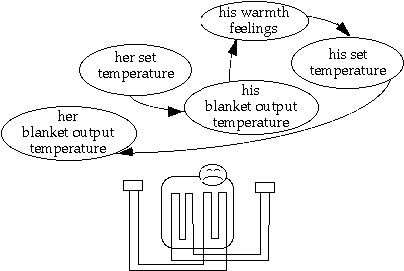
Figure 12.1 -10 Flipped blanket without wife
The broken information path in the flipped over electric blanket example is shown in Figure 12.1 -10. If the wife of the sick husband is not in bed when he turns up his blanket, his blanket will not get warmer or colder, until his wife comes to bed, finds it too warm and turns down her control.
These two examples illuminate a way of working backward and forward from any variable or mechanism. That is, one can ask the questions:
Process models contribute to our understanding of thinking and learning in that they:
These explanations are derived from the process model’s
12.2.1. Structure of Variables
Variables describe systems. Predictions are the values of variables at times in the future. However, exact numerical values are not the only useful indicator. Simply knowing the trend of a variable can be enough of a prediction to shape behavior. And if this is true then just knowing that a trend is changing can be enough to shape behavior.
In the next two sections I focus on just a small part of the information associated with variables useful in making predictions:
-Variable trends
As systems get complex and mechanisms between variables get vague, predictions about variables change from how big and when to:
and if changing:
The loss of precise mechanisms changes the visual composition of process models. With mechanisms removed we are left with variables (in ovals connected) connected by arrows that show the casual affect of one variable on another.
This simplification, while losing the process model’s ability to predict the exact value of a variable, retains the model’s "trend" predictive capabilities. For the arrow-oval diagram to create a prediction requires only that the arrow indicate the relation between the trend of the variable at the tail of the arrow and the trend of the variable at the head.
An unmarked arrow means the trends of the two variables are in same direction. If the tail variable goes up the head variable goes up. For example
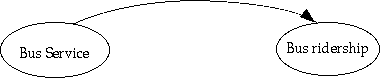
Figure 12.2-10 Arrow implying same trend between variables
Figure 12.2-10 shows the relationship between Bus service (how often the bus goes by) and ridership (the number of people that ride the bus) If the bus service becomes more convenient ridership will increase. The figure shows that if bus service goes down, then bus ridership goes down.
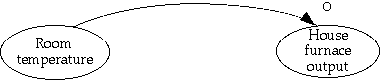
Figure 12.2-20 Arrow implying opposite trend between variables
Conversely in Figure 12.3-20, I show that if the variables at the ends of the arrow trend in opposite directions, that is if the tail goes up the head goes down, or if the tail goes down the head goes up, then the arrow is marked with an "O" for opposite. The figure shows that as a room temperature rises to that required by the thermostat, the furnace output will be less. Also that as the room temperature goes down, as it would if someone left the door open, the furnace would have to put out more heat.
In summary , these process models make predictions without numbers. The model tells the direction of the change in each variable's value relative to changes in another variable.
-Variable limits
A connection in a process model implies that a second variable is forced to change or gets a signal to change when its predecessor changes. However, the dependent variable does not always change.
Let’s assume you are a cherry picker. And you can pick 25 cherries a minute. You are carrying a pail where you put the cherries you picked.
Your model predicts the number of cherries in the pail. At the end of one minute you have 25 cherries. At the end of two minutes you have 50. At the end of three minutes you have 75 cherries etc.
Minutes collecting x 25 cherries/min ==>> cherries in pail
Sounds simple enough until the pail gets full. Then "minutes collecting" does not predict the "cherries in pail." The variable "cherries in pail." has a limit and once the limit is exceeded more minutes does not mean more cherries in pail.
There are cases where variables have idiosyncrasies. These cases sometimes lead to the addition of new variables not included in the original process model, "cherries picked and not in pail" and additional predictions (not previously thought of a future conditions resulting from the original system) cherries dropped.
The presence of these newly discovered future conditions change the decision environment, which is created by the process model without the new variables. Thus the efforts to review undiscovered idiosyncrasies within the process model’s existing variables is itself a powerful process for making predictions.
Identification of variable idiosyncrasy is a large research area I introduce it only to reveal some of the predictive powers of process models. Besides the example above, called "overfilling a sink" listed as 1) below, I describe three others.
1) "elements pushed above a limit" extend additional impetus (exceeding the capacity of a sink)
2) "elements below their minimums" extend the null impetus to down stream elements. (emptying a source)
3) "elements sending out delayed messages" may appear as if they are sending out no message (releasing freon into the atmosphere seems to have no effect until it affects the ozone layer 15 years later)
4) "non linear changes in a variable" (if each generation has four children, the increase in population increases changes with each generation.)
12.2.2. Connection geometry
Some of the predictions created by process models stem from the geometry of the connections among its variables. These shapes include chains, trees, and loops.
- Chains
Consider a process model that describes the gas in a gas tank and the "gas consumed by a running engine. " The model of the two variables appears below:
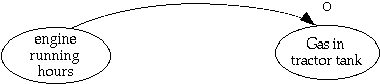
Figure 12.2 –30 engine running hours and gas in tank
The model follows the general rules outlined previously. For example, the engine can not run without changing the amount of gas in the tank. The tank (assuming it is not at a refueling station) can not change its fuel amount without the engine running.
This two variable dependency can be expanded into a chain of dependencies. For example, assume that the engine drives a tractor and the tractor is plowing a large field. Each row of the field takes a period of engine running time. Now we have three variables in the chain where none can change unless all change.
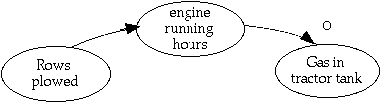
Figure 12.2-31 rows plowed, engine hours, gas in tank
If you make three rows, the engine must run three time periods and the tank must empty three units of fuel. If you measure the amount of fuel in the tank at the beginning of the day, and know no one adds fuel, then you can measure fuel at the end of the day and predict how many rows have been plowed. Visa Versa if you count how many rows of the field have been plowed you can predict how much gas has been removed from the tank. These predictions, being based on mechanism, are quite reliable.
If the field is big and would take many vehicle tank refills to plow the whole field and there was a fuel storage tank at the field’s edge and the tractor stopped there to refuel, a fourth element in the chain could be added – the fuel in the storage tank.
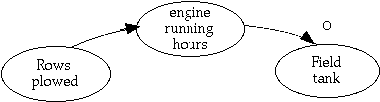
Figure 12.2 –32 rows plowed engine hours field tank
Predictions of how many rows in the field were plowed, how much the engine ran, and how much gas was added to the tractor’s tank, could be made from how much fuel was left in the storage tank and visa versa.
If the field was so big that many fills of the fuel in the field storage tank would be required to complete all the rows. Then a central farm tank, that holds fuel only for plowing, would periodically make fuel transfers to the field tank. Then the fuel removed from the farm’s central plowing storage tank could predict the number of rows plowed.
This chain of mechanisms describing fuel flow, can be expanded by tracing back through, the fuel distributors tanks, the refiner’s tanks, the transporter’s ship tanks, the oil well pumper’s tanks and finally the crude oil reserves in the ground. The process model can make predictions about each of these from the amount of field plowed.
- Trees
Process models can be more than single chains. They can branch like trees.
Much of the dependence and predictions made possible by the process model were made possible by doing a conservation of mass analysis. That is the atoms that were in the fuel reservoir are the same as the atoms in the oil tanker, and finally the atoms in the fuel tank of the tractor.
Buy following these atoms along their journey we could identify additional variables in our system. Notice that in the above chain we went from fuel consumed to rows plowed.
We could have also done a conservation of mass trace and identified a variable called "carbon dioxide put in the air." The carbon atoms in the fuel tank went somewhere.
Thus our chain can branch. Burning fuel in the tractor has two depend variables – plowed rows and carbon dioxide added to the atmosphere, see Figure 12.2-33.
It is easy to see that the tree shapes that show up in process models also have predictive qualities. Several variables can have their changes be dependent on the change of a single variable.
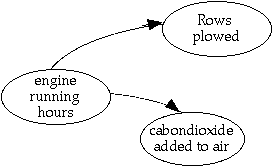
Figure 12.2-33 tree dependence on process models
For example, identifying the change in any variable in the tree infers that there is known motion in every other variable.
The limitations on the model’s ability to predict in these branches still relate to each connection being a mechanism. The plowed rows exist only if the tractor "caused" the ground to be turned. If the tractor idled in one place, there is no causality. Similarly the chain of variables describing changes in the containers of fuel "predict" each other’s value only if there is a causal (in this case conservation of mass) connection. If it was possible for an atom of carbon to appear and disappear at will, conservation of mass would not hold, causality would be lost, and the chain or tree would not have predictive capabilities.
Summary of chain and tree process models
If:
a person makes a graph of some world variables,
and
it is that person’s best guess of how things are put together,
and
the graph predicts a future condition that does not presently exist but which is abhorrent to the individual
and
the individual has no better prediction than that created by the graph,
and
he acts to change it,
Then:
we can assume that without the graph he would not have seen or appreciated the future effect of existing motions or actions and would not have changed behaviors.
- Loops
In process models, what happens when a down stream variable gets its signal to change, changes, and sends out a signal to an upstream variable? The upstream variable changes. This in turn creates an impetus for the down stream variable, the one that just did the telling, to change again.
Once any variable changes in such a circular "loop" all the variables in the loop and all the variables not in the loop but dependent on changes of variables in the loop continue to change. Thus loops, in process models, predict immutable future changes in variables just as they do in chain or tree configurations.
- Divergent loops
The changes in the values of any two variables in a loop are determined directly by the mechanisms that form the connections. However, the loop geometry, the connections all working together also tell us something about the future states of variables.
With loops the signals
Given these alternatives in continuing communication,
The bus system is a good example of a divergent loop Figure 12.2-34.
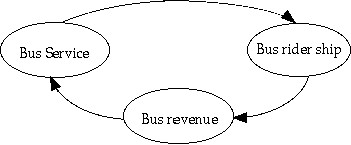
Figure 12.2-34 bus system loop
If the bus service is improved, ridership will go up, revenue will go up. With more revenue the bus service can be improved. If follows with better service, ridership will go up, revenue will go up, which means service will go up, which means ridership will go up, etc. This is a divergent loop. A result many people like.
Unfortunately divergent loops have two directions. If ridership falls, then revenue falls and this will cause service to fall... etc. The end of divergence is that service is so poor no one rides the bus. There are no revenues and the buses stop running.
- Convergent" loops
In "convergent" loops " change in a loop’s variable sets off a chain of changes around a loop resulting in the restoration of the variable’s initial value.
For example consider the furnace output in a house and the room temperature in a house.
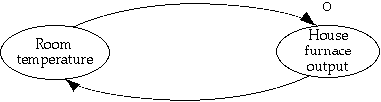
Figure 12.2-35 convergent loop system
In the convergent loop above, assume the thermostat is set at 72 degrees. When room temperature is below 72 degrees the thermostat tells the furnace to turn on. When the room temperature is 72 degrees the thermostat will tell the furnace to turn off. The outside air temperature will slowly make the room temperature colder and when it goes below 72 degrees the cycle will repeat. In this way the loop is always running but the room temperature variable is held constant at 72 degrees no matter what the outside temperature.
Notice however that as the outside temperature decreases the furnace will have to be on more of the time. As the outside temperature rises as it does in summer the furnace will be on none at all to maintain the room at or above 72-degree temperature.
- Determining divergent from convergent loops
We have discussed convergent and divergent loops before when we used the two control electric blanket to show how people failed to predict what the blanket would do under everyday circumstances. The figures from that section are repeated here. The same six variables predict comfort or chaos depending on the order they passed information to one another.
While not calling them process models in previous sections I showed how the six variables connected together in two three variable loops maintained two independent comfortable blanket temperatures for two people under a wide range of room temperatures and individual feelings of chill. I also showed the six variables connected together in a single loop predicted discomfort for both parties.
In this section I will use those diagrams to describe how the loop diagrams, could predict whether a loop is divergent or convergent. I will show a mechanism for determining whether:
My purpose is not to teach you how to model electric blankets but to show how powerful very simple process model graphs are in making predictions about future conditions. And to help you realize that in the absence of these strong predictions, expectations and behaviors will be different.
The correctly operating two-control electric blanket was shown in Chapter 3 Figure 3.2-50. That figure is the same as Figure 12.2-50 shown below. In Chapter 3, I told a story about how the structure relating the variables in a system determine its behavior. Here, I will provide a process model graph tool that will show how the stability or instability of any loop of variables can be determined. In this way I will be able to show in more detail how process models make immutable predictions.
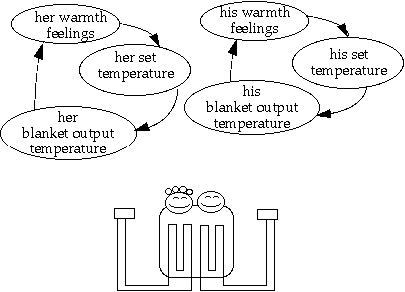
Figure 12.2-50 electric blanket feedback loops
Electric blankets maintain temperature under the blanket according to the setting on the dial. If the air is very cold, the blanket temperature is maintained at the set temperature using lots of electrical energy. When air temperature is close to the set temperature, little electric power is fed to the blanket.
The person under the blanket did not request more energy on cold nights and less energy on hot nights. They requested a fixed temperature under the blanket. It was the blanket’s controller that requested the energy to maintain that temperature.
The controller acts like thermostat on the wall of your house. If the room temperature is too warm it turns the furnace off and if it is too cold it turns the furnace on.
The set temperature of the furnace thermostat can be changed. For example, from a set temperature of 55 degrees at night to 65 degree set temperature during the daytime. Whatever the set temperature is that is the temperature at which the room is maintained.
Similarly, if the blanket "set" temperature is not what the individual wants he or she dials in a new set temperature, higher or lower for the blanket to maintain.
We can model the blanket with just three variables:
These three temperatures communicate-with one another – just as the gasoline atoms moved from one container to the other.
The blanket can be graphed as in the figure below.
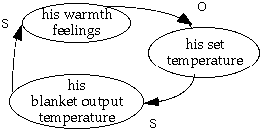
Figure 12.2-52 process model graph of electric blanket.
In the loop if the set temperature goes up, the blanket temperature goes up. Conversely if the set temperature goes down the blanket temperature goes down. This mechanism is labeled the "S" for same, because either:
Also notice that the sleeper under the blanket either feels an increase in blanket temperature or feels a decrease if the blanket temperature decreases. So connect also is marked with an "S" for same.
The third connection is between what the sleeper feels and the set temperature. If the sleeper feels her temperature is increasing she decreases the set temperature down. If the sleeper feels her temperature decreasing she increases the set temperature. Thus a change in the first variable obtains an "opposite" change in the second variable. Thus the connection between them is marked with an "O."
The net result of these three interactions among variables is that the system is rather well behaved. After the individual raises and lowers the set temperature several times, she finds the temperature she likes and then leaves the set temperature untouched for long periods of time.
This loop, with one opposite control link (marked "O"), displays a tendency to center one of its variables about a fixed value like the set temperature.
To generalize,
If:
any loop,
containing any number of variables and connections, and
containing an odd number such as 1,3,5.... of "opposite connections"
Then:
the loop will have a convergence property for some of the variables.
If :
Any loop of any number of variables
Contains an even number of opposite labeled connections such as 0,2,4,6..
Then:
Some of the loops variables will continue their changes overtime toward extreme values.
- Loop mechanics of divergent predictions
You will remember that if the blanket was turned over, so that her "set temperature" controlled his half of the bed and his "set temperature" controlled her half of the bed the system became very badly behaved.
By flipping over the blanket it becomes clear that the two loops of three connected variables become one loop of six connected variables, Figures 12.2-65.
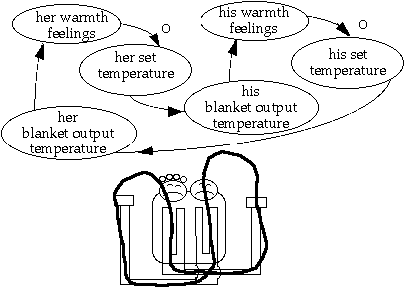
Figure 12.2 – 65 Flipped dual control blanket
It is easy to predict that the six-loop system would not maintain comfortable temperatures for either person using simple inspection. However if there were hundreds of variables this task becomes difficult.
Is there a simple structural difference between the six variable and the two three variable systems? Is there away to tell if a loop will have the nice behavior or the deviant behavior.
From inspection we can see the six variable loop has two opposite links in the same loop instead of one each in the two loops. The two opposite links cancel each other out, and the loop operates like the unstable bus system model. That is as if it had an even number of opposite links the loop.
If we generalize what we have learned any process model with an even number of opposite links, that is 0, 2, 4, 6, etc. will be a system predictably susceptible to all of its variables going to their extremes. That is it will be the same as having all same links. While any loop with an odd number of opposite links 1,3,5,... will predictably maintain some variables in the loop near expected values.
(Note: Connection geometry makes strong predictions. This type of prediction is most important when long time periods between action and outcome make learning by experience too weak to make strong predictions and thus adequately influence behavior which would avoid bad future conditions.)
12.2.3. System control
Feedback Ë The return of a portion of the output of a process or system to the input, especially to maintain performance or to control a system or process.
American Heritage Dictionary
Feed forward Ë No definition
American Heritage Dictionary
system control Ë the dependence of variable change on changes in other variables in a system.
Most of us are so familiar with the concept of "feed back control" that we have nicknamed it "feedback." The vernacular exists in the American heritage dictionary. On the contrary, the concept of "feed forward control" is so hidden from our consciousness; the word feed forward is not even in the dictionary.
Not surprising "feedback control" operates effectively at our level of temporal blindness and "feed forward control," an integral part of our elusive temporal sight, is can hardly operate at all. Process models describe why.
For example, we have seen what problems the flipped electric blanket can make. We have seen how process model graphs can predict the consequences when the system is graphed. Next I will electric blanket problem to explain the difference between feedforward and feedback control.
A close inspection shows that the arrow accepting information from the variable "feelings of warmth" and sending it to the "set temperature" is not a simple mechanism. Instead it is a collection of mechanisms. The arrow includes:
These mechanisms and variables facilitate a wide range of thinking processes. Some of these processes can be recursive. They look at themselves.
A human being can see itself as an element in a system. By inspection of that system’s connections, the human being can conceptualize motions or changes within the system, which have not occurred. These images can contain the potential dangers of untried behaviors. When the image rather than the experience facilitates an avoidance of that behavior the thinking processes can be called feedforward control.
For example, if the graphic of the flipped blanket can be constructed and its instability can be calculated, before the act, then there can be a consciousness in remaking the bed not to perform the behavior of turning the blanket upside down.
This realization of understanding the consequences of a behavior before it has been taken, and using that realization to direct behavior, is a form of system control. However, it is not feedback control because the avoided conditions never existed.
In the next two sections I will present process model graphs that make explicit the information flows for the feedback and feedforward control described in words above.
- Feedback control in thinking
Begin by focusing on the following subset of aspects of process models.
In this context the cognitive portion of system control means seeing the need, and creating the behavior to get a system variable to change in the direction of preference.
Remember that mechanisms are rectangles and have conditions as input and output. Ovals are conditions or records of conditions in memory. When a condition becomes overwhelming complex, as is the "state of the world at an instant of time," in the following figures, these large aggregates of conditions have been noted as two character designators not ovals. For example t0 means the condition of the world at a time zero.

Figure 12.2-70a Physical world processing the present into the future
In Figure 12.2 - 70a, the "physical world" rectangle can be thought of as a process model with billions of mechanisms with billions of connections. The input to the process model is the "state of the world" at that instant (marked t0.) An instant into the future the process model creates an output, a new state of the world (marked t+1).
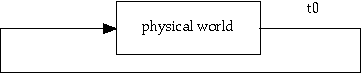
Figure 12.2-70b No human input –When the physical world changes variable values not structure
For situations in the physical world where the connections among the mechanisms remain unchanged, and the variables change over continuous parts of their ranges, the process model can take the form Figure 12.2 -70b. – a feedback loop which has no human input.
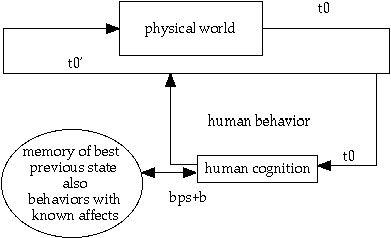
Figure 12.2-70c Human impact on the physical world
Think of human behavior as one small change in one of the billions of physical system variables (Figure 12.2 - 70c). Think of human cognition as the means to create the behavior that changes the variable. Think of the output state of the physical world, at t0, as the input to human cognition. Also fed into human cognition from memory is a "target for physical world variables." This target is the "best previous state, "bps."
In memory "best previous state" is connected to a behavior that have moved past less-than-best-previous-states, (e.g. matching closely t0) close to that target state. In this sense, behavior moves the physical world, at t0, toward a previously experienced target state with behaviors used previously to attain that target state. T0’ represents the modified t0 condition.
If this model were to fully describe our cognitive control over the physical world, consciously chosen behavior would depend on a combination of
With this description of control, humans can at best reproduce the best of the past. Humans can not improve present conditions, through their conscious choice of behavior beyond the best conditions that existed in the past except through serendipity.
If a form of creativity exists in addition to serendipity, there must be a process model that describes the additional flows of information through the physical and cognitive systems.
- Feedforward control in thinking
My search for this new model begins by reformatting and expanding our view of feedback control. Expand Figure 12.2 - 70a into a series of physical world states, t -3, t -2..., separated by a series of physical world processors as shown in Figure 12.2 - 70d.

Figure 12.2-70d Physical world processors overtime
Between any two of these physical world processors, consider the flows of information shown in Figure 12.2 - 70e. The state of the world at t0 is feed into "Human cognition." Human cognition then sends "t0" to memory with requests for:
Human cognition then sends that behavior in conjunction with t0 to form t0’ as input to the right collection of mechanisms labeled physical world.
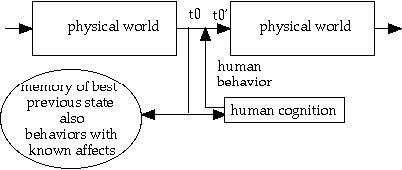
Figure 12.2-70e Feedback control of behavior selection
Limited to information flows depicted in Figure 12.2 - 70e, there can be no input to cognition from any image of the world that has not yet occurred. All of the information used in choosing behavior was a depiction of:
Thus when a behavior is chosen for implementation at t0’, that behavior is depend on information that came from back in time. Thus the control process depicted in Figure 12.2 -70e might truly be given the name feedback control.
This is a much more restricted view of feedback control than the reader might have. However, it is much more useful in describing the feed forward control process used in the creation and use of temporal sight.
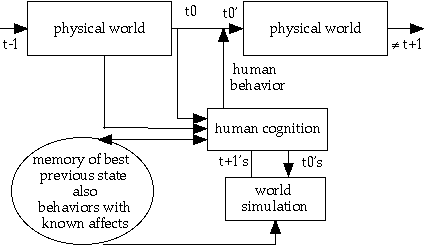
Figure 12.2-70f Feed forward control of behavior selection
Next consider the information and flows depicted in 12.2 - 70f.
Consider two examples:
Example 1) human cognition can create a world simulation. A world simulation can provide images of the physical world at times in the future if no new behavior is taken. That is memory now contains an image of t+1 in memory for the present condition t0 when no behavior is taken. Then the condition at t +1nnb is included in memory and can be used in choosing the t0 behavior.
Example 2) behaviors (t0’s) never tried in the physical world, and thus whose results could not exist in memory, can be tried in the simulation. The conditions produced by each of these imaginary behaviors can also be added to memory and then used in the process of choosing the actual behavior for t0.
In both examples information exists in memory before a choice of behavior about conditions which have never existed but will exist after the behavior. That is information from the future exists in memory.
Now we can divide the contents of memory at time t0 into that which occurred in the past and that, which occurred in the simulated future. In Figure 12.2-70g, information about the past that is supplied to the behavior selection from memory is depicted as entering from the left. Information about the future that is supplied to the behavior selection from memory is depicted as entering from the right.
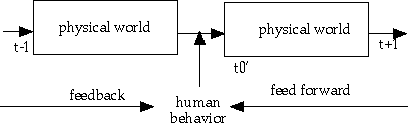
Figure 12.2-70g Feedback vs. feedforward control
If the behavior that is actually applied to the physical world at t0 comes from the past then the control is said to be feedback control. If the behavior at t0 comes form the future then the control is said to be feed forward.
It follows that temporal sight is the choice of behavior based on feedforward control.
12.3. Process model predictions in competition
Fifty years ago Claude Shannon, a Bell Labs engineer, published a monograph with the first modern definition for information: a message that reduces the uncertainty. And he added that the amount of information carried by a message can be quantified by looking at the extent to which it reduces uncertainty.
Wired 4/98 p. 97
The predictions made by process models are not the only predictions that the individual might use in choosing behavior. In competition with process model predictions are many others made by other mental processes. In this context, if two predictions for the same conditions and or behavior are different, the chooser must have a reason to choose the process model prediction over its competitors. According to Shannon’s view of information, both the prediction and the uncertainty of its truth must be part of any choice of image or behavior. Individual must have some means for evaluating the uncertainty of a prediction.
To the process model bridge designer, choosing a prediction that does not match that made by his or her model, means his or her model is wrong. To correct it requires changing a mechanism or variable so the preferred prediction results form the model. The conflict arises when the process model’s original mechanisms and variables are the ones that seem most correct, and the required changes, to obtain the alternative prediction seems wrong.
12.3.1. Relative uncertainty of rule based predictions
This conflict requires some serious inspection. We already know the basics of process models, which connect two values of a variable using a mechanism. The second condition is a function of the first condition.
Now lets look at some alternatives thinking processes that connect to values of a variable. These connections produce relations like:
While these relations also:
the predictions have limitations. One we have already discovered,
Next, I show an indirect limitation:
Rule based predictions pollute the certainty of immutable predictions of process models.
Relation or rule connections are based on experience – direct or indirect.
Direct experience means the relation is learned from interacting with the physical system. B followed A in one’s experience.
Indirect experience means the relation is learned from another individual. Who had the relation stored in his or her memory
In both cases the relation can be learned without having knowledge of its connecting mechanism. These relations create weak predictions, because they are not "always true."
.
.
.
The net result of this long list of ways for an individual to learn an incorrect relation is that the predictions resulting from rules are sometimes incorrect. And since there is no way to verify the correctness of any rule based prediction, all rule based predictions have unknown uncertainty. Our experience with rule based predictions verifies our knowledge of uncertain.
Everyone knows someone that knows someone that survived the fiery crash of an airplane or car. Or the person who was underwater for 20 minutes but was not killed. Or... Predictions that people get killed in crashes or through drowning are based on rules, which are based on direct or indirect experience, and they have exceptions. The exceptions create uncertainty. So many, it seems, like random and unquantifiable uncertainty. This opens the door to let any prediction compete with any other prediction. This reduces the integrity of choosing behavior based on prediction.
When these views of uncertainty, prediction, and behavior also permeates the thinking based on process models, it derails any possibility of attaining the feed forward control required to create temporal sight.
For example, There is a rule that some people will not be injured in a terrible car crash. Given the counter prediction that people are injured in terrible car crashes and a large portion of uncertainty attached to, a decision-maker can conclude that he or she will be covered by the former prediction rather than the later.
However, there are no exceptions or uncertainty when people in a car crash are subject to injury producing forces. Masses require forces to change velocity. A crash is a change in velocity. If these forces are high enough they cause injuries. The mechanistic connections of a process model include:
These mechanistic relationships are immutable.
A rule of thumb prediction, for example, "A person with a rabbits foot in his possession will be saved from these injuries," should not compete with a process model’ s predictions. A person should choose to put on a seat belt. When he or she does not, it is due to uncertainty.
The rabbit’s foot prediction, when transmitted with the weight of culture, creates uncertainty about the predictions of injuries created by the process model. Predictions that are based on these less than mechanistic relationships unjustifiably diminish the influence of predictions based on mechanistic connections. The undeserved uncertainty lessens a mechanistic prediction’s influence in choosing behavior.
To give a second example, we know that the fuel, consumed in a car, comes from the gas tank. We know that the amount of fuel burned is the amount absent from the tank. We know that if we burn all of the fuel in the tank the car will stop running. These connections are not based on experience, fantasy, or expert advice. The predictions are underlain by the mechanisms that reflect conservation of mass. Predictions between amount of fuel remaining in the tank and a running engine are not fuzzy or debatable. They are immutable. It is inappropriate to attach uncertainty to these predictions.
Counter predictions, like:
"The gas in the tank on Tuesday's will last for a million miles"
are fantasy. To let random allocated uncertainty be facilitated by a prediction based on non mechanistically built relations derails rationality.
In summary, the strength of a process model’s predictions is based on the following set of constraints.
guarantees a false prediction.
Within this set of constraints, a person’s process models creates immutable predictions.
When this prediction is disbelieved or ignored in choosing behavior it suggests that there exists some other prediction which appears stronger. It suggests that the constraints of process modeling do not carry the weight of their rational structure.
Process model structure allows us to:
12.3.2. Pitfall of correlational predictions
Immutable predictions make behavior selection easier, however complex systems are difficult to process model. They contain many variables with many connecting mechanisms. Faced with having to make decisions that interact with systems that seem too difficult to model, humankind has found a quicker, yet less accurate predictive process. It uses non-mechanistic relationships to create predictions.
These, in their least dangerous form are called correlations. Correlation is what results from the scientific method. The scientific method identifies a relationship between variables using strict rules:
Unfortunately these safeguards do not prevent the scientific method from discovering incorrect predictions. The net result is that non-mechanistic modeling creates uncertainty about its predictions and unjustly uncertainty of all predictions including those created by process models.
Let me give an example of how correlational information creates uncertain predictions.
Smoking causes lung cancer – Or is it coffee?
No one really knows exactly what makes lung cells become cancerous. We do not know the cause. There are many examples of people who are heavy smokers who have contracted the disease and died. There are also some heavy smokers, who have not contracted the disease.
So this leaves the door open as to "if" smoking causes lung cancer. "Smoking causes lung cancer" is not as perfect a prediction as "If the engine is running the gas tank is being emptied."
The studies that have been performed to answer, "What causes lung cancer?" look at groups of people who are the same in every way except some smoke and some do not. A group could be all people who lived in New York City their whole lives and died at age 70 in the year 1975. The researchers recorded who in the group died of lung cancer and how much each person (independent of the cause of death) smoked.
The measurement of smoking is "pack years." A person who smoked a pack a day for 20 years was given a score or 20. A person who smoked a pack a day for 40 years was given a score of 40. A person who smoked two packs a day for 20 years was also given a score of 40.
The researchers divided the people who died in 1975 in New York into groups. All the people who had smoking scores between 50 and 45 were in a group. All the people with scores between 45 and 40 were in a group, down to a group that had scores between 5 and 0.
For each group they calculated the percentage of the group that died of lung cancer. And they plotted a graph with the percentage death on the vertical axis and the group’s average smoking score on the horizontal axis. (See graph below). Of little surprise to no one, the points created a rising line to the right. The groups that smoked more had higher percentages die of lung cancer.
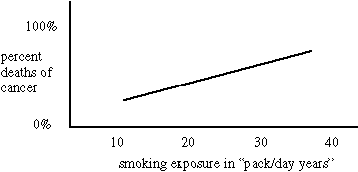
Figure 12.3-80 Correlation between smoking and cancer
It seems like a fairly reasonable way to process the measurements. It does predict the more you smoke the more chance of lung cancer. But it is not mechanistic. And because it is not mechanistic it is susceptible to being very wrong.
Let me give another example to demonstrate the vulnerability of this means of making predictions. A second group of researchers measured amount of coffee each of these New Yorkers drank. They came up with the number of "cups of coffee/day/ years" instead of "packs/day /years" for each person. Then they divided the coffee drinkers up into groups as they did the smokers. They calculated the percent in each group of coffee drinkers that died of lung cancer. When they plotted coffee consumed vs. percent in group died of lung cancer they found the new line, rising to the right, that showed the more coffee drunk the higher the chances of dying of lung cancer.
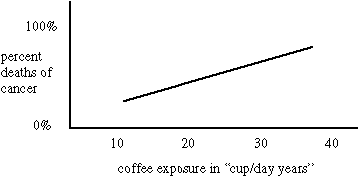
Figure 12.3 - 90 Correlation between coffee drinking and cancer
From the two graphs both the smoking researchers and the coffee researchers would be equally justified in their prediction that the more you do their thing (coffee drinking or smoking) the more you have a probably of dying of lung cancer.
While we want to believe the prediction," the more smoking we do the more the lung cancer we will have," we don’t want to believe the prediction, "the more coffee we drink the more lung cancer we will have." However, from the data and the analysis both relationships and both predictions are equally strong.
In the creation of correlation, we gather the data, plot it and see if "the more of this quantity means more of that quantity." However, correlational data is not mechanistic. It is not like the gas tank emptying when the car is moving. A percentage of the heavy smokers don’t die from lung cancer. The uncertainty weakens the prediction. Maybe the uncertainty is deserved. It is easy to see why the heavy coffee drinkers wheel that argument. They don’t want to give up or feel guilty about drinking coffee. Other than the correlation, there is no reason to believe that if people drink less coffee they will have less lung cancer.
Many of our most scared scientific beliefs (experiment based beliefs) are dependent on correlational analysis. So many of these correlational beliefs have made incorrect predictions (that is they measure cup of coffee instead of packs of cigarettes, that all predictions, including those derived from mechanistic models seem uncertain.
Uncertainty has a devastating the effect of any prediction on decisions. Decisions with high present costs and larger predicted future benefits are the most susceptible to this uncertainty. That is, you have to believe your prediction is very good to give up something good today to get a bigger good in the future.
However, the reversal of humankind's trends toward war, famine, and pollution depends on making these types of decisions. Non mechanistic (e.g. correlational) predictions increase rather than decrease the uncertainty. That is why we have to understand the difference between process model and correlation produced predictions and allocate different certainty to ea.
Our global problems can be described by either a process model or multiple examples of correlation. Predictions, resulting form correlation analysis, are often in conflict with each other. One study says there is no increase in one variable as the other increases and the other says there is such an increase. However, when we let these correlation uncertainties take credibility away from process model predictions, then, our behaviors do not reflect the available temporal information.
In closing, each of us does not want to take personal responsibility for perpetrating war, famine, and pollution on our great-great grandchildren. A process model says six billion of us share that responsibility. The correlational analyses are divided. The uncertainty of these latter analyses let each of us take the same isolated stands of the heavy smoker. We firmly cling to a belief that we are the 1% whose behaviors, while looking like everyone else's are not contributing to the common march toward our ugly future.
12.3.3. Complexity, mechanisms, and correlations
The motivation for using correlation instead of process modeling was that the complexity of systems made it difficult to make explicit each unique variable and each connecting mechanism.
For example, the human body has millions if not billions of variables and connecting mechanisms. Taking a medicine directly changes millions of these variables and mechanistic connections trigger changes in millions more. The medical researcher side steps this complexity by measuring the medicine added and the affect on the target anatomy. She or he then plots the data to obtain the correlation. She also plots the correlation of the medicine against other parts of the anatomy that she hopes are not affected. It is a crude science at best but it may be the only possible way to proceed with medical research.
It would be better if medical researchers had a process model of the human body. Lacking such a model leaves the door open to untrue predictions like "coffee drinking causes cancer." Worse, the trial and error development of new treatments causes tragic side effects because there was no way to predict what the drug might do besides effect the target anatomy.
However, medical researchers too often confine themselves to believing that systems are too complex to allow any mechanistic predictions and that experimentation with correlational analysis is the only path to understanding. Some tragedies might be avoided using an aggregate form of process modeling. In this form, aggregated elements and their mechanism connections can still make strong immutable predictions. For example, if no water enters the body, and water leaves the body, dehydration occurs. No amount of additional complexity will counter this prediction. Contrary beliefs, for example, that we can not know for sure that dehydration is taking place until we test, are counter productive.
The world’s war, famine, and pollution problems are examples where process models, using aggregations of many variables, still maintain their predictive strength in the face of great complexity.
12.3.4. Strengths of process model prediction
The most important strength of process model predictions is the reduction in uncertainty inherent in their design facilitated by using mechanism rather correlational connections between variables.
The second strength of process model predictions is their change in strength over time. Process models produce predictions that gain strength over time while predictions from correlational models grow more uncertain over time. This follows from the fact that correlational connections depend on historical information which ages as predictions extend father into the future. Conversely mechanistic predictions become more robust as the time period lengthens. Running the engine empties the tank. As the engine runs longer, the exhausting of the fuel in the tank becomes ever more probable."
The third strength of process model predictions derives from the need of the modeler to be explicit on which variables and mechanisms are included and excluded. We have seen that when many variables and mechanisms are aggregated as they are in correlational analyses, then factitious predictions result. For example, increased coffee intake increases the chance of death by lung cancer.
Fourth, process models create predictions, which are continuous. If the engine does not run the fuel remaining in the tank does not change. With correlation if we stop smoking it will not stop the lung cancer you have already contracted from killing you.
In this chapter I used dynamic models to introduce process models. Process models illuminate several temporal capacities of, thinking, learning, and behavior selection.
Chapter 13. Behavior models & temporal thinking
Economic models predict that behaviors stem from weighing the recognized and valued benefits and costs resulting from an act, against the recognized and valued benefits and costs that accrue from not acting (or acting alternatively.) The key words are
"recognized and valued."
Unrecognized or miss-valued benefits and costs distort the choice of behavior.
In this chapter, I will focus on distortions in:
behavior that occur when:
learning that occur when temporal blindness fails to create the impetus to:
In this chapter I show, using process models, that temporal blindness induces differences in "knowing" and "valuing." As a result, a temporally blind person makes different decisions from a temporally sighted person. These differences result because he or she:
13.1. Behavior selection process model
The goal is to create a process model that:
By comparing this process model with more familiar behavior models we can realize their limitations and understand our choices of behavior. For example, we will understand why spiritual, cultural, rational, physiological, autonomic, genetic, and social biologic, models produce behaviors that create the future conditions no one wants.
I will show that their limited performance relates to the temporally limited images created by direct experience of worldly objects or symbols. For example, I will show that using this information to choose behavior is often like using only the information view from the rear view mirror to drive a car.
Lets begin building the process model of behavior selection by describing, in broad-brush strokes, the information flows, and processes that transform information into behavior. Then, complete the model using progressively more temporal definitions of information and process.
13.1.1. Behavior selection environment
The process model in Figure 13.1 - 10 describes the behavior selection environment. The part that lies below a bold horizontal line contains elements within the physiology of a human decision-maker. The upper part, external to that physiology, contains the billions of variables and processes in the "external world."
Behaviors, physiological activity, cross the line upward. Changes in the external world cross the line downward as physiological sensations.
The fluid of the model is information. Information, flows, is transformed, collects, and is compared. This information is in compliance with the rules presented in the dynamic process model chapter. That is, the information can be physical or abstract. It consists of variables and derivatives that describe changes in those variables.
Groups of variables form a condition. Variables range from the meta physical of, "How much god loves me." to the physical, like, The number of staples in my stapler." From the indirect like "how many dollars are in my bank account." to the physiological "How much carbon dioxide my body produced in the last five minutes."
The six conditions in Figure 13.1 - 10 are described below.
- "Existing" condition
The "existing" condition is the individual’s registration of the "external world." The variables in the condition are not limited to direct recording of sensations. The acquisition processes can also create registrations of variables through mental manipulations of these sensations and residues of previous sensations and manipulations. These include the individual’s perceptions of quantities of variables and positions of objects at the present instant, their trends, and expectations of their future quantities and positions.
- "Desired" condition
The "desired" condition is the individual’s preferred state of "existing" condition. These include not only the preferred quantities of variables and positions of objects, but also their preferred trends and a "preferred-future-scenario." The same group of acquisition processes that created the "existing" condition creates the "desired" condition.
- "Problem" condition
The previous two conditions feed into a "comparison" process. This process produces a set of differences between an existing and desired condition. If the differences are small, (small as defined by a meta class desired condition) the process induces no change in the previous behavior patterns, which allows or maintains them. If the difference is large, the differences are collected into a problem condition.
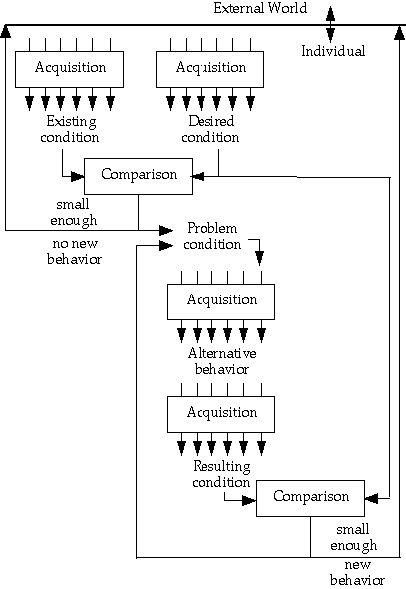
Figure 13.1 –10 Behavior selection process model
- "Alternative behavior"
The "problem" condition induces a search for alternative behaviors that will change the existing condition and make it closer to the desired condition. This could be a wish that an outside force (e.g. god, the parent, or the government) changes the existing condition. It might also mean a search for an alternative personal behavior that could be executed.
- "Resulting" condition
An alternative behavior triggers a fourth application of acquisition processes. These processes attach to each behavior a "resulting" condition. The range of acquisition processes provides for a range of "resulting" conditions. Some of these are little more than fantasy and others are the result of strict causality. In strict causality the resulting condition depends on a tracing of motions in the "existing" condition and then a tracing of these changes as they are affected by the behavior.
- New problem definition or new behavior
The winning "resulting condition" is compared with a "desired condition" to obtain a difference. If the difference and the cost are small the alternative behavior is implemented in the external world. As in the previous comparison, large and small is based on a second set of meta desired conditions.
If the difference is found to be too large, then either
a) another "resulting condition" from another alternative behavior is compared or
b) the problem conditions are modified,
The process model in Figure 13.1 - 10, while grossly oversimplifying the human decision environment, provides a skeleton which will help us understand the temporal aspects of thinking and learning.
13.1.2. Parallel acquisition– serial behavior
The geometric structure of the process model in Figure 13.1 -10 shows parallel and serial information flows. Parallel flows will show us that many alternative conditions simultaneously compete for dominance and thus use in a behavior selection environment. Serial flows will show us that behaviors are taken one at a time. Parallel and serial flow geometry are starting points to describe temporal limitations in our thinking and learning.
- Parallel acquisition
When we think of models that explain why we choose the behaviors we do, we commonly think of spiritual, cultural, rational, physiological, autonomic, genetic, and social biologic models. Each model produces a behavior for a real world condition. Each model contributes an image of a resulting condition. And each does it simultaneously even thought only one of the proposed behaviors and can be taken at an instant of time and only one future condition can result.
Consider the case where a male approaches several females. The genetic model predicts he will sexually engage all of them to ensure the survival of his genes. While his cultural model predicts "he must limit sexual activities to his spouse." However, the models are not running inside his brain. Parallel acquisition processes are running inside his brain. They are producing competing images for the
If the processes that are creating the images corresponding to the genetic behavior are stronger than those creating images corresponding to cultural behavior, then cultural penalties appear smaller at the instant of behavior than the, possibly subconscious image, of passing on ones genes.
This parallel acquisition geometry is one of two, which I will use to detail the temporal limitations in human thinking and learning. The second failure is revealed by serial information flows.
- Serial behavior
The second geometric structure revealed in Figure 13.1 -10 is that behaviors must be taken one at a time. After a behavior is taken the external world changes. Inputs to the existing and the desired condition change and the next behavior selection environment is not exactly like the previous. As a result, each successive behavior is dependent on all of the conditions and thus all of the behaviors that came before it. Each successive choice of behavior depends on the ability of an acquisition process to:
This temporal view of the acquisition processes focuses our attention on their longitudinal capabilities. By longitudinal I mean, an acquisition process that chooses one behavior to address an immediate condition and then is used again to choose a second behavior to address a subsequent condition. The question is, "Does the process used in the first decision have a view of the second decision environment."
For example, to what degree does the acquisition process make apparent, at the time of the first decision, that the first behavior will create the external condition which is the basis for its second application. Depending on the quality of the acquisition process, its view of the dependence can be strong or weak. Depending on the strength of this reflective view, the second condition plays a strong or weak role in choosing the first behavior.
For example, if one is thirsty, then one drinks liquids. If one has a full bladder one urinates. If the connection between drinking and urinated is weak then the decision to drink is not effected by the discomfort of holding one’s bladder. If the connections are strong, it will.
A second example of strength and weakness in acquisition processes emerges when in addition to the first behavior creating the condition addressed by the second, the second behavior creates the condition that is addressed by the first. The serial flows of information form loops within the behavior selection environment. The question is "Does the acquisition process discover the loops?" Certainly those processes that discover the loops will make a different series of behavior choices than those that have no discovery. Those that discover the loops only after several cycles around the loop make different behavior choices than those that make the discovery with no cycles around the loop.
For example, consider the case where the first behavior "making peace" makes peace between two groups by redistributing scarce resources. Peace allows individuals to focus on improving their lives. This means increasing their personal demand for resources. Unfortunately these resources were only redistributed by the peace-making behavior. They were not increased. Under these circumstances successful increasing one’s own consumption recreates the uneven distribution. Which remakes the war and re-requires the peace making behaviors of redistribution. We have uncovered a circular series of behaviors that have a life of their own.
The difference between a strong and weak acquisition process is that the resulting :
weak view Ë would not connect the two alternating behaviors as being dependent on one another (and thus would doom the alternating behaviors to repeat the unconscionable conditions over and over, and
strong view Ë would see the interlocking connections and would stop the repeating series of behaviors. Hopefully, by making peace in a way other than redistribution of resources.
As we found with parallel structures, serial structures determine the quality of behavior selection. Different behaviors result when different acquisition skills are present. The remaining sections of this chapter will view in detail the acquisition processes and their operational effects on which behaviors are chosen.
- Summary
Figure 13.1 -10 implies that:
This implies that, at that instant, the values and preferences, produced by the other six pathways (if they are not identical to those in the winning condition) are considered inferior and are not brought to comparison.
13.1.3. Temporal singularity
Choosing one condition over another means they must be compared and ranked. To compare two things requires dimensions. The temporal singularity of these dimensions is central in determining a condition’s strength and weakness.
- Singularity within a competing condition
While the dimensions of a condition are allowed to range over time, at the instant of comparison, numerical values are fixed. Objects can not be at two places at the same time - variables can not have two sizes.
This singularity extends to both the value of a variable and that variable’s temporal aspects. For example, an object must assume one of three trend states: getting "closer," "farther" or "staying the same distance" from some reference. A variable must be getting "bigger," "smaller," or "staying the same size."
Singularity in condition also extends to "desired " conditions. Each must contain a singular preference for each object’s position and each variable’s numerical value. The desired condition also includes preferences for temporal terms.
- Singularity among competing conditions
Singularity also extends to the difference between two conditions. A single hierarchy must exist for the set of deviations between two conditions. How else would one know which of the existing deviations must be dealt with first.
- Summary
For each instant, only one value and trend describe the variables within a condition of:
When doing comparisons between the existing and desired conditions, or between the existing and resulting conditions, at the instant of comparison only one condition can exist.
If each condition shapes behavior differently than its rejected competitors, then to understand how temporal blindness weakens each of these acquisition pathways and shapes behavior selection, we will have to make each pathway more explicit.
13.1.4. The plan
Conditions are created using acquisition pathways. Each pathway has mechanisms, which transform information and create conditions. Each mechanism accepts input information and emits output information. Each sensing mechanism may not be sensitive to the temporal aspects available in the information. Each transforming mechanism may not use the temporal information, which is correctly sensed. If the resulting condition is partial or weak it will compete poorly. If the condition that would be dominant is not brought to comparison with it true full strength, the chosen behavior may not correctly reflect temporal aspects of the external world.
In the next sections I introduce the sets of mechanisms used in acquiring conditions. I begin with mechanisms used to create existing conditions and then use them as a base to describe additional mechanisms required in creating, desired conditions, alternative behaviors, and resulting conditions.
Describing mechanisms that create an individual’s descriptive view of the world (existing condition,) not a preferential view of the world (desired condition), has been one of the most fundamental issues of both philosophy and psychology. Tens of thousands of books and papers have been written to describe how an individual comes to know this view. Only an infinitesimal sliver of this view can be addressed in the next pages. This sliver focuses on temporal aspects of information and mechanism.
13.2.1. From snapshots to state spaces
To focus on temporal aspects of conditions we need to eliminate from the discussion aspects, which commonly distort behavior but are not temporal. The most common of these distortions is omission. That is when "existing conditions;" omit objects with position and size that exist in the external world. A second common distortion is inclusion of objects that do not exist in the external world.
However, even when an "existing condition" is a perfect snapshot of the external world, that is, when:
this perfect description does not tell anything about the objects in the future.
For example, a snapshot of a car does not tell if the car is traveling backward or forward. How fast it is traveling. If it is changing its speed (as it would if it was rolling up or down hill). If it is changing its acceleration, (as it would if the hill was getting steeper or flatter.)... If it is changing its rate of acceleration, (as it would if the rate at which the hill was getting steeper or flatter, increased or decreased...etc. The "etc." means associated with any variable (in this case car position), is an infinite series of change descriptors.
The snapshot does not describe this family of temporal terms. The snapshot tells nothing about where the car will be in a second, a minute, a day, or a year - even if no behavior is taken. When combined with positions and temporal terms of other objects, e.g. trees, guard rails, and other cars, the snapshot tells nothing about if the car will be in an accident and what kind of injuries will occur.
Different behaviors result for the same "external world" when "existing conditions" and "desired conditions"
Take, for example, the case where the "existing conditions" of a car and the "desired conditions" of a car are identical snapshots. Then, no alternative behaviors are selected. On the other hand, consider the case where the existing conditions include temporal terms that predict the car is on course to impact a tree. Then there is a difference between the existing and the desired condition. And the difference demands behavior to stop or alter the course of the car.
In this temporal view, "conditions" are more than snapshots. They are even more than a series of snapshots. Conditions include a family of "change terms" for each object and variable within that snapshot.
Engineers call this temporal view of conditions a "state space." A state space is the values of variables and the locations of objects – each with its associated family of change terms.
In mathematics, these change terms are called derivatives. In layperson’s terms, a derivative is the difference between two measurements of an object's location, divided by the elapsed time between the two measurements. For example, velocity is the derivative of an object’s location. It is the speed of an object at a location. It could be calculated by taking the number of feet traveled from the initial location during a time period divided by the number of seconds elapsed during the travel. (e.g. Ft/sec.) This velocity is actually the average speed of the object during the time period. However as this time period gets very small, the calculation becomes the velocity of the object at the starting position of the interval.
To summarize the engineers’ view:
13.2.2. From state spaces to imperfect scenarios
Each of us is not so naive that we select behavior by choosing between two snapshot images of a moving world. We don’t learn to steer cars by looking just at pictures of parked and crashed cars.
Neither are most of us so sophisticated that our behaviors are based on state spaces. We don’t consciously use very many members of the large families of derivatives associated with objects and variables. For example, while we do use the maximum deceleration force, "how icy the road is" to determine the maximum speed we drive the car, we do not use yaw rate to determine steering wheel behaviors to recover from skids. We do not use the almost invisible or abstractly visualized societal movements toward war, famine, and pollution to guide our procreative behaviors.
Using something better than snapshots but less than state spaces, we create an imperfect scenario to be used as the condition in selection of behavior. Sometimes the scenario is adequate and our behavior achieves our goals and sometimes not.
Less than perfect scenarios have a profound affect on
The uncertainty created by our experience with incorrect predictions encourages our disbelief in all scenarios. Even when a scenario is based on first principles (or laws of nature) we don’t take its predictions as immutable. On the other hand, we have to chose behavior, and with the certainty of causally created scenarios greatly diminished, mythical scenarios, those supported by cultural approval become equal competitors. Furthermore, when mythical scenarios are the ones culturally accepted, there is real inertia for an individual to create and believe a counter scenario. In such a society the learning to build scenarios that challenge societal beliefs is both not encouraged and un-rewarded.
The uncertainty of any scenario increases with the complexity of the decision environment. One aspect of complexity "time" is particularly troublesome to us. The slower the detectable motions in the present, and or the farther forward in time the results, the more uncertain the future elements of a scenario appear to us and the more we discount them. Unfortunately this has a profound affect on our choice of behavior to control them.
Our task in making a new temporal thinking and learning model is to understand the pathways we currently use to acquire, build, and compare the scenarios we use as our conditions - specifically the temporal limitations in these pathways.
13.2.3. From imperfect scenarios to future images
The "imperfect scenarios" that we use to shape our behaviors are not snapshots or state spaces. However, calling them scenarios is not an adequate term either. Scenario is only a story about variables as they move forward in time. To create and select behaviors that implement feedforward control we need a term, which conveys the causal reasons the variables move as, they do. We need a term that conveys the Rube Goldberg magic along with the story. This term I call "image."
Image, behavior, and social outcome were terms presented by Kenneth Boulding in his 1956 book Image. Boulding defined the temporal aspects of image, which makes them useful in my process model of thinking and learning
- What's an image
Kenneth Boulding outlined ten dimensions of image; (The formatting below is added.)
(1)"... the spatial image, the picture of the individual location in the space around him.
(2)... the temporal image. His picture of the stream of time and his place in it.
(3)... the relational image, the picture of the universe around him a system of regularities.
(4)... the personal image, the picture of the individual in the midst of the universe of personal roles and organizations around him.
(5)... the value image which consists of the ordering on the scale of better or worse of the various parts of the whole image.
(6)... the affectional image or emotional image, by which various items in the rest of the image are imbued with feeling or affect
(7)... the division of the image into conscious, unconscious, and subconscious areas.
(8)... the dimension of certainty or uncertainty, clarity or vagueness.
(9)... dimensions of reality or unreality, that is an image of the correspondence of the image itself with some ‘outside' reality.
(10)... closely related to this but not identical with it, we have public, private scale according to whether the image is shared by others or is peculiar to the individual".
In addition to these definitions, Boulding’s view of how an image comes to exist and how it gets continually modified is useful in understanding my process model of learning and thinking. For example, he defines the meaning of a message as "the change it produces in his image." He sees value scales determining both
Boulding, as do I, believed, image governs behavior.
- Six parallel image acquisition pathways
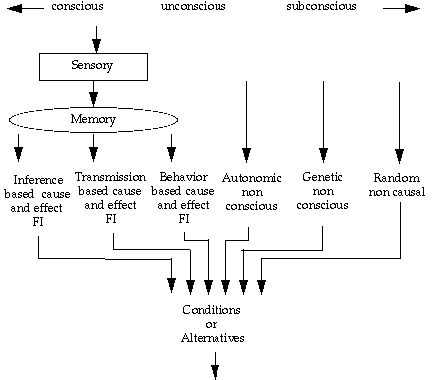
Figure 13.2 -10 Six classes of acquisition pathways
Figure 13.1 - 10 showed six vertical lines through each acquisition process. Each line represents many pathways. Thus each of the six lines represent a class of pathways. Each class produces conditions with varying strengths and weaknesses depending on the temporal character of the external environment they address.
In Figure 13.2 - 10 I show the differences among the six classes using physiological sensation, memory, level of consciousness of the inputs and outputs, and the transformations they perform. The six classes form a continuum of "condition - creation" that ranges from:
Random
Some human behaviors appear spontaneous. The information that creates the condition that begets the behavior appears from an unknown source. In review, after their execution, these behaviors are attributed to serendipity, intuition, extra sensory perception, or a deity’s advice. The apparent randomness names the pathway class.
Genetic
Konrad Lorez(?) suggests that human instinct included directives in procreation, hierarchy, and territory. Freud[1933], Dollard and Miller [1950] describe many social behaviors they believe have subconscious origins. Wilson [1975] suggests that humankind’s destiny, is part of a genetic code. They all believe the genetic code produces information that drives our behavior. This class of pathways is given the name "genetic."
Autonomic
Our hearts keep beating, our diaphragm muscles keep our lungs exchanging air. We don’t have to consciously think about keeping our pours sweating, and stomach churning. This class of pathways is given the name "autonomic."
Behavior based cause and effect
Skinner [l974], Rotter [1954], 1972], and Bandura[1977], suggest that behavior is dependent on information drawn from direct personal experience. Skinner [l953] believed that the individual consciously chooses to repeat the behavior that provides the best previously experienced reward. This class of pathways is called "Behavior based cause and effect." A more common name might be "trial and error."
Transmission based cause and effect
[Mischel 81] Rotter[l972] and Bandura[1971] suggest that individuals choose behavior based on expectation, however, in their view the reward does not have to have been a direct result of their own behavior. The expectation can be learned from observation of a system they have not perturbed. The social learning theorists believe that an individual can learn to expect an outcome of a behavior by watching, listening to, or reading information created by other people. This class of pathways is called "Transmission based cause and effect." A more common name is cultural transmission.
Inference based cause and effect
Expectation, (image sequence, specifically future image), can be created based on partial state space information and causal relations. That is the image sequence does not previously have to be created by behavior based, or transmission based "cause and effect" pathways. Instead the future image is created (inferred) using a simulation of the physical world.
- What’s a future image
Boulding derives future image from relational image. He writes:
"As an important aspect of relational image is the image of the relation between the acts of the individual and their effects. We may regard this part of the relational image as consisting of a number of potential future or time images, each of which is associated with some particular mode of behavior in the present. The image can be expressed in a series of sentences:
If I do A,
then B,C,D, Etc. will follow
in a definite time succession. (p.50)
A future image is a present mental representation of future conditions.
However, all future images are not functions of preceding events. For example, later events in an often-told fairy tale are future images of the initial events. However, there is nothing within the earlier events that predict the outcome of the tale. The portion of future images which are important to this discussion are those whose future existence are predictable from preceding conditions without the person (who makes the prediction) actually having previously experienced them. That is, the "end of the story" can be predicted from the first parts without having heard the story told before.
These predictions, based on cause and effect, can be formed based only on initial conditions and elapsed time. Thus, for us the important future images are the ones where present images where mentally transformed by existing in-process motions or behaviors that modified the in-process motions. For us, the important effect of these mentally manufactured future images, is that they add to the behavior selection process a competing alternative condition that otherwise would have been absent.
Other effects of mentally manufactured future image beyond shaping the existing conditions, include:
- Future image and feedforward control
A dog has no idea that there were dogs before him and there will be dogs after him. The human being on the other hand, is firmly located in a temporal process. He has an image of the past, which extends back far beyond the limits of his own life and experience, and he likewise has an image of the future. Closely associated with the time structure of his image is the image of the structure of relationships. Because we are aware of time, we are also aware of cause and effect, of contiguity and succession...
The image of man is also characterized by a much greater degree of self-consciousness and of self-awareness than that of the lower animals. We not only know but we know that we know. This reflective character of the human image is unique, and is what leads to philosophy. Because of the extended time image and the extended relationship image man is capable of " rational behavior," that is to say, his response is not to an immediate stimulus but to an image of the future filtered through an elaborate value system. His image contains no only what is, but what might be. It is full of potentialities as yet unrealized. In rational behavior man contemplates he world of potentialities, evaluates them according extended image, he is also capable of organizing his own experience in ways that will extend the image further.
Kenneth Boulding in Image 1956
Using the "image" contained within the mind of the human being, Kenneth Boulding completes his description of the universe. His universe has two countervailing forces. The first is the second law of thermodynamics which dictates that all things tend toward the most disorganized state a state with an evenly distributed gray continuum of things that has no more potential for disorganization. The second force creates or maintains pockets of order inside this general trend toward chaos.
He classifies and ranks seven levels of organizational forces. He names these levels static structures, clockworks, thermostats, biologic, botanic, zoologic, and human. At one extreme of his organizational force continuum, he sees static structures as passive resistance to disorder. At the other extreme, he sees human beings as the most powerful active forces creating new pockets of order.
According to Boulding, the human being is the most powerful organizational force because her image, her means of guiding behavior, is extensible.
While Boulding mentions many dimensions of image expansion and describes science as the subculture of the extending process, his most powerful contribution for our process model of human thought is his belief that a human being's image is extensible, not only in spatial breadth of the present, but in temporal depth into the future.
Boulding believed that humankind's image can contain knowledge of future conditions that are shaped by the choices of his own present behavior. That is, some alternative future images are extensions of knowledge that result when alternative behaviors are mentally preformed on present conditions.
Boulding’s theory underpins the feedforward capacity of a process model. That is a future image resulting from a present condition extended into the future can be the motivation to identify and implement a behavior.
- Summary
From Boulding's descriptions, images are the conditions within the process model of behavior selection. The pathways within these models acquire, store, recall, manipulate, and compare images. The creating of these images I call learning. The learning of "pathways that create images" is learning to learning.
The important subclass of images that relate most directly to the temporal mechanisms of our thinking I call "future images" (FI). The learning pathways that create future images I call "future imaging skills" (FIS). The learning of these future-imaging skills is one definition for the acquisition of temporal sight. The part of temporal sight on which I focus deals with the mental abstractions of motions too slow or too fast to be sensed and manipulated directly by physiology. Again this is getting ahead of my story but it does establish the vector.
13.2.4. From future image to behavior selection
Figure 13.1 - 10 shows parallel acquisition pathways producing competing conditions. The temporal part of these conditions, at least with respect to feed forward control of the physical system, is the future image. Next I describe:
- Behavior, consciousness, and Future image
The random, genetic, and autonomic pathways produce subconscious images that influence behavior. These images do contain a sub or unconscious truncated future image. For example, a truncated future image could contain a connection between the secession of an internal dissonance and behavior. These future images are called truncated because they carry with them no view of the change in the future states of the external world that also result from the behavior.
If all the competing images, in any decision environment are unconscious or subconscious, that is they all have truncated future images, then behavior selection can be considered non-conscious. That is when the behavior springs forth, the individual can not recognize a preceding conscious process.
If these truncated future images compete in a behavior selection environment with less truncated (conscious) future images produced by behavior based, transmission based , and inference based pathways, (from the left side of Figure 13.2 - 10.) the behavior selection process is conscious.
This is true even if the chosen behavior reflects the dominance of a truncated future image. For example, under normal circumstances a person would choose life over death. However, a man kills his wife’s lover even though society will take his life in the gas chamber for his action. This distortion in his behavior selection has a logical explanation. At the time he discovers the lover, his image of the gas chamber taking his life is small and weak. While the competing subconscious image (of another man supplanting his genes) (his genetic rage) is large and clear.
Boulding offers an explanation for why satisfying a genetic rage dominates an expectation of certain death. His explanation uses a description of the physiology of the human eye as an analogy for the range of pathway’s that produce future image. His analogy separates image into conscious, unconscious, and subconscious.
While the human eye has a wide field of view, only a small part of this view, that part that falls on the retina’s fovea is in sharp focus. To see other parts of the view in sharp focus the eye must be moved so that that part of the image falls on the fovea area.
Like the eye, the mind can not hold in conscious view all parts of a mental image. Like the eye the mind has a scanning process that brings the unconscious into the conscious. The subconscious portion of the image is that part of the image which is not made available by the scanning process (p53.)
In this view, the strengths and weaknesses of any scanning process become powerful determinants in the behavior selection environment.
Boulding believes, "how the scanning process works," is one of the great unsolved mysteries. The mind may not know what it is trying to bring into consciousness from the unconscious until it sees it. The mind’s scanner may not know what to recall before it recalls it. "We have a curious capacity; for giving ourselves examinations. We know how to write the questions that we have answers for." p.53.
In the proposed process model the six classes of pathways are like six scanning processes. The temporal aspects of these pathways describe our time blindness. Their temporal mechanisms are important in creating our temporal sight. To establish feedforward control requires the use of the left most pathway in Figure 13.2 – 10 - inferred future image.
- Feedforward control or instinct
In Figure 13.2 -10, the autonomic, genetic and random pathways do not appear with indications of future image. The behavior based and transmission-based pathways have future image indications but the future images they produce are not the kind that can implement levels of feed forward control. Only the future image created by an inferred cause and effect pathway can facilitate the feed forward control for which we seek understanding.
Consider some cases in nature where it appears that future image plays a role in behavior selection when in fact it does not.
When Wooldridge describes the difference between thought and instinct, he argues that instinct has no future image. He feels much of the very intricate actions of animals that we attribute to conscious thought are only stored behavior patterns that were part of the subconscious mind at birth. What we see and sometimes judge as conscious behavior is the playing of these complex programs. To prove his point, Wooldridge provides four examples that show a disconnection of the environmental stimuli, which triggered the program and its function. The four examples come from the genetic preprogramming section of The Machinery of the Brain.
First, a male moth released into a cage, where a female in heat and her scent glands (not her vagina) have been separated and attached to opposite ends of the small cage, heads for the scent glands rather than the female moth's vagina and proceeds to deposit his sperm totally ignoring the function of his action.
Second, the Thermometer bird of the Solomon Islands incubates its eggs, by burying them in the warm beach sand. The small chick hatches by pecking through the shell. It then starts a climbing motion that brings it to the surface of the sand. Not only is it difficult to get out of the shell and, though buried alive in the dark, climb up through the loose sand, but when the chick breaks into the sun light, the sand is searing hot. The chick jumps to its feet, opens its eyes, determines the location of the nearest shade and runs for cover before it is broiled. It could be asked, in the face of all the chick's actions, why it isn't at the top of the earth's cognitive order? The answer is obvious. The chick is not thinking. It is just running programs genetically implanted in its brain. In the chick's case, each program is a one-shot. It can only be run once and then it is destroyed. If the chick is captured during the running program and re-buried in the loose sand, the chick does not revert to the climbing motion but continues its running motion. The climbing motion program is gone.
Third, the Sphex wasp has a very intricate process for laying its eggs. She lays her eggs in a burrow. Then she stings a cricket in such a way that it is paralyzed rather then killed. The cricket lives and is preserved by its own bodily functions until the grubs hatch and use it for food. After the wasp drags the paralyzed cricket to the door of the burrow. She then enters the burrow to check to see that the eggs have not been disturbed. If they are OK, she returns to the cricket and drags it into the burrow. The checking of the burrow gives the illusion of thought. What destroys the illusion is that if the cricket is moved several inches while the wasp is checking the burrow, the wasp will not drag the cricket into the burrow, but only to the door. Again she will go inside to check if everything is all right. Moving the cricket away from the door several inches will trigger the same drag and recheck behavior tens of times. Thus, it is not the function of the behavior that controls it. It is not a desire to ensure the eggs are all right that causes the wasp to recheck the burrow. If the wasp had a conscious brain it would already know it had just checked the eggs. The recheck behavior is instead triggered by the dragging of the cricket near the burrow.
Fourth Wooldridge describes the octopus that builds a wall of stones to hide behind so that it can jump over and get its prey. Given clear plastic blocks as the only building material the octopus will build a wall of them and hide behind it even though it has an eye and can see through the wall that is suppose to be hiding it.
These examples predict that simple instinctual beavers in animals are not the feedforward control for which we are searching.
Next let me give an example of much higher order behavior in humans where instinct
- Conscious future image – unconscious behavior
Human thought requires input , process, and output. Human action requires stimulus, computation, and actuation. Each of the three can be either conscious or unconscious. The combinations of consciousness describe the utilities of future image in behavior.
Consider the act of "increasing the heart’s rate to be able to perform a future act," like, flight from danger.
The information to increase the heart’s rate reflects conscious sensation of external world conditions.
However, the individual has no conscious role in the computation, which creates the information that make, the heart rate increase.
Thus the individual can not have before the fact, a future image of "being able to flee faster or farther" if a heart beats faster before flight. No one makes a conscious plan to raise his or her heart rate, seconds before the game commences.
- Summary
I suggested that the conscious alternatives are in competition with the unconscious ones. That conscious alternatives have conscious future images. And that, the presence or absence, the strength or weakness of the future image determines how well a conscious alternative competes with its competitors in the behavior selection environment.
I have discovered the existence, if not the exact content of a scanning process that separates the conscious from the unconscious and the unconscious from the subconscious.
The abilities and limitations of this scanning process determine the boundaries among the three. Images, believed to be impossible to extract from the unconscious or the subconscious, may be invisible due to under used or underdeveloped aspects of the scanning process.
Many of these aspects may be temporal. Investigations into temporal limitations in this scanning process will help us extend our view of our temporal blindness. They will help us define the mechanisms that implement temporal sight.
13.2.5. Perceiving "in-process" conditions
There are many conditions that we see. There are many conditions we partially see. The conditions we don’t see are our blind spots in our decision making. The conditions we don’t see are either unchanging or changing. I call them "static" and "in-process" conditions. While missing either form of information is equally disruptive in rational decision-making I will focus on the "in process" conditions because they are most disruptive in the production of future images.
Let me provide an example of blindness to "in-process" conditions.
|
Answer the following four questions. |
Write in your answer |
|
1) Are you hungry before a meal? |
|
|
2) Are you hungry after a meal? |
|
|
3) Are you getting more hungry before a meal? |
|
|
4) Are you getting more hungry after a meal? |
|
The answers respectively are yes, no, yes, YES!!! The surprise answer to question number 4 is the start of our investigation.
You would probably not have been surprised at that answer if had I asked questions three and four in their temporal form.
These questions eliminate the static answers (not hungry or hungry) and force the answer to be temporal.
However, I did not ask the questions in that restricted way. And in its loose form you allowed yourself to transform it into a static form of hungry and not hungry and then chose ""not hungry. It is the same mistake we made in transforming the car skid control problem from its in-process form "rotating" or "not rotating" into its static from "rotated" or "not rotated" and why we missed our chance to came up with an easy robust way to control skids. So what can we learn from these examples, useful in creating a temporal learning model?
Consider how this blindness to the fact that all living people are:
"in the process of getting more hungry every second of their lives,"
might effect behavior. The motivation "to get food" derived from the static condition "hungry" is different before and after a meal, while the motivation "to get food" from the "in-process" condition "getting hungry" remains the same before and after eating.
If the static condition governs behavior, then, after a meal, lie down, siesta. Hunger will be the cue to get up and start looking for food. If the in-process condition governs behavior, after the meal go back to work to ensure future meals.
Its a good thing that the "going back to work immediately after a meal" behavior is governed by several factors other than temporal sensitivity to the in-process condition. (Remember, most of us did answer "NO" to the fourth question above.)
There are many reasons to go back to work independent of temporal insight. They fall in two groups:
personal experiences
cultural transmissions
Ë Cultural guidance suggests you will lose your job if you don’t go back to work after lunch." Culture does longer range guidance, like recommending that in summer you eat berries instead of the seed you should plant for the fall harvest. Failing to plant and harvest may leave you starving in the winter.Culture may keep you from starving, in the absence of being sensitive to temporal information however, there are some cases, when culture makes no recommendation or recommends an inappropriate behavior. We have discussed the "unbelted child protection during braking before an accident" as an example of the first, and that "procreation overloads the environment" as an example of the second.
It follows, that when culture fails and an event would be a terrible hardship to learn from experience, temporal sensitivity would be an asset. The questions to answer now are:
The answer to the first question is that temporal sensitivity comes from our physiology, our experience, or our abilities to make causal connections. It follows that failure to detect in-process motions, our temporal blindness , results from:
- Physiological sensing and computation
Since the first part of the book discussed ball throwing and car driving case studies, each, which focused on physiological limitation on sensing and computations, only a brief review is required here.
Consider a passenger of an airplane looking out a window to calculate airplane speed. Assume that the passenger gets to look out for only one second.
If the passenger looks forward down the runway just as the airplane takes off and sees the markers go by he will be able to approximate if the airplane speed is one, two, or three times the speed of a car going 50 mph his familiar reference. However, if:
Case 1) he is a bushman and never traveled more than 4 miles per hour this will be much harder for him for it will be too many multiples for his reference.
Case 2) the passenger looks straight down at the concrete runway the blur prevents the acquisition of the start and finish point and thus prevents any estimate of distance during the interval and thus no estimate of speed.
Case 3) at 30,000 feet above the ground, the view at the two points in time is so similar our physiology can not measure a difference. The passenger can’t tell if the plane is going zero or 500 miles per hour.
Case 4) At 30,000 feet over the checkerboard of Iowa fields. Then you look out 5 minutes later. You realize the first image is gone and can not be used as a reference.
To summarize there are four physiological limitations in visual temporal abilities:
1) inappropriate reference.
2) unable to imprint a unique position of an object because it is traveling two fast, E.G. concrete blur or flying bullet.
3) too little difference between images, which is caused when if the motion is too slow or the time interval to short.
4) initial image loss too much time between first and second image; as with grass growing the first image is lost before it can be compared with second image.
Thus our visual physiology determines a range of in-process motions we can determine. In-process motions that lay outside of these parameters are all but invisible.
We not only see motion but we feel it. Accelerations create forces on our body, which we can feel. And in some cases we can calculate in-process motions from these feelings. However, like limitations found in the visual physiology there are also limitations in the body’s physiology to sense forces.
We can feel ourselves speeding up on the runway. However, long before the airplane, reaches it cruising speed of close to 500 miles per hour, we have long since lost our ability comprehend the in-process motion. When we are traveling in the fastest airplane, we have no sensation of motion at all.
There are many other cases where there are huge in-process motions and we feel no motion at all. Two people siting in chairs, one at the north pole and one at the equator would both say they feel no motion and are not moving. However, the person at the equator is traveling at 1000 miles per hour around the axis of the earth. The person at the north pole, being on this axis is not moving but simply rotating in his seat (one revolution each 24 hours. If one travels from the north pole to the equator he or she increases his or her speed by 1000 miles an hour and he or she won’t feel any different.
Similarly anyone on the earth travels one trip around the sun each year - a distance of 300 million miles. Each person is traveling more than 30,000 miles each an hour but feels no in-process motion.
If you are at the equator you are traveling 2000-mph hour faster along this path around the sun at noon than you are at midnight. Yet you feel no change in your speed during the day.–
-Conscious measurement and computation
An object at a position 5 minutes ago, and that same object at a new position presently can have a calculated motion. The calculation depends on the ability to symbolize two locations and times. This requires the existence of spatial and temporal scales and references.
However if these exist, the person must also be able to due the computations at the mental level. Sometimes this is simple addition, subtraction, multiplication and division.
For objects like cars traveling across country the measurements and computations are easy. However, objects that have complicated motions require more advanced mathematics. For example, measurement of a star’s distance from the horizon at one hour intervals, while quite precise, would be more related to the earth’s rotation than to star’s motion relative to its previous positions in space.
-Dependence tracing
A third limitation in understanding in-process motion is failing to detect the motion of objects that move because their motions are connected to the motions of other objects, which we can see.
For example, during an all day flight, the gas gauge needle swings from full toward empty. The motion of the needle is slow but steady. If the pilot realizes that it took 4 hours to swing half the distance from full to empty, he or she can predict that in four hours the tank will be empty. This does not by itself tell the pilot that he will crash in the mountains. For this, he must connect motion of the gas needle to the motion of the airplane, and the distance to the mountains.
Consider how many motions remain invisible to us because we lack the sensitivity to find and realize their connections to motions of variables we can see.
If :
the observance of the myriad of dependent motions is limited by our abilities to trace the dependent chains among variables,
Then:
our temporal sight is also defined by these limitations.–
-Summary
Insensitivity to motion creates a class of behavioral failures. Three processes for identifying motion in the physical environment include:
1) physiological sensing and computation,
2) motions realized through conscious measurements, memory storage retrieval, and difference calculations, and
3) non-visible motions found to be dependent on visible motions.
Each process has complex information requirements. When any of these requirements are violated the process fails. While temporal information is but one dimension in the creation of existing conditions, its absence causes failure. We can use these failures to generalize temporal mechanisms in thinking and learning.
13.3. Acquiring a desired condition
Thus far we have focused on distortions in the selection of behavior caused by the absence or inaccuracies in an "existing condition." However, the choice of behavior depends on more than just better images of what is and what will be. It depends on the preferences for these images. In Figure 13.1 – 10, I suggest that behavior selections are made based on differences between a "desired condition" and an "existing condition." (later between a desired condition and a resulting condition.)
It follows that behavior selection depends on the quality of a "desired condition, "as much as it does on the quality of the knowing what is and what will happen. Our goal then is to describe a "desired condition" in enough detail to understand its content and creation. I will focus on how poor use of temporal aspects of the environment’s information distort a "desired condition" and thus distort behavior selection.
13.3.1. Behavioral choice from feelings
"if it feels good do it."
We have already defined "condition" as an image of a state space. A state space of a physical system is its variables each with its associated change descriptors.
The desired condition, by comparison to the existing or resulting condition, has a bias. It describes both what the world’s variables should be, and the priority with which "deviancies" between itself and the others should be addressed by behavior.
That is, if a world could be described by 10 variables, eight with no deviance from the values in the desired condition, and two equally deviant, the priority part of the desired condition determines which of the two variables is addressed by behavior first?
If we ask a person how he or she chooses which deviance to address first or which of two behaviors to take first , he or she is lightly answer "it feels right." We may conclude that humans attach "feelings; to deviancies about variables. Feelings, announce" I want this variable, which is quantity "Y" to be quantity "X" and "I want to change the world toward "X" before I do anything else."
This view of behavior selection requires both target values for variables, and feelings for deviancies away from these targets. This view of the desired condition requires that its associated processes have the additional task of creating feelings. The view leads to questions like:
1) What happens when we assign too little feeling to large benefits, or too much feeling to little benefits?
2) What happens when we assign no feelings to liabilities or benefits we don’t see or imagine?
3) What happens when we assign feelings to imaginary liabilities or benefits?
The answers are obvious. We get behaviors we would not have chosen if we had done a better job gathering and processing information to create these feelings. We implement lower priority, lower impact actions, while leaving higher priority, higher impact actions undone.
13.3.2. Processes create feelings
If processes create "feelings," our "time blind" task is to describe how the temporal aspects of the environment shape our feelings or reshape them over time. The task is to explain how these processes disuse or misuse available temporal information to produce:
This is a very large task. In this brief section we can preview only a partial skeleton of this field of study. However, the search will demonstrate more of the workings of temporal blindness in behavior selection.
Begin by considering the feelings against a behavior that results in the death of ten people in each generation. The first ten people that will die will be immediate friends. The next ten people will the children of those friends. The next ten people will be the unborn children of those children. The behavior is very powerful, there is no uncertainty about these deaths.
Theoretically the contributed feelings to behavior selection should be three blocks of feelings of equal size. If only one of the three blocks was used in the selection process, it should have the same influence on selecting against the behavior as any of the other blocks. Together the three blocks of feelings should have three times the influence of one . We know this is not the case. And it is the starting point to understand the miss use of information in processes that create feelings.
- Presence in desired condition
First we must separate two process failures.
1) The failure to create feelings when there was no image memory.
2) The failure to create feelings for an image that exists in memory
Up until this section we have focused on processes that fail to create image. Now we will discuss processes that fail to create feelings from images that do exist in memory. We focus on whether an "image in memory" has "presence" contributes feelings in behavior selection. If an image exists in memory but has no presence at the instant of behavior selection, the process failure is that it creates no feelings.
+ Processes that create "presence"
Thought processes have mechanisms that create feelings. Two types of these mechanisms are worth mention because they help us see how processes fail to correctly use temporal information and how they themselves vary over time. The two types of mechanisms run in series. The first type I call "scanning" mechanisms. The second type, I call "conversion" mechanisms.
- Scanning mechanisms
Our memory is filled with images - billions of them. When we focus on any of these memory images we create feelings – feelings of gut wrenching pain or heart-warming delight. However, like our eye, which views clearly only a small part of our field of view, our mind’s eye can see clearly only a small part of the images in our memory. If it is this small part that creates the strong feelings we bring to desired conditions and which determines our behavior. Then the scanning mechanisms which determine on what image the mind is focused determine what feelings we apply in behavior selection.
The temporal aspects of this scanning process are obvious. Scanning implies a sequence of images a sequence of feelings and a sequence of different behaviors. Buried in memory are the joys of being a vamp and the joys of being a "goody two shoes." Depending on which image has just been scanned can determine the dominant feelings and behavior. In the temporal sense schizophrenic behavior seems almost normal.
- conversion mechanisms
Two images are not directly comparable. For example an apple and an orange are images. One image is not directly better than the other is. However, a feeling of eating an orange, or the feeling of eating an apple can be compared. Thus there must be mechanisms that convert images to feelings. And the strengths and weaknesses of these conversion mechanisms determine the behaviors we select as much as the scanning mechanisms.
Converting mechanisms have their own idiosyncrasies when it comes to distortions created by temporal aspects of the environment’s information.
In summary, the scanning and converting mechanisms together create feelings. With scanning the same event, good or bad, can be relived a thousand times. The feelings brought to behavior selection can be the sum of each scan and thus be larger than the actual feelings of a single experience or they can be smaller in that repetitive scans have had a numbing effect.
Guilt without a basis can crush an individual. Self-adulation can raise an individual to undeserved heights of pleasure. It is all a matter of control over the mind’s eye. It is a matter of how the conversion processes work.
- The role of the inference in creating feelings
Consider for a moment that like image creation, feeling creation, results from six parallel processes as shown of Figure 13.2 -10. That is there are six pathways of scanning and converting mechanisms creating competing presences or desired conditions. Only the winning desired condition is used at the instant of behavior selection. If any of the six processes is weak in its efforts to create feelings, its desired condition competes poorly. As a result, some behaviors are not selected even though they may produce larger benefits for less cost than the behavior taken.
In our search for variation in existing conditions, based on improper use of temporal of the environment’s temporal information, we found that the inferential processes were the ones most severely affected among the six processes. That an improvement in the use of temporal information created a large improvement in the inferentially produced "existing" condition. Subsequently it competed better and was more likely to determine behavior.
This was true because inferential processes were the only ones that could create images of future conditions not yet experienced by or not yet transmitted to the individual. And if these images resulted in the dominant existing condition, then certain behaviors could exist only if the inferential process existed. Thus we should expect that variations in the strength and application of inferential processes to produce different feelings. And these in tern to result in different behaviors.
Let me add some intermediate steps to this proposition. The three unconscious processes, "genetic," "autonomic," and "random," produce feelings, like hunger, procreation, lust, domination, and territorial control. These processes produce these feelings within each individual. At different times in the individual’s life they vary greatly. How they become very strong or weak is hidden from us.
What is not hidden in this behavior selection design is that whatever feelings these three unconscious processes produce, they are in competition with competing feelings created by the three conscious pathways, namely behavior, transmission and inference.
When conscious processes produce feelings that dominate the feelings created by the unconscious processes, understanding the strengths and weaknesses of each of these conscious processes provides a route to explain variations in behavior selection. This explicitness allows us to find examples where the chosen behavior reflected the dominance of a behavior based feeling, or transmission based feeling over a inference based feeling.
Among this subset of examples we find cases where the competing inference process could have produced a dominant feeling but failed. Among these, we can see examples where the inference process failure was caused by not fully utilizing the temporal aspects of the available information.
For a physical example of this theoretical proposition, consider the case where feelings of, "a child being run over by a car," creates a desired condition to "not run over a child in the future."
The underlying feelings of this condition could have been acquired:
Lets take for example the direct experience case. The individual learns the anguish if he or she sees a child run over by a car.
What is the relationship between this anguish and the attention that driver gives his or her driving? By what process does this driver visualize the personal anguish of himself running over a child? How does this anguish change as the visualization is applied to behavior selection each day of a 60 year driving career?
Does the impact of this image on behavior change when instead of acquired through direct experience, the image is created by cultural transmission. Are the feelings different if the cultural transmission is a verbally related story?... a picture?...or a movie?
Does the impact of this image on behavior change when instead of experience or transmission these images are created by an inferential process. That is the image of the child being crushed was created by inserting hypothetical behaviors into a simulation?
Are these feelings different if the simulation is physical or mental? Are the feelings different if the simulation user was the simulation builder or the simulation was provided? Are the feelings different if the builder was told to build the simulation or the individual derived the need for a simulation from his or her view of his or her environment?
The answers to these questions, I suggest leads to a belief that the inferential process for creating feelings is highly underutilized and highly under developed and that if inferential processes to develop feelings were upgraded our behaviors would be different.
13.3.3. Issues and research questions
***Note to reader: section needs development)
The following sections are examples of distortions in behavior selection based on weak inference. These are more research questions than well focused observations of the human condition.
- Discounting of future feelings "individual"
Consider a behavior that will prevent a fatality. Preventing a fatality has some benefits. Implementing the prevention behavior has some costs. If the costs exceed the benefits, economists predict the behavior is not taken. If the benefits exceed the costs the behavior may be taken if there is no alternative behavior with larger benefits with smaller costs.
However, there difficulties in that costs and benefits are in the behavior selection process feelings. The best set of feelings determines behavior. The image of the same person dying in 10 years produces less gut feelings of loss, than the gut feelings of the image of the same person dying today.
While economists have documented this truth, they have not explained why. They have not raised the question what would be the feelings attached to the two deaths if some other scanning or conversion mechanisms were in place.
The costs of a fatality are a measure of what someone feels they lose if someone dies.
In each of these measurers, the cost of a death of a 20-year-old person in ten years is same as the cost of the death of a 20-year-old person today? However, the gut feelings are different? The question is why?
- Discounting of future feelings "market "
We are willing to pay X to feed a million people and prevent their starvation tomorrow. We are willing to pay only X-Y if that food prevents starvation in five years? Is not the good we are implementing the same?
We are willing to pay X to prevent the starvation of our child or grandchild, and only X-Y to prevent the starvation of an unborn great grand child?
These two cases show a non-linearity in the economist's model for the present worth of a future value. If the grand child and the child have the same value why doesn’t the great-great grandchild have the same value?
The economist has an answer. The answer depends on a market. A market created by feelings of many people.
If the people in the market had different feelings then there would be a different discount rate.
Economist would have different predictions about the differences between the two values of similar events happening at two points of time in the future.
- Discounting of feeling (special future cases)
There are some special distortions caused by discounting. These distortions can be viewed by reviewing the three questions below.
1) How do we create "feelings " for a prevented liability? For example, how do we develop feelings for the benefits already provided to us by the polio vaccination?
2) How do we create "feelings" for conditions never experienced by anyone? For example, how do we develop feelings for a world with no wars, famine, or pollution?
3) How do we develop feelings for human extinction?
We don’t. There are no feelings. The economists correctly predict that these conditions have no value at all.
It also follows that a desired condition as I have defined it does not reflect these benefits or liabilities and thus these benefits and liabilities can not influence behavior.
- Decay of feelings for past experience
"Do the feelings attached to an experience decay over time?" That is when a the scanning process reviews experiences in memory, do the older ones have less punch because the older images have lost some of their vividness.
Conversely, we might ask, "Are the inferential scanning and conversion processes impervious to these faults. Does inference, while harder to perform, when operated, always produce a constant scan and production of feelings independent of the dates of event occurrence. That is, are inferentially produced images like dreams - when you have them they seem as real as any immediate experience?
- Contradictory Feelings single behavior
Memory can contain two images that can not coexist in the physical world, like "I like to have my cake." and "I like to eat my cake." In the desired condition, at the instant of behavior selection, this duality is not an allowed luxury. At the time of behavior-selection "eat" or "not eat," must be the top preference.
- When the desired image derives from existing or resulting images
Motivating feelings derive from deviancies between what your want and what your have. However, to want something requires an image of it. Sometimes this image exists only if an existing or resulting images creates a view of it. After the view exists it can be incorporated into a desired image and gut feels can arise for its absence. When the creation of the desired image is based on a temporally defective existing or resulting image no deviance can exits. There is no reason to search for either:
- Timing among perception and behavior
Future images of existing and desired conditions (or between resulting and desired conditions) are sometimes based on a circular creation process. That is the loops in figure 13.1-10 can be both feedback and feed forward processes. Therefore while some feelings can exist through experience or transmission of a past event, feelings for events that have never previously occurred, for example human extinction, can exist only through a feedforward process.
However, the creation of motivation for the feed forward of creation of image is a chicken and egg process. You need the feelings to go looking for the behavior yet you don’t have the feelings for the behavior before you simulate it and abstractly feel its consequences. Thus the creation is doubly hobbled by an weakness in temporal sight.
- Values and feelings for a collective result
Humans choose different behaviors for the same existing conditions when:
For example, swimming pools naturally get algae from un-showered bodies of people. The algae grows using sunlight and nutrients like swimmer urine. If the organic matter is limited the algae growth is limited. If it is high, growth is high and the pool gets cloudy.
Chorine, if its concentration is high enough, kills the algae as fast as it enters the pool. The chorine is depleted in its process of killing the algae. Thus if swimmers urinate in the pool the algae grows faster and the chorine is consumed faster.
Pool maintenance people put in enough chorine to keep the level far above that required to kill the algae in a urine rich environment. There are some side effects to these over-chlorinating procedures, swimmer red eye, bleached and degraded swimming suits, damaged contact lens, and the smell. These all reduce the pleasure of swimming. If everyone bathed before entering or refrained from urinating in the pool, then the pool maintenance people could keep the chorine level a lot lower.
Pool owners who want to keep the chorine low put up funny signs "I don’t swim in your toilet... Please don’t pee in my pool." However, the decision is still left to the individual swimmer.
Let us assume that the swimmer knows all this information. At a home pool where he is the only swimmer he can decide not to urinate, keep the chorine level low, and not expect the algae to grow radically.
However, this same person, in a pool with lots of swimmers, where anyone one of them can urinate in the pool, he sees his action differently. The pool maintenance people already have higher chorine levels. His "not peeing in the pool" is not going to get them to drop their chorine levels. The high values on "not peeing" do not exist and can not be learned through experience.
"Not Peeing" can not be socially coerced. People can see when you jump in the pool without taking a shower first, but they can not see if your are peeing in the pool. Thus there is no social coercion for this event. So value for the behavior "not peeing" can not be created by cultural transmission. (Unless you say god is watching you and will not take kindly to you peeing in the pool. However, this will not work for those that think that god will forgive them their sins. And it certainly won’t work on people who do not think that there is no god watching.)
This leaves us with the third and least capable process for creating value for the behavior of "not peeing." That process is we personally feel that our act is inappropriate. We create value from the mental abstraction "My act of prevention, of the cloudy pool and my act keeps the chorine levels low.
That is a heady concept. Yet in our social lives, we are faced with a system that creates scarcity, pollution, and violence, all based on individual behaviors where the experiential and social coercion process for giving the outcomes of the behavior value fail. Only the internal mental abstractions can give meaning to the behaviors that actually control them.
Individual actions that prevent war, famine and pollution, will not be taken, given the existing level of cognitive process. Like the swimmer, who knows the other swimmers do not grasp the reactions of the physical system, and cognitively will not be motivated to act properly, the individual actor in the war, fame, and pollution cases, will not be motivated to act any more than the swimmer.
The transition from knowledge of an event to value for an event is dependent on a cognitive mechanism which at present still remains dormant.
To give a second example, driving slowly through a neighborhood slower than the speed limit to avoid running over a child seems reasonable. However, if everyone is driving fast, does that make it correct to drive fast. If a child is run over only every 20 years, then is it ok to drive too fast to stop. When does a hazard become acceptable. Some might say when it feels right but we know that these feelings are a function of cognitive abilities. Abilities we now recognized as temporally flaw.
Later in the text we will investigate the tragedy of the commons and see how different levels of cognition change social outcomes.
- Oscillating dominance in feeling
A famous doctor arrives to fight a disease in a city of 10 million people. So far the disease has killed 200 people a day for the last 100 days or 20, 0000 people. She has two ways to fight the disease:
Aggressive treatment: She takes all her available resources and applies them clinically to individuals. Using this path she can save 20 people a day. 180 per day will still die.
Aggressive research: She can take all of her resources and apply them to creating a vaccine that will stop the death of all 200 hundred people each day. It will take 15 days to make the new vaccine.
She does not have enough resources to pursue both activities simultaneously.
The doctor has two competing desired conditions. The first is to help the sick faces in her hospital. The second is to prevent deaths of faceless people not yet infected.
Patients in the hospital are physical. Future deaths are abstractions. Each represents a different desired condition. Which condition tops the doctor’s hierarchy on any given day determines which way the doctor allocates resources.
On the first day, the doctor chooses to implement the research program because in the long run it will save many more lives. After three days, she gets word while working in her laboratory that a little girl she knows will die without her personal attention. She decides to take the day to help the little girl and treat 19 other patients. The treatment is successful 20 of the 200 patients that day are saved, but the research is delayed by a day.
At the end of the 16th day the new vaccine is completed. The day the research is completed, 200 people die. If she had not taken the day off to help the little girl and save 20 lives, she would have prevented the death of 200 people, among them three little girls.
If someone had told her about the three little girls who were about to die on the 16th day, she might have selected to have taken an additional day out of the lab, However, the net number of people dying from the disease would have increased by 180.
These oscillations in the doctor’s hierarchy of desired conditions drive two alternative non-coexisting behaviors
1) get out of the lab and save faces.
2) stay in the lab and save much larger numbers of faceless.
What does it mean that, on some days it seems better to the doctor to save a little girl and 19 other people whose smiles she can see, and some days it seems better to save 200 faceless people some time in the future.
It means that the competing processes for making the desired condition’s hierarchy, vary in their respective performance from moment to moment. The doctor is "cognitively unstable." She can choose the rational behavior one moment and the irrational behavior the next.
This oscillation in hierarchy explains how we end up with an overcrowded environment with war, famine and pollution.
The decision to control the amount of people in our world is the number of children per family. When the beauty of a large family is the top of the desired condition hierarchy we choose to have an additional child. When a not crowded environment without war, famine, and pollution for our faceless great grand children is the top of our hierarchy we don’t create additional family members.
The oscillation, "in how we create the hierarchy of our desired conditions," always gets us too many kids.
+ Summary
There are some failures in the processes that create images that carry over into the scanning and conversion processes that create feelings.
First, experiential processes for producing image can be upgraded because they are limited by their inputs, which are an extremely narrow temporal band of physiological sensation and computation.
Second, the transmission process probably can not be upgraded as long as its content:
13.4. Acquiring alternative behaviors NW
The third application of the six parallel pathways in Figure 13.1 –10 creates alternative behaviors to fix the problem identified by the first comparison. In this section I present additional mechanisms that describe how we acquire a view of implementable behaviors or how did we "come-to-know" the "available" behaviors we bring to each moment in our lives.
Alternative behaviors, like existing and desired conditions, are produced by a multitude of processes and are stored in memory. Those that do not exist in memory, can not be extracted. They can not be used consciously or subconsciously to create new behavior. By reviewing the acquisition processes and their mechanisms, we can visualize which behaviors have a good chance of appearing as alternatives in memory and which behaviors that could be physically implemented remain invisible and unusable. In this discussion attempt to keep separated, the outcomes of behavior from the physical acts of behavior.
Besides the unconscious processes, we have:
The use of inference to build new behaviors (those not in memory) from knowledge requires similar mechanisms to those already mentioned in the creation of feelings and future images that are not in memory. However there is one additional pathway of mechanisms that is worth mention.
Problem conditions as defined by each of the two comparison processes, Figure 13.1 -10, can be used to drive a search for behavior.
When a problem condition exists containing variables of size and position of objects, and are linked by causal mechanisms, chaining and looping are revealed. This in turn identifies targets of intervention, which if changed, cause change in potential future images.
Of course this process modeling, the connecting of variables through linked mechanisms, the pathway tracing, and location of targets of opportunity to change the problem image is facilitated or inhibited by strengths and weakness in the thought process and these in turn depend on the mind’s ability to use the temporal aspects of the information.
13.5. Acquiring resulting conditions
If you handle toads you will get warts.
In Figure 13.1 -10, we see a "resulting condition" follows from an image of behavior operating on the problem condition. The detail of this process, Figure 13.2 -10 shows that as many as six different process types can be working to create a resulting condition for each behavior alternative.
Because the comparison process either results in behavior or a continued search for behavior each resulting condition must be addressed serially. By "serial" I mean Ë the resulting conditions in a search, are each compared to a desired condition in some order. When a "a resulting condition is found acceptable,
Should this model correctly describe behavior selection, the strength of any competing "resulting conditions" determines behavior.
To some degree this strength depends on the quality of the temporal aspects of the mechanisms which produce the images of the resulting condition. If some of the mechanism’s use of temporal information is weak:
These distortions in the behavior selection process, when created by unconscious processes are not easily investigated. However, we can investigate the distortions created by the temporal mechanisms of the conscious acquisition processes. These include the behavior driven, transmission driven and inference driven.
We have already seen how the temporal aspects of physiology (e.g. sensation, computation, and memory) induce strengths and weakness in behavior based "existing" and "desired" conditions. We have already discussed why cultural transmission creates conditions containing as much truth as fantasy. The only way to get beyond the limits of behavior based experience or the randomness of cultural transmission is to have a highly competitive condition produced by an inference driven process that is not susceptible to these distortions.
Most future image parts of "existing conditions" are based on expectations that
"all things being equal,
old behaviors will create a future pretty much like the past."
However, "resulting conditions" are future states of the existing condition based on "alternative behaviors" (read not the same old behaviors.)
That is the future image of resulting conditions will be different from the future images of expected conditions. The inference process, through its use of causal simulation, is the only process that can, with other than random certainty, create the future images and resulting conditions not experienced by or transmitted to the individual.
Without such an inferential process, a huge domain of conditions can not enter into the competition. Without an exceptionally strong inference process, uncertainty diminishes the competitive edge of what otherwise would be the dominant resulting condition. As a result a "transmitted fantasy" or a "spuriously learned" "resulting condition" candidate may be accepted and its associated behavior taken.
Let me give some examples of how variations in the inferential process affects behavioral selection.
13.5.1. Future point evaluations
The behavior chosen changes depending on the point in the future relative to the behavioral action, where the resulting conditions are computed. For example, review, the doctor’s diseases fighting choice. The decision was between:
Clinical effort Ë Saving 10% the dying people each day without improving the cure rate , or
Research effort Ë Doing research to find a cure that would save all infected patients after the cure is found, and letting the 10%, that could be treated and saved, die during the days it takes to bring the full cure on line.
Lets assume that she picks a single day in the future and uses the deaths on that day to make her decision.
The choice of behavior depends on the displacement into the future of the analysis.
13.5.2. Time series evaluations
A second way of performing the analysis is by using the cumulative deaths from each decision.
For the treatment behavior:
|
Elapsed time |
Deaths |
|
1 day |
180 |
|
2 days |
360 |
|
15 days |
2700 |
|
20 days |
3600 |
The number keeps growing until all the people in the community of 2 million, who are going to get the disease, either survive the disease or die from it.
For the research behavior,
|
Elapsed time |
Deaths |
|
1 day |
200 |
|
2 days |
400 |
|
15days |
3000 |
|
20 days |
3000 |
200 people will die each day until the 15th day when the new treatment will be online, after the 15th day no one will die from the disease.
Using time series analysis (we can add up the difference in deaths between the two behaviors on a day by day basis. The difference will show that the treatment behavior will have 20 less people a day die until the 15th day, or 300 less people dead. At the end of the 16th day the treatment decision will have only 10 0 less people dead. Half way through the 17th day the two behaviors save the same number of people. And, at any time after 17.5 days, the "research" behavior will be produce less dead than its alternative "treatment behavior."
Using time series mechanisms the best behavior to choose, in terms of lives lost, changes depending on how long the community will produce 200 new people a day with the disease. If it is less than 17.5 days the chosen behavior should be treatment and if it is more than 17.5 days the chosen behavior should be research.
13.5.3. Deductive and inductive inference
Resulting relations can be derived from two different inferential processes, logic and causality. The strengths and weaknesses of each modify this competition by changing either the content or the certainty of the relations they create.
I loosely couple:
These two processes result in different behaviors either because they produce:
or
We have already discussed in the Dynamics chapter (Chapter 12) why a scenario, based on a simulation, should have a stronger influence on behavior selection than a rule-based relation. However, in our current state of temporal blindness, we have discovered that rules produce more certain predictions that causally based scenarios. Let me clarify some of these distortions by clarifying the different structures of logical and causal inference process.
Logical inference
Ë means that the resulting relation can be logically deduced from the available conditions and their connections. For example,If:
All men are mortal.
and
Socrates is a man.
Then:
Socrates is mortal.
That "Socrates is mortal," is deduced from, two premises already exist in memory. A deductive mechanism, "logical rules," can take the definitions of man, mortal, and Socrates, contained in the first two premises, and convert them into a new relation made from existing conditions.
Causal inference
Ë means that a new (non-preexisting) condition can be induced through causal simulation. In causal simulation, a hypothetical behavior can be introduced into a mechanism (a simulation) which can produce a new condition.In a temporal sense the simulation produces a series of new conditions that reflect the real world’s response to the hypothetical behavior.
Logic and simulation processes produce not only different relations and conditions but also different uncertainties. The logic processes produce low uncertainty because of the strength of their logical rules but high uncertainty because their premises and terms may have been learned from behavior or transmission driven learning. An example of the logic is strong but the premises are fantasy is:
If:
John handles toads,
and
John has warts
Therefore:
toads cause warts
The incorrect relation is based on spuriously learning, or transmitted fantasies. The randomness of the correct vs. the incorrect predictions from the logical process attaches large uncertainty to them.
Contrast this with the certainty attached to a resulting condition or scenario produced from a simulation using scaled and continuous variables. The predictions from the simulation are not susceptible to transmitted false premises, or spurious experience.
The simulation requires more intellectual work. It requires the identification of mechanisms that explain how some toad excretion causes a growth on your skin. In the absence of such a mechanism there can be no simulation that predicts handling toads will not produce warts.
The process model of behavior selection opens a window which allows us to see additional weaknesses in our use of temporal aspects of our environment to shape our behavior. It builds on the structures described by dynamic models. And will be combined in the next chapter with learning models to create a process model of learning. Thus we are way along our path to creating a process model of learning and thinking.
Chapter 14. Learning models & temporal thinking
Learning
Ë 1) the capacities to acquire and use information to shape behavior2) the capacities to acquire those capacities"
3) the capacities to acquire those capacity)"
.
.
.
In this chapter I use learning models to create a third process model of human thought. As with the previous two process models, the temporal aspects of learning are best described by the flows of information, being transformed by mechanisms, linked together in pathways, which themselves are linked together. Since there is both "learning" and many levels of "learning to learn," the chapter discusses both the function of such a model and its creation.
14.1. Learning – a temporal perspective
A carpet has easily seen patterns in its fuzzy surface which is called the "nap" and long strong threads, which are almost completely hidden, called the "warp." The patterns in the nap can not exist without being tied to the warp. In learning, think of "time" as the warp, and trial and error, listening, watching, reading, and reasoning as patterns in the nap.
Learning is complex. I can not begin to describe everything that is transpiring during cognitive development and knowledge acquisition. My goal is to focus on a small sliver of this body of knowledge that describes the temporal aspects of learning. These include:
14.1.1. A learning problem to focus on the temporal
Consider what content and process facilitates learning in the following environment.
A child is born and raised on a Mar’s colony. The colony is small enough that all activities are in walking distance. Thus there are no vehicles. The biggest collision is two people bumping into one another at walking speeds.
The child at the age of 16 is brought to earth to live. Earth is much as it is today. The parent teaches the child to drive a car well enough to pass the driver’s test. Assume that the tester is satisfied with the child’s skills, however, in his hurry to pass an obviously well educated and trained young driver, he fails to observe that the child is not wearing a seat belt.
Assume the child does not wear a seat belt because the father has forgotten to tell him or her to wear it. The parent also forgot to tell the child anything about accidents or injuries. Having lived on Mar’s for the last 20 years, where there were no vehicle accidents, the parent overlooked it.
The child gets a job delivering pies for a neighbor. During two weeks of delivering pies, he or she has no accidents, sees no accidents, sees no accident produced injury, and receives no verbal or graphic information about automobile accidents or injuries. He or she sees no one put on a seat belt and is not told to put one on.
The child does have some experiences while driving. Worthy of mention are two with slowing the car to a stop from speeds of 30 MPH. The first and most common was; seeing a stop sign 300 feet ahead, moving a foot from the gas pedal to the brake and very gently coming to a stop. In these cases the transported pies stayed on the seat beside near the child.
The second experience, less common happened only once in two weeks. After tuning the radio, the child looked up too see a stop sign only 30 feet away. The child stepped on the brakes very hard. The car screeched to a stop; no accident, no personal injury. However, the pies fell off the seat and onto the floor.
Ë
What thinking mechanismsconvert these two stopping experiences into the
seat belt-wearing behavior?
This is very uncommon learning supported by uncommon thinking. Common learning, supported by common thinking would more likely result in new behaviors like:
Converting two stopping distances into seat belt wearing is not normal. If it was normal, our great grand parents would have demanded and worn seat belts in their cars. Why not, pies were sliding off car seats since the early 1900’s.
The learning problem describes a very special kind of thinking. A kind of thinking that facilitates "inference learning." A portion of inference learning is temporal inference learning. Our task, then, is redefined to build a process model that describes temporal inference learning.
That is, to describe learning that we do in terms of:
Then to extend the model to describe:
The temporal aspects of the Martian child’s learning problem include:
and
14.1.2. Memory definition of future image
Consider that the function of thinking is to choose behavior. Behavior selection, as defined in the previous chapter, depends on the acquisition and comparison of existing, desired, and expected conditions. These conditions were images. Part of these images was future images.
Future images exist when two criteria are met. These two criteria are displayed in Figure 14.1-10 and are described below.
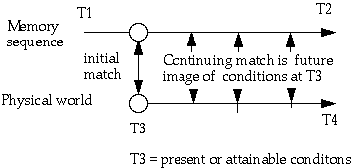
Figure 14.1-10 Future image in terms of memory
If:
a memory contains a sequence of images,
and
an image of the existing physical world, (or an attainable image of that physical world based on behavior), can be matched to a non-end member of that sequence.
Then:
a sequence of future images for that physical world, are the remaining images in the existing memory sequence.
If:
Figure 14.1-10 defines future image
Then:
future image depends on processes that insert sequences of images into memory,
and
the process model for which we search defines how image sequences are inserted into memory.
My goal then is further refined to create a process model of thinking and learning that describes how image sequence is inserted into memory.
To achieve this goal, I present three pathways (through the process model Figure 13.1 -10) that insert future images using:
1) transmission driven learning,
2) behavior driven learning, and
3) inference driven learning.
And I close the chapter by hypothesizing interactions among the three that explain how the mind became
Information,
mechanism,
pathway, and
pathway-sequence
Each italicized term needs a definition that contributes to an understanding of the Martian child’s learning problem. The temporal attributes of each term are developed below.
14.2.1. Information attributes
A temporal view of information, can be created by thinking of information as a fluid flowing through our physical and cognitive existences. This fluid view of information can be created by making distinctions among:
- Physical and abstract information
First think of two types of fluid. One with mass and one without. Consider the differences in their mobility. Then think of two types of information:
Physical information Ë is a part of moving mass or changing radiation. This information requires elapsed time to change. These delays conform to Newton’s laws of motion or in the case of radiation the speed of light.
Abstract information Ë is a symbolic representation of physical objects, radiation, or the meta physical. Symbols having little mass, and can change their states with lessor temporal constraints than the massed systems they represent.
Consider the difference between
Consider:
"pushing our moon so that it revolves around Mars"
With abstract information, the written symbols, representing the massed character of moon and other solar bodies, can be changed as easy as pushing a pencil across the page. While moving the physical moon would require creation of forces so large they would tear the earth apart and take millions of years to complete the transfer.
This difference, between physical and abstract information, has a profound effect on human temporal inference capacities. Some of these differences have emerged in the dynamic and behavior process models. Next we will discover that the differences become dominant factors in what can be learned and what remains un-learnable.
Information is transformed from physical to abstract as it passes the interface between the physical world and a mental perception of it. After the physiological sensors remove the mass constraints, the resulting abstract information can be manipulated without the time delays associated with movement in the physical world.
For example, if a ball is thrown the catcher does not wait until the ball is at the catching point to move his glove there. If he did, the ball would be gone because of the delay caused time required to move the glove there.
By converting the physical ball trajectory, (that exists and is sensible early in the ball’s flight) into an abstract ball trajectory, a simulation, can race the ball forward in time to determine the catch point. With this prediction the individual has plenty of time to plan and execute a glove move to that catch point, before the ball arrives.
In the "ball" case, it is easy to see the differences between physical and abstract information. It is easy to see understand how abstract information allows feed forward control and physical information does not.
In future sections I will show that the learning of temporal inference and our prevention of temporal blindness depends on our ability to understand this difference between physical and abstract information in temporal domains beyond the simple experiences of playing catch.
- Continuous and related information
In the physical world, information is continuous.
In thinking, information is discrete related conditions.
Our understanding of temporal inference lies in understanding the difference
A roller coaster traveling its course emits a continuous (and thus an infinite) stream of information. Given that any recording system is a finite entity, it’s record is finite and contains only part of the total emitted information For example, human physiology is a finite recorder because it has a finite number of neurons to sense and transform. Human memory has a finite number of neurons to store information.
For a human being to have an image of continuous motion from the finite bits, the bits must be related to the other bits. the relation allows a reconstruction of the infinite.
Related information can be brought to sharper focus using an example where the information, presented to a human being, about a dynamic and continuous world, is already a subset of the infinite set.
I have chosen this special subset because the mechanism used to convert the bits and their connecting relation into continuous motion is developed naturally in each human being. That is the mechanism is learned without schooling. The mechanism is either genetically hard wired or is learned subconsciously thought experience and remains in operation at a subconscious level.
Consider a movie camera’s record of the roller coaster. That record is 24 still pictures for each second. Two adjacent images, are different by the amount the roller coaster moved during the elapsed time between pictures.
When a human views these successive images at 24 frames per second, instead of seeing 24 little jumps, the roller coaster appears in continuous motion. The subconscious mechanism, creates through interpolation, information that lies between the two stored images. The resulting cognitively held image of the roller coaster is in continuous motion.
While each of us accepts this illusion of continuous motion we fail to realize how fragile it is. If the pictures are only a few hundredths of a second farther apart, for example, at 14 frames a second, the mechanism, we have all naturally built, will not work and our view of the roller coast will proceed forward in little jumps.
The illusion also breaks down if the roller coaster speeds up just a few miles per hour, or we are standing a little closer, then our mechanism will not produce a shape image of faster motion but a blur.
The creation and viewing of movies reveals just one example of how the mind converts finite information into understanding of the temporal aspects of our moving world. The human mind has many other cognitive and physiological mechanisms that do this. For example, another family of mechanisms, lets call them "imagination," creates motion even when all that exists for viewing are two still pictures. Consider that one picture is the roller coaster just to the right of a hill and a second picture in which the roller coaster is just to the left of that hill. Imagination can create detailed pictures of the roller coaster going over the hill. These pictures can be so detailed they show the little girl’s pigtail being thrown up as the coaster tops the hill.
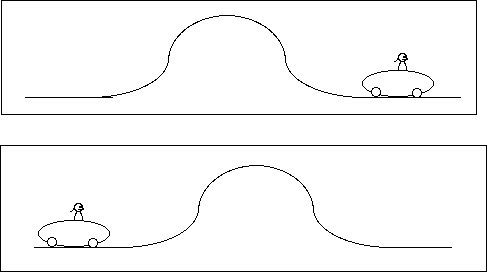
Figure 14.2 - 10 Two pictures of girl in roller coaster
However, all of these intermediate images are a cognitive construction. The mechanisms that created them are as limited as the mechanisms that make movies work.
Consider, that the two pictures could have been taken of a train traveling left to right with the little girl facing forward to motion or a train traveling right to left with the little girl facing backward.
A human cognitive process, a learned relation, converted the little girl’s seated position, that of facing forward, into an image of "left to right" motion.
Summary
If:
temporal information from the physical world is continuous information,
and
any concept we have of continuous information depends on the relationships among still conditions,
Then:
our temporal sight is defined by the relationships we can build.
Relations determine the quality of the:
Our model for "learning temporal sight," must describe the actual and potential ,
14.2.2. Mechanism attributes
A relation in memory connects two conditions. However, a relation can not exist without the existence of the two conditions. Nor can it exist without a process to connect the two conditions. Mechanisms can create, extract, and connect conditions. Mechanisms can identify or be the connector between the conditions. Mechanisms define learning, especially the special kind of learning required to facilitate the Martian child’s learning.
+ Inputs and outputs
Mechanisms can be viewed as machines that manipulate information as seen in Figure 14.2 – 35.

Figure 14.2 – 35 mechanisms process information
Information is the machine’s input and output. Since we have seen that information can be abstract or physical, we know that mechanism input and output can be abstract or physical. It follows that there are four possible combinations of input and output and thus four different types of mechanisms.
The experience, transmission and inference pathways use unique mixtures of the four types of mechanisms. Each mixture determines the range of future images and behaviors that can be produced.
- physical input/physical output (type 1)
Physical world systems are type 1 mechanisms because the information manipulated, responses as if it contains mass or obeys relativistic considerations.
- abstract input/abstract output (type 2)
Thinking is a type 2 mechanism when the input is, for example, memory and the output is also to memory. Type 2 mechanisms are not time constrained in the same why as the mass systems they represent.
- physical input/abstract output (type 3)
Human sensors are type three mechanisms. The inputs are sensible change of physical systems and thus are constrained by the mass associated with them. The outputs are abstractions.
- abstract input /physical output (type 4)
Human extremities of examples of type four mechanisms. For example, in taking an action an abstraction is converted into muscle actuation. Type 4 mechanisms are time constrained by their output but not their inputs. That is at the rate muscles can manipulate the next physical mechanism.
- Functions vs. extractions
Mechanisms have two forms.
1) "extraction" mechanisms, create relations by connecting two conditions that already exist.
2) "functional" mechanisms transform the first condition into the second condition and then creates the relation by connecting the two.
Each form has different temporal strengths and weaknesses and lead to different behaviors.
Extracting mechanisms take the form a or b:
a) sequentially sampling the physical world and then connecting a previous sample condition to a successor sample condition. or
b) extracting the first condition, the connector, and the second condition from spoken or written symbols.
Functional mechanisms take the form:
The predicted future condition and its relations to the present condition is created by using the "Given state" as input to the "given function;" for example, input (the number ten) being inserted into the mechanism which doubles the number to create the second condition - 20 lilies.
These three steps are summarized as:
1) I saw 10 lilies the first day and 20 lilies the second day, therefore I predict that if I see ten lilies I will see 20 the next day.
2) I was told that on the first day there was 10 lilies and on the second there were twenty, therefore I predict that if I see ten lilies I will see 20 the next day.
3) My mechanism is a double function. Therefore: I see "X" lilies today I will see "2X" lilies tomorrow.
There are many implications for learning in the differences between extracting and functional mechanisms.
If :
future image depends on the existence of a memory sequence,
and
a relation of two conditions, is a two image memory sequence
Then:
a functional mechanism can: operate on many different pieces of information and, create second conditions for each successive condition.
It follows that learning from an extracting mechanism produces a single relation and thus a single future image. Learning using a functional mechanism allows acquisition of a whole family of relations and potential future images. Memory sequences can be entered simply by passing a possible set of yet untried initial conditions into the mechanism.
Note, this extra robustness of functional mechanism is not without cost. It requires precursor learning. For example, before functional mechanism learning can begin, the learner must extract enough relations from the environment to complete the construction of the function. That is enough lily ponds must be measured enough times to make the generalization that lilies in a pond double every day.
- Interpolations vs. extensions
The most common use of a functional mechanism is interpolation between two conditions. The mechanism computes the missing conditions "in between" two known conditions.
A less common but no less important use of a functional mechanism is extension. Here the mechanism, extends beyond the domain of experience. That is given a condition or group of conditions, a condition that:
can be created.
For example, assume you are putting water in a barrel. At various times you measure both the weight and the number of gallons. These points are placed on a graph where gallons are the bottom axis and weight is the left side axis. A straight line can be drawn through these points. The function of the line can be created. For example 8 times the number of gallons equals the number of pounds of fluid in the barrel. From the function a non-experienced point can be created. That is existing conditions can be extended to non-experienced conditions.
Extension, sometimes called inference, is very important to the understanding of the Martian child’s learning problem. The form of extension most important has to do with time, and is called temporal extension or temporal inference. Let me give an example and then provide more detail to help the reader understand the capabilities of temporal inference and the limitations of other kinds of inference.
"Time" can be the variable the function used to transform the first condition into the second condition. To facilitate temporal extension, the function uses the temporal aspects contained within the first condition. For example, a picture of a train to the left of a tree (which is not in memory, can be calculated from a picture of the train to the right of a tree and "the laws of nature,"(when both are in memory). That is, part of what is in memory (about the train to the right of the tree) is the speed of the train. The functional mechanism can then combine the present picture, the train speed, and a time interval to create the second picture of the train to the left of the tree that does not yet exist in memory.
To generalize temporal extension (also known as temporal inference) is a capability of the mind to convert a condition of the mind into a non experienced condition of the mind using the laws of nature and elapsed time. The result is a succession of pictures along a time line or a movie.
This same extensional capacity can create the alternative scenarios that would result for a multitude of intervening behaviors.
- Conscious vs. subconscious
The mechanism that extends existing conditions can be subconscious or conscious. For example, the mechanism helps us compute continuous motion from sequential still pictures operated subconsciously. The power of this mechanism is awesome. What the human physiology does computationally puts fast modern computers to shame.
However, as the time interval, between any two conditions, increases, the jumps in object position within a field of view get bigger, the subconscious mechanism fails. A more conscious and less physiological mechanism must do the calculations.
For example, we know that for a mass to move from one point to another it has to pass through all the points on a line connecting the two known positions.
When shown two pictures separated by 3 seconds of a roller coaster train, the first picture with a hill before the train and the second with the hill after the train, a conscious mechanism interpolates several images of the train going over the hill even thought no picture of the train on the hill exists. Depending on the level of development of these conscious mechanisms, we may see the pony tail of the little girl fly up as she crests the top of the hill.
In a second example, consider that when seeing the lawn at different lengths, the physiology would not create an image of continuous motion of grass growing. consider that most of us even consciously do not create a vision of continuous grass growing. This vision would result from a vision of conscious computation (reflection) most of us do not have.
- Fantasy vs. the laws of nature
To the great misfortune of the human being, the mind does not exclude relations that are formed by fanciful mechanisms. That is mechanisms that do not align with the laws of nature. In some relations in memory, energy, mass, and time do not play the roles they normally play in the physical world. Without the constrains of natural law, the mind can connect (relate) any two conditions. Without these constraints, the human mind can relate any future condition to any present condition. For example, the human mind can learn, use, and transmit the belief that the universe was made in six days.
Such fantastic beliefs, justify any behavior, no matter what its bad expected future outcome, because there is an entity that can undo any resulting conditions in six days.
- Logical versus causal mechanisms
In Section 13.5, I described the difference between logical and causal inference. This distinction also exists in learning. Logical extensions do not predict new conditions that have never previously existed. Logical extensions create only new relations constructed from existing memory images.
For example, let me represent a syllogism that performs a logical extension, creates a new relation, but not a new condition.
If:
all men are mortal, and
Socrates is a man,
Then:
Socrates is mortal.
A logical mechanism creates a new relationship, however, men, mortal, and Socrates were defined conditions before the extension was performed.
Where as a functional mechanism that performs causal extension creates a new condition.
If:
a car burns 2 gallons an hour,
and
it has a ten-gallon tank.
Then:
the tank will be empty in five hours.
and,
All systems that depend on the engine running will cease.
The condition, "car out of gas," is a new condition that has never previously existed, in the memory of the individual performing the extension.
The Martian child’s learning problem is temporal. It can not be address by relations that are not temporal, like "The hat is black." which has two connected objects but no temporal aspects.
Relations and conditions resulting from functional mechanisms have two additional properties that logical relations do not have. The image sequence produced by a functional mechanism has,
These temporal aspects are central to the Martian child's learning problem because that problem is not solved by a single mechanism. It is not solved even by a group of linked mechanisms (pathways.) The Martian child’s problem is solved by no less than a group of linked pathways.
14.2.3. Pathway attributes
Pathways have been defined as processes that create condition, relation or scenario. The three products are not the same nor are the pathways that create them the same. The Martian child’s learning problem requires a special subset which are quite different than pathways with which we are more familiar. In this section I describe pathway attributes which help us focus on the difference. These include the difference between pathways that create active and passive relations. And pathways that produce conscious and subconscious predictions.
- active vs. passive pathways
Pathways create relations that are stored in memory. Examples include:
All are relations. All share this common information structure, two conditions joined by a connective. However, the connective can be a passive or active verb. For example,
-- Passive relations
When I try to verbalize the passive forms, I say they are conditions connected by terms like, equals, inclusion, exclusion, greater than, less than, etc. An example of equality is, "The hat is black." An example of inclusion is "All hats are black." The relation is passive because the hat does not change the meaning of black and being black does not change the hat. The relation is logical not causal.
-- Active relations
In verbalization of active forms I say that conditions are related by a function such as, proportional, non-linear, inverse, etc. "A running engine empties the gas tank" is an example of a proportional relationship. Running the engine causes the tank to empty. "Putting paper in a waste-basket, leaves less room for more paper" is an example of an inverse relationship. The relation is active because the act of having the first condition change, causes the second condition to change. Active relations are casual not logical.
Passive relations can make predictions, ala Socrates is mortal, however there is no temporal component to this prediction. Socrates, was, is, and will be mortal with time playing no role in the truth. Active relations, have a temporal component. That is the condition has duration, interval, and attachment to a time line. So let me now focus on pathways that make predictions in the time domain.
+ subconscious vs. conscious pathways
Pathways that make predictions in time are made from strings of mechanisms.
condition > mechanism > condition > mechanism > condition...
Two kinds of pathways make predictions.
1) subconscious pathway
2) conscious pathway
Ë to create a seat belt wearing behavior, the abstract information is passed to mechanisms that consciously create behavior.Each type of pathway has its place in helping choose behaviors. However, each has it limitations and each can produce behaviors that beget tragedies. Let me give an example of each.
Example of a problem best resolved by a subconscious pathway
Example of a problem best resolved by conscious pathway
Ë Learning to recover from car skids (most often solved subconsciously) is better solved consciously.-- Subconscious processing
Learning to ride a bicycle is a task that is easily accomplished by 6-year-old children. That most children succeed so easily belies the problem’s complexity or computational intensity.
To learn to ride a bike requires:
The eye, ear, and other sensors, subconsciously connected together, facilitate all four tasks. Learning naturally proceeds thought trial and error. That is, if the errors during learning have no serious consequences that prevent further learning. For example, falling down does not break a leg.
Consider how inappropriate it would be to learn to ride a bike using conscious mechanisms. Most people do not know enough Newtonian physics to:
Even if they knew enough Newtonian physics to accomplish these four tasks, most people could not consciously perform the required computations fast enough to produce the stream of behaviors required to balance the bike. Until recently even the fastest computer could not do that.
To give one an idea of the powerfulness of the physiological subconscious process, remember that the child is designing, writing, and debugging the program at the same time he or she is performing the intensive computations to create behavior. A task that strains even the most powerful neural net – a process by which a computer learns from experience .
Why is something that is so hard to learn consciously so easy to learn subconsciously. Human physiological processes subconsciously,
This rather phenomenal feat should not be a surprise to any one. Bicycles were designed to match their human rider’s capabilities, just as are our snow skis, diving boards, and automobiles.
However, all physical systems which humans are expected to control and learn to control are not so closely matched to our physiological mechanisms. For example, we can not hear the crack of a gun and then use that information to step aside of a flying bullet.
-- Conscious processing
The overlap between the properties of the system and the physiological capacities of the human being, for some systems is only partial. The operating domain of skidding cars is so large that some parts of the domain can be learned physiologically while others must be learned through conscious process. For example, it’s easy to learn to control car skids at 25 MPH on icy roads. An afternoon of trial an error fun in an icy parking lot results in the required learning. Learning to control skids at 50 MPH on dry pavement using trial and learning requires a very large parking lot and a willingness to destroy several sets of tires.
The 50 MPH skid learning is never accomplished because most of us don’t have such a parking lot. Nor do we have a willingness to shred our good tires. Even if we did, what we would learn, would suffice for only a few MPH on each side of 50 MPH. It would suffice for only very similar vehicles and on very similar road surfaces to that on which, we completed the training. Learning to accommodate the full range of car skids, to which we expose ourselves is almost never learned.
Many drivers think they can handle 50 MPH skids by scaling up what they have learned in the icy parking lot. However, this is a figment of their imaginations. Their learned, behaviors in a 50-MPH skid, are just as likely to make the skid worse. Suffice it to say that learning to control car skids, using only trial and error supported by human physiology, in the full range of our exposure is a remote possibility.
The alternative, learning skid recovery consciously, is an equally remote possibility. The tasks previously described and completed by human physiology for icy roads must be performed and directed consciously
Ë variable identification, model building, and computation, must be consciously performed and consciously directed.This turns the entire learning process on its ear. None of us learn this way. Since our temporal blindness never uncovered the liability of being exposed to a 50-MPH skid, or our inability to recover from it, does not motivate us to implement any other solution.
Cognitive models do create motivation if they exist and if they are exercised. However, they exist only if the most fundamental and basic cognitive inference processes exist and we are motivated to use them. The cognitive model of skidding, its components, their discovery and integration processes, and the underpinning cognitive processes and their learning processes, reflect an iterative process that loops back on itself.
attributes of abstract and physical information determine the attributes of the mechanisms. Which determine the attributes of pathways, however, the products of pathways determine the content and process of information and mechanism.
For example, physiological mechanisms do not actively pass information or its structure to the conscious cognitive level. The conscious level must poll the physiological level for both. The cognitive level, besides actively collecting the base state of variable information, it must also be polling for relationships. And it must be in a continuous process of building a model (for example the car skidding problem) to promote this polling.
This complex and recursive view of learning has always been found to be too exhausting to include in any curriculum. However, the product of such an effort has not been understood either. Consider that after the model is built, the car skidding control problem can be solved cognitively. A control strategy can be designed that has a vastly reduced data set and a vastly a reduced computational intensity. Consider that with this strategy, using only a few parameters already discussed in Chapter 3, and some very minimal trial and error practice, cognition produces a robust set of behaviors that can be easily be applied real time to a wide range of skids.
Summary
The conscious and the subconscious learning processes use different strings of mechanisms. Conscious learning processes creates a model, predictions, and behavior, while the subconscious learning processes create only behavior.
The two pathways of mechanisms handle different parts of the domain of car skidding. The conscious pathway of mechanisms handle skids beyond those a previously experienced in the car. The subconscious pathway of mechanisms handle only those that are close to those which have been experienced. Conscious strings of mechanisms can in addition create correct behavior for control in domains such as boats, airplanes and motorcycles.
In a conscious pathway of mechanisms, behavior is not a reflex arc. Polling the environment for elements to build models is the first effort. Model building is the second, exercising the model for predictions is third, generalization of the relations between condition and behavior is forth and defining control interactions is fifth.
Constructing the model and having the model poll the external environment are two required activities to facilitate temporal inference. They are not even a part of the subconscious learning process. The range of learning processes used to arrive at behaviors to steer a car through skids when the conversion of physical information remains at the subconscious level is severely limited to the cases of direct experience. Conscious cognitive manipulations, extend information to a range of circumstances outside those of the direct experience, if the direct senses are converted to mechanisms as well as state data.
Further more, with subconscious learning the driver remains unaware of the limitations of what he has learned. This does not happen if the transformation of information from the physical to the abstract happens at a conscious or structural level. The structural abstractions can be manipulated by cognitive mechanisms (if they exist) and this learning is robust enough to solve situations not directly experienced.
It follows that physical and abstract information, each capable of being transformed into the other and each being subject to the different temporal constraints of mechanisms in their respective physical or abstract domains can produce vastly different:
- graph notation attributes
After a pathway has been made explicit in the form of a graph of mechanisms and information flows, the graph’s structure becomes a meta-tool to make predictions. That is, by removing or adding flow pathways, by changing the type of information flowing, and changing the processors, we can see predictions that we have not seen before. The structural manipulations enhance learning capabilities. The activities reduce limitations in thinking that might be caused by too narrow a focus. We can also posit curriculum that would enhance the use of these activities and thus advance the development of human thinking.
Graphs provide mechanistic help by creating and using the following realizations:
14.2.4. Pathway-sequence attributes
A pathway with successive inputs conditions creates a sequence of conditions.
The output of such a pathway can be the input to a pathway. The resulting memory sequence can be the output of a sequence of pathways.
The flow of information among pathways may adopt several configurations. Three, shown in Figure 14.2-50, are important in the conversion of stopping experiences into seat belt wearing.

Figure 14.2 - 51 Sequence Pathway connections

Figure 14.2 - 52 Parallel Pathway connections

Figure 14.2 - 53 Loop Pathway connections
The solving of the Martian child’s learning problem requires two distinctly different sequences of pathways.
1) looping sequence: Ë where a single pathway and uses the outputs of the first pass as inputs to the second.
2) serial sequence: Ë where the information chains through a series of pathways.
Consider a single inference pathway takes two stopping experiences and extends them to conditions which has not been experienced in the physical world. For example, in the Martian child’s case the first pass through such a pathway, produces and image of accidents. In the second pass the same extension pathway, accident abstractions are extended to occupant injury - again an abstraction. Several more passes extend injuries to injury attenuation and a final pass extends injury attenuation to a prevention behavior, "seat belt wearing."
Consider two different pathways where the second pathway runs only after the first is completed (or after some other synergistic interaction.)
To cause the Martian child to run an inference pathway that extends information to discover an accident, some other pathway must create the motivation to run that pathways without the accident as motivation. That is the motivation pathway must take the original input information (e.g. stopping distances) and without the conclusion of the first pathway, (accidents) and create motivation to implement the pathway that discovered the accidents.
This bears repeating twice more.
1) A parallel pathway Ë coverts information (an experience or an abstraction) into motivation to search the environment for conditions related to, not directly presented by, that information.
2) A parallel pathway Ë must create curiosity. In this case a special curiosity about the unknown yet possible futures. It is the product of a motivational pathway that drives the inference pathway to interpolate or extend the original input information.
As part of our search to understand thinking and learning in the temporal domain, we must define the mechanisms that make up the pathway that covert two experiences of stopping the car from 30 MPH into "motivation to identify" the stopping distances that are possible but have not been experienced in the world or transmitted by teachers.
The uniqueness of this motivational pathway points to the uniqueness of its mechanisms. Some of this temporal uniqueness is revealed by the fact that the search mechanism is domain rather than case driven. That is, the condition created by the mechanism is created new though computation rather than extracted from memory. The condition is based on a temporal manipulation of an abstraction rather than:
a) a search of all experiential sequences,
or
b) analogic transformations of these experiences.
Let me give an example of this last case. Lets assume that within memory there was an experience of a car running into a tree. An analogical transformation mechanism, cause the driver to look for objects that could act like a tree.
That would imply the mechanisms in the pathway searches for obstructions in the field of view that could be run into, and then makes analogical computations as to their similarity to a tree.
By contrast the mechanism in the pathway, which I envision, instead identifies that the two experiences (30 ft and 300 ft) are members of a bounded domain of stopping distances. The domain extends from infinity to zero feet. A complementary domain in stopping times ranges from infinity to zero seconds. Exercise of this pathway illuminates the fact that, longer stopping distances (durations) have lower forces related to them and shorter distances (durations) have higher forces related to them.
Summary
Thinking and learning is a complex web of pathways. The web resolves a huge number of very complex problems which explains our survival. The most fundamental of these pathways, and the mechanisms that comprise them, are called our common sense.
While these pathways do assist in choosing behavior by creating both image sequence and motivation, they are ineffective in getting an individual to wear a seat belt based on stopping experiences. The pathway sequences that create inference (specifically temporal inference) are not part of the common sense of the average Joe.
Even physics professors who have all of the laws of motion at their finger tips and thus whose common sense includes the mechanisms that allow the implementation of the inference pathway, still lack the common sense to drive the parallel motivation pathway. Not motivated to look for dangerous situations in their temporal environment leaves them uninterested in bringing their vast intellectual capabilities into play while they are driving their cars.
In Chapter 13 I described a behavior selection environment based on the comparison of conditions. Each condition was created by competing acquisition processes. The acquisition processes created images, which were parts of each condition.
Three of the six outlined acquisition processes, labeled "behavior driven," "transmission driven," and "inference driven," inserted image sequence into memory. The image sequence facilitated the formulation of future image. And in some cases the image sequence facilitated feedforward control. Our task in this section is to use the definitions of information and relation to convert these three image acquisition processes into process models. The process models in turn make explicit three pathways which describe how we learn.
14.3.1. Mechanics of a learning pathway
A relation connects two conditions. Each condition must be acquired. Each condition must have a source. The possible sources can be divided into two groups:
1) sources external to the human body and
2) sources internal to the human body.
For a source of a condition to be classed as "external" means:
as the physical world expresses the condition (as the mechanisms external to the human body produce output) the physiology senses and absorbs it.
For a source to be classed as "internal" means
the human body constructed the condition from state and causal information already inside the body. (The resulting constructed condition never existed in the physical world or if it existed was never sensed or if sensed was never absorbed into memory.)
Given:
Then:
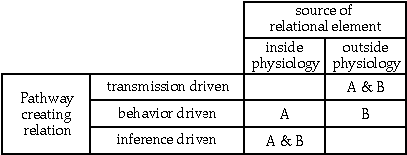
Figure 14.3 - 05 origins of a relations elements
The three combinations of sources are shown, Figure 14.3 - 05. They form the basis of three learning pathways, and align with the three acquisition processes in Figure 13.2 – 10 that produce image sequence.
External sources for A and B Ë transmission driven learning
If:
"A" and "B" are already connected together in the external world,
and
the external world emits: a series of symbols for example, A-connective-B,
or
a serial conditions for example, condition A time interval condition B
and
these emissions can cross the skin barrier separating external and internal,
and
the mind can: in the case of symbols recognize and give meaning to each symbol separately and give meaning to the connected parts,
or
in the case of non symbolic information can distinguish differences in two successive conditions
Then:
we have a means for acquiring a relationship using an external source for "A" and external source for "B. "
This combination of sources defines the ‘transmission driven" learning pathway.
Internal source for A, external source for B Ë behavior driven learning
If:
An individual has in memory the image sequence of existing external conditions reflecting no new behavior,
and
the "A" behavior originates internally, for example, the "A" is "a conjured up behavior, "
and
the "A" can be stored in memory,
and
the physiology can implement "A" (make the "A" cross the skin boundary),
and
the "A" can cause a change in the progression of world conditions,
and
human senses can recognize a stream of information from the external world recognize it as an image sequence, that is can time stamp the events.
and
the human mind can extract from the original and new image or successive images in the sequences a difference "B"
and
realize the difference depends on "A"
Then:
We have a means for acquiring a relation using an internal source for "A" and external source for "B."
This combination of sources defines the behavior driven learning pathway.
Internal sources for A and B Ë inference driven learning
If:
behavior "A" is conjured up within the physiology,
and
the means and motivation exist within the physiology to create a simulation of the external world,
and
instead of acting on the external world, the "A" is inserted into that mental simulation of the external world,
and
the simulation produces a sequence of conditions for both "A" and not "A"
and
the human mind can extract a difference "B" from the two sequences.
and
"B" can be connected to "A,"
Then:
we have a means for acquiring a relation using an internal source for "A" and internal source for "B. "
This combination of sources define the inference driven learning pathway.
In summary the combinations describe three ways we learn relations, and in so doing form the foundation we need in understanding the Martian child’s learning problem. Next, each description will be expanded to include its temporal aspects.
14.3.2. Transmission driven learning pathway
Information can be physical or abstract. The use of one or the other creates two forms of the transmission driven learning pathway:
1) physical transmission Ë where the information is directly express by objects in the physical world and
2) cultural transmission Ë where the information is a property of symbols representing these physical objects.
+ Physical transmission
Physical transmission is observation of physical systems. It results from an extremely complex mesh of mechanisms and information flows. The temporal aspects, for which we search, are embedded in them. As a means to discover these temporal strengths and weaknesses, I create a process model that aggregates many mechanisms and flows into just the few elements shown Figure 14.3 -10.
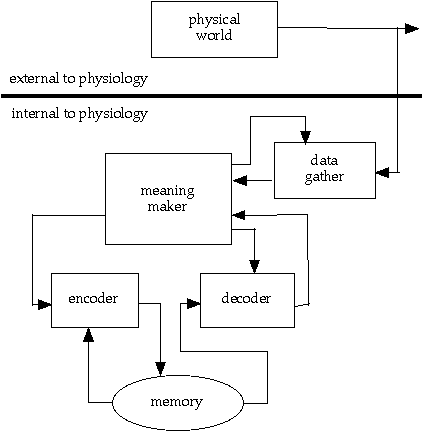
Figure 14.3 –10 Physical transmission learning sequence
The abbreviated model describes, a learning pathway, a series of mechanisms that loads sequential conditions of the external world into memory. The discussion focuses specifically on how each mechanism:
- Loading external world conditions in to memory
Assume the world’s emission is a red light in a dark space. It is on 5 seconds and off 20 seconds.
The box at the top of Figure 14.3-10 represents the physical world external to the human body. The box represents billions of interconnected Type 1 mechanisms. The output of some of these mechanisms, is sensible by humans; for example, the above red light.
From the box representing the external world is an arrow that implies that the red light information is emitted. The signal is available to many mechanisms. One of these mechanisms is a box labeled "data gatherer. " A data gather is a mechanism that accepts the red light’s physical information as input and converts it to a mental abstraction as its output. (The data gather mechanism is Type 3 because it has physical inputs and abstract outputs.) The human eye captures the red light as part of its field of view and converts the sensations to a mental representation.
The information from the data gather mechanism is emitted and flows to a mechanism, labeled "meaning maker. " It accepts the abstraction from the eye and provides a reference for its meaning. For example, it places the red light in a location in the individual’s mental model - field of view. (Because it takes an abstraction as input and produces an abstraction as output it is a Type 2 mechanism.)
Information emitted from the meaning maker mechanism is received by a mechanism labeled "encoder. " This mechanism facilitates storage of the light’s color and location in an already existing mental map of the physical world.
The encoder mechanism also builds an index to possible meanings for the red light’s location. These meanings have been stored previously in memory. For example,
Thus drivers, ship captains and airplane pilots each have one or more index connections to a red light’s position in the physical world.
The model hypothesizes that four mechanisms load a single location of a red light into memory. However, the mechanism sequence is limited to storing the existence of the light at a location in the field of view. For the mind to realize that:
requires that additional mechanisms must exist. Additional information flows must have already transpired.
For example, the eye must continue to gather information from the space were the light was seen. Each eye sample must be attached to a different time of day. Calculation on these times must provide a history of "on" and "off" durations. The history must be converted into a repeating code. And the code must be related to map information about a location in the physical world.
Next I will describe some of these mechanisms. Remember that our global task is to understand how these mechanisms (and their creation) facilitate or inhibit our temporal sight.
- Attaching conditions to a time line
To attach the conditions, in this case eye samples, to a time line requires a clock mechanism. Clock mechanisms can be thought of as the company time clocks that stamped the arrival and departure times on a worker’s time card and allowed a clerk to calculate pay.
The concept of time stamping brings into focus several temporal aspects of information in memory.
These temporal aspects determine what meaning can be derived from the time stamped information.
Consider the identification of durations in the channel light’s "on/off" pattern. Remember that it is blinking "on" for five seconds and "off" for 20 seconds. What would appear in successive samples of the field of view if the samples were one second long and 25 seconds apart. The light could appear "off" in all samples or "on" in all samples, or on and off each for fractions of one second, depending on when the sample was initiated.
Good thing the eye does not sample only once every 25 seconds. The brain tells it to watch possibly for minutes. Actually the field would have to be continuously sampled for at least the duration of several intervals of the "on/off" sequence, E.G. more than 75 seconds would be required to guarantee inclusion of two successive repetitions of the 25 second code.
Consider that the durations of on and off could be measured to the nearest second, only if the eye sampled enough times a second that after rounding the measurements to the nearest second they would round to, for example, five and not four seconds. (four seconds on and 21 seconds off could be assigned to another light on the map.)
There is some other time stamping going on in the process of locating and giving meaning to the channel light.
To establish the color of the light, the physiology must be able to distinguish between a red light and all the other color lights in the field of view. Light is like sound. It travels in waves. And like sound where if the waves are closer together the pitch is higher, when light waves are closer together the color is less red and more blue. Thus, to determine the color of light something in the physiology must time stamp the light waves as they come into the physiology through the data gathers. Then the time stamps must be subtracted to get the duration between two light waves and then depending on the duration determine color.
This is a super clock. Blue light waves are coming in at about a 1000 trillion waves per second and red light is coming in at 500 trillion waves per second. The clock must time stamp some very small durations.
Physiological clocks must also measure longer durations and cycles. They must measure seasons that have months duration and cycle times of a year. They measure ice ages that are thousands of years in duration and tens of thousands of years separated. They must measure geologic events with durations of millions of years and galactic evens that take billions of years.
If we had only one clock mechanism, we would be measuring events that are millions of years apart in trillionths of seconds. This would require storing more that 20 digits for each time stamp; half of which would be to the right of the decimal point.
The complexity of such storage would boggle even the fastest computers.
In the space domain it would be like using a mechanism that measures in angstroms (the size of an atom) to measure the distance to the nearest star. We have found that it is better to use many rulers. For example, we use light years (the distance that light travels in a year - 6 trillion miles) to measure distances to stars. Alpha Centauri is 4.5 light years from earth. We use inches to measure the height of people. And we use angstroms to measure visible light wavelengths. Blue light has a wavelength of 4000 angstroms and red light has a wavelength of 7000 angstroms.
Similarly, humans don’t use just one clock for all 22 orders of magnitude of time stamping. Human physiology is infused with a multitude of clock mechanisms. The samples from eyes, ears, and skin are time stamped using different clocks. Another batch of clocks, sometimes external to the human physiology tell us when to go home from work, when to take a vacation, and when to retire. In other words the clocks are distributed among the mechanisms represented by the boxes in Figure 14.3 -10.
+ Computing durations
Time stamped memories can inform the learner that the light is not "on" or "off" continuously. However to get the durations of the "off" or "on" period requires a computation. There must be mechanisms that subtract time stamps to get durations. They too are distributed through out Figure 14.3 - 10.
For this discussion we will focus on two mechanisms that do computation on samples from the physical world.
- Brain computation mechanisms
In the example of on/off red channel light, the eye samples are shipped to the brain. Samples of an external clock, for example, a wristwatch are also transmitted to the brain. The two are combined to create time stamped eye samples which can be subtracted to obtain duration of the "on" or "off’ periods.
- Peripheral nervous system computation mechanisms
This procedure becomes cumbersome when computing durations which determine the color of light or the pitch of a tone. In the case of pitch, both clock and computational mechanisms are embedded in the sensory (data gathering) mechanism. For example, the pitch of a sound is not created by the ear’s sampling system sending pre-time stamped sound pressure measurements to the brain to be computed. The computation that determines the time interval between waves is also done at the ear. All that is sent to the brain is the final computed pitch.
Human physiology has evolved to contain many integrations of the sensor, clock and computer. The eye takes this specialization one more level. The eye’s ability to see difference colors is facilitated by different groups of neurons in the retina of the eye. Some neurons are capable of sensing only light waves that are red. That means that if the light waves are 7000 angstroms apart the neuron sense sequential waves, time stamp them and calculate duration. Blue light, which is 4000 angstroms between wavelengths, is sensed, time stamped and duration computed by other neurons.
- Summary
There are some generalizations that help us understand the various human clock and computational mechanisms.
As the time interval between two events increases the:
Where one or both events in time happen before the individual’s life the records have to be stored external to the physiology.
In summary, multiple clock and computation mechanisms facilitate learning. It is sometimes easy to see how our learning might be distorted if any of these mechanisms only partially or inappropriately developed.
(The mechanisms discussed have been limited to those used in giving transpired events temporal status. I have left the most important clock mechanisms for a later discussion. These special clocks facilitate a temporal domain for images that have not been experienced or transmitted. These clocks will be addressed in the section on inference learning pathways. However, before we can address them we have to complete the explication of the mechanisms used in the cultural transmission and behavior driven learning pathways.)
- Directing sensors
There are some additional pathways (sequences of mechanisms) within Figure 14.3 -10 which are affected by temporal aspects. For example, while leaving the pathway for "how the information gets into memory" to a later section, consider the affect on thinking induced by the ship’s movement bringing the shoreline into the field of view. The data gather, presents the shoreline to the meaning maker, which passes it to both the encoder and the decoder. The decoder, scans memory, for data connected to "ship’s approach to land." It finds a reference to the ship channel light’s color and code. This is passed to the meaning maker, which directs the data gatherer (eye) to scan for a red light with that code. Which means that the meaning maker must have as part of its mechanism a clock that directs the eye to remain fixed on each field long enough to discriminated a repeating 5 sec "on," 20 second "off" code. It is a pathway of mechanisms within the meaning maker that realizes that these fixation periods must have a minimum duration of 75 seconds.
The eye (the data gather) in its second instantiation in this learning pathway is not a passive element. It is directed and thus becomes an active element in learning. Learning is completed when the light is found and the location of the light becomes a reference by which to steer the ship.
This pathway, beginning with sensing the shoreline and ending with the learning of the location of the navigational aid outlines a chain of mechanisms which learns but does not change the external world to do it.
+ Cultural transmission
Cultural transmission
Ë is observation of physical systems. It is much like physical transmission in that, information flows through mechanisms connected in pathways. The net result is stored related images that can be used to direct behavior. The relations include the same forms, A follows B, A equals B, or A causes B. Even the figure for cultural transmission Figure 14.2-20 is identical to the physical transmission Figure 14.2-10. The difference is that when the cultural transmission "data gather" in Figure 14.2-20, senses the physical world’s output, it is looking for items in the information stream that match tokens that previously have been stored in memory.The concepts of tokens in the learning process has been heavily researched. I can not do justice to this body of knowledge in this text. However in the next section I will focus on the advantages and disadvantages of the use of tokens in learning when the objects of interest have temporal aspects.
- Temporal content of token emitted information
Tokens, in the physical world emission stream, are presented as visual or audio objects. If these observed objects match pre-learned tokens in memory, then the meaning of the stream objects can be linked to the meaning attached to tokens in memory.
Tokens in memory can be nouns or verbs. Which means while the tokens themselves are static during any sample, they can be made to represent motion. Depending on the motions in the natural world , a great efficiency may achieved by the use of tokens.
For example, the infinite emissions of a physical body moving through space can be reduced to a short string of noun and verb tokens.
The noun verb string not only reduces the infinite emissions to the finite string, it also has a capacity to transmit to the consciousness motions which the physical transmission data sensors can not. For example, when motions of the physical world are too fast or too slow for the human sensor, linked tokens (symbol strings) can culturally transmit the meaning of these motions.
Consider
There are many cases where cultural transmission can do things that physical transmission can not. For example, when the images in memory are nouns and verbs, they extend much more easily than if they are sequence of images with no causal relation.
However, the use of any tokens is dependent on you giving it meaning. That is you either adopt the meanings that other people to gave them, or you make meaning for them yourself.
Now we can consider the question, If tokens are useful when they leave out some of the details of the infinite expression of a moving physical object, how do you know that the parts of the expression that you have left out are important.
If tokens do not include properties of the physical object that are important to understanding and behavior, behavior reflects a partial set of properties.
Thus while the cultural transmission pathway overcomes the limitations of infinite emissions from a moving physical body it also introduces a whole class of failures when tokens are accepted as complete descriptions. It should come as no surprise to the reader that temporally blind teachers have been making and transmitting temporally defective tokens. Since these tokens play a major role in directing the focus of the "data gather," that the student is temporally blind at the token level of learning as well as at physical or non-token level.
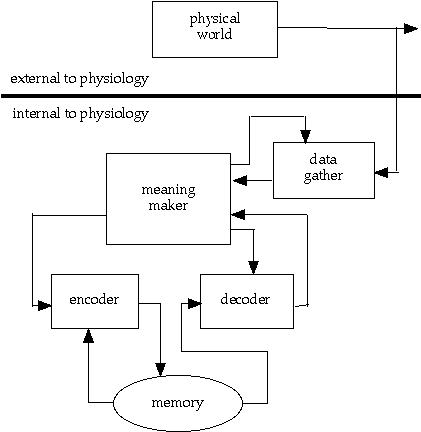
Figure 14.3 - 20 The cultural transmission learning sequence
The undermining of temporal learning that results from the use of tokens and the acceptance of token limitation is quite natural. It can be explained using several examples. Consider the bandwidth for token transfer (at least for humans) is much smaller than the bandwidth for human physiological sensation. Consider that you have a digital recording of a Brahm’s sonata. Your player, because of format incompatibilities, can not play the disc. So you print out the 1’s and 0"s and begin reading them understand in your brain without using your ears the music. While the 1’s and zero’s do contain enough information for a machine to create a fairly good reproduction of the sonata, the learning or processing path is almost impossible for a human being. Thus the token information even if correct is not always useful.
However the ones and zeros are not without value. If you wanted to know how many eight notes were in the Brahm’s piece above, it would be pretty hard to listen to the piece and count them as they are played. There are hundreds and they are very close together. However, once one learned to recognize a token (a combination of 1’s and 0’s) searching for these strings and counting them is not beyond the human ability.
Let me summarize the implications of these considerations.
Step 1: "A" is defined
Step 2: "B" is defined
Step 3: "Connective" is defined.
Step 4: the physical world produces the readable or audible string "A connective B"
Step 5: The meaning maker divides the string into three independent token
Step 6: Each token is converted into an image of a physical world condition,
Step 7: The meaning maker operates on the string of physical world conditions to obtain the meaning of the new token relationship.
Step 8: The result relation is encoded and stored in memory.
14.3.3. Behavior driven learning pathway
The transmission learning pathways which, we have reviewed did not require the learner to change the external world to complete the learning. Next, we review learning pathways that do. I have call these pathways "behavior driven learning" More common names include "trial and error learning" or "perturbation response learning."
We have already discovered that behavior driven learning is both very powerful in its success in providing image sequence and also very weak.
An example that demonstrated the very best of behavior driven learning powers is that of learning to ride a bicycle. An example that demonstrated a weak part is that of learning the rudiments of regaining control of a skidding car. The differences between these two learning environments are the temporal aspects of the physical system and their relationships to the temporal aspects of human physiology.
Part of the ease of successfully accomplishing the learning to ride a bike was explained by highly developed physiological and cognitive equipment that operated subconsciously in the bike’s "temporal" operating range. Much of this physiological and cognitive equipment developed through interaction with the existing pre-bike natural environment. No conscious effort was required on the part of parents, teachers, or peers to create a special environment to develop it.
The failure of human beings in using the behavior driven learning pathway to master car skid control, a just slightly different control problem from learning to ride a bicycle, demonstrates the narrow temporal range of this specialized physiological and cognitive equipment. It also implies that the natural environment in which we all developed those learning capabilities is not a robust teacher. The natural environment produces capabilities, which facilitate correct behaviors for only a small portion of the temporal domain in which we live.
This is the starting place for our investigation of a temporal view of behavior driven learning. By using the definitions of information, mechanism, and pathway, I can now describe temporal aspects of behavior driven learning. These in turn will explain why experiential learning has become:
Figure 14.3 - 40, a process model of behavior driven learning, like its predecessors, is a gross simplification of an extensive body of knowledge. The pictured simplification is designed to help the reader focus on its temporal parameters.
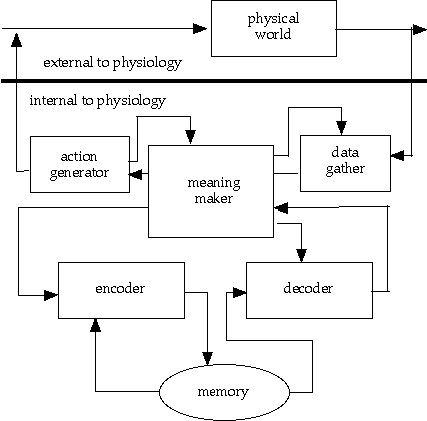
Figure 14.3 - 40 Behavior driven learning pathway
Beginning with the output of the action generator I will trace a flow of information through the mechanisms.
Thus, behavior driven learning is accomplished using a loop of mechanisms. Information passing through the loop connects an initial condition, a behavior, and a final condition. Each cycle around the loop leaves a relation in memory. The relation is a basis for future image in that the learner now expects:
If:
in the future the same circumstances exist,
and
the same behavior is taken,
Then:
the same change will result.
Multiple passes through the loop produce a family of relations.
Initiation of the loop could be initiated by any input to any mechanism in the loop. Thus, behavior driven learning can be started by the external world’s changes, a random action on the part of the individual, or as will become increasingly clear if we want to understand the Martian Child’s learning problem, inference produced input.
We have already seen that behavior driven learning is exceptionally strong for learning some relations like those needed to learn to ride a bike and equally weak in learning others like recovery from dry pavement skids.
In some domains behavior driven learning is strong at directing itself to discover what needs to be learned. In some domains it allows blindness to ensure blindness. The temporal aspects of both the information and the mechanisms, which manipulated them, account for some of these strengths and weaknesses. Next I will use examples to show the roles that temporal aspects of information and mechanism play in creating these strengths and weaknesses in learning.
- Captain's learning problem
The following example of a captain learning to steer a ship makes explicit how these temporal aspects facilitate or limit what the captain can learn.
Assume that a captain sees the red channel light off to the left of the present course. He wants to point the ship toward the light. This change in course will require turning the ship’s wheel. First to get the ship’s bow rotating toward the new heading and second to stop that rotation at the new heading.
The relations the captain must learn are, "what is the correct amount of steering wheel turn, and what is the correct duration for this left rudder to be held to start the ship rotating. And then what turns and durations will stop this ship’s rotation at the correct heading Too little or too much turn, too long or too short the duration and the ship’s new heading will not be the one desired.
We all have had the experiences of "over or under steering" when we learned to drive a car. Yet, we all mastered "steering the car" so quickly we can hardly remember that our first turns of the steering wheel were not correct. The reason for using a ship for the example is that few readers have driven a large ship in the relatively tight constraints of harbors. The novelty, may slow the reader down and let his or her full attention attend to a discussion that makes explicit what happen implicitly while learning to drive the car. Once explicit it will be easier to see the role that temporal aspects play in behavior driven learning.
Behavior driven learning is completed by a pass through the loop. Normally the first wheel turns will not be correct. The ship will rotate too far or not far enough to attain the proper heading. However, the history of "wheel turns" and the " change in ship heading" form a relation in memory that can be used in the future to correct "a difference in heading," (even though its is not "the difference in heading" for which it was designed and tried.) Also the relation, with some modification can be used to suggest behaviors that could have solved the initial difference correctly.
After many iterations a family of behaviors, each with its and resulting ship change in direction are stored in memory.
In many environments, behavior driven learning is hugely successful. Most of us drive cars most days without accident. Seasoned captains are better than novice captains. Their "wisdom" is better because they have steered many different ships, in many different sea conditions, through many different turns, each many times.
- Mechanisms of behavior driven learning
The temporal aspects of the mechanisms in the loop in Figure 14.3 - 40 explain under what circumstances behavior driven learning succeeds. They also explain the circumstances when it fails. They explain why the learned wisdom of even seasoned captains is still dangerously inadequate.
Let us begin by dividing the ship captain’s learning problem into a sequence of steps. Since learning is a loop it is quite arbitrary which step is first. The list breaks the complicated process into a sequence of steps and later, we can look at each step separately to discover its strengths and weakness.
Data gather mechanism:
Meaning maker mechanism:
Decoder mechanism
Meaning maker mechanism:
Encoder mechanism:
Meaning maker mechanism:
Action generator
Meaning maker mechanism:
Physical world mechanism:
Meaning maker mechanism:
Data gather mechanism:
Meaning maker mechanism:
Decoder mechanism
Meaning maker mechanism:
Decoder mechanism:
Meaning maker mechanism:
Encoder mechanism:
Meaning maker mechanism:
Each of the mechanisms in Figure 14.3 - 40 consists of many mechanisms. And each of these performs part of a very complex task. For example, the encoder mechanism performs indexing.
Indexing in this case means connecting the learned relation to the descriptors of the physical environment, which contributed to the ship’s motion. Like:
Each of these steps, each mechanism, each descriptor of the physical environment, has temporal aspects. Each of these aspects affects the utility of the learned relationship.
-Physiological support for learning
The strength of behavior driven learning is made possible because its many parameters are measured, computed and indexed subconsciously.
While this is a very complex process, it is accomplished the same why a child learns to ride a bicycle, or an adult learns to recover from a car skid.
Through the seat of their pants, the skipper, driver, and bike rider learn very complex activities. However, like holes in the seat of any pants, the limits of the learning process are hidden from the learning party. The ship captain can not tell what he does not know.
Consciously keeping track of the many parameters which affect steering is a task as undoable as a child keeping track of the physics parameters and computations required to balance a bike.
Thus while the relation placed in memory is exactly what happened in "a set of circumstances," the behavior that is connected to the resulting ship motions will not produce these ship motions if the myriad of subconsciously measured and indexed parameters are not exactly the same.
This dangerous aspect of the trial and error learning environment is hidden and given the structure must remain hidden.
Because the indexing mechanism operates at the subconscious level, any relation learned through trial and error is locked to a large number of system descriptors, which are invisible to the conscious mind.
This leads to the most dangerous problem resulting from successful physiological supported learning. Unknown to the learner, what he or she has learned is the reliable response in one and only one situation.
The learning path is so powerful, that is for the stored cases, the learned behaviors are so useful, it lulls the learner into reliance on the pathway’s adequacy for the production of relationships.
A review of the temporal aspects of the domain of situations where a correct behavior has been learned, shows that even the most experienced ship captain’s memory contains but a small fraction of the possible emergency cases he might experience.
This limitation exists partially because
To generalize, any learning loop that includes the physical world as a mechanism is limited. The Martian child learning about car deceleration and the ship captain’s learning to steer the ship, at least using behavior driven learning, can not understand and handle all the cases they might face because what they have learned is :
-Summary
Because of its physiological support system the relations produced by behavior driven pathways have limitations which include:
Filling out missing areas of the domain so that a ship’s captain might be able to handle a wider range of possible steering problems, are inhibited by the
Plus’s
Minus’s
14.3.4. Inference driven learning pathway
There are three types of men in the world,
One type learns from books,
One type learns from observation,
One type just has to piss on the electric fence.
Laura Schlessinger
Schlessinger, informally ranks the cognitive learning capacities of the men she has met. The least cognitively developed man learns by trial and error. More cognitively developed men learn by observation. Smart men learn from reading (other people’s observations.) If trial and error learning maps to behavior driven learning, and observing and reading map to transmission driven learning, then In her description, Schlessinger does not even recognize a level of intelligence were a man learns from inference.
Her view, not different than most, implies that an inference driven learning pathway is used very seldom. Therefore, we should expect to find few examples of men using inference learning and almost no examples of men using temporal inference learning.
In spite of the lack of common sense examples, temporal inference learning is the learning that implements the feed forward control required to solve the Martian child’s learning problem. Temporal inference learning explains how a child might convert stopping distance experiences into seat belt wearing.
I will describe the pathway by answering three questions:
1) What is inference learning?
2) What is inductive inference learning?
3) What is temporal inference learning?
- What is inference learning?
Inference driven learning was defined as learning where a relation was built, or an image sequence was constructed and either was stored in memory without additional flows of information to or from the external world.
Inference learning is not like behavior driven learning because:
Inference learning is not like transmission learning because:
In inference learning the "A’s," the "B’s," and the "connectors" either originate in memory or are derived from that which is in memory. The resulting relations and image sequences exist only as mental abstractions in memory not in the physical reality.
Accepting these definitions, three elements, in the model of behavior driven learning, are not needed to implement inference learning:
1) the mechanisms in the external world, and
2) the human mechanisms that implement change in the external world, and
3) the mechanisms that read the external world.
After removing the "action initiator," "data gather," and external world mechanisms, from Figure 14.3-40, what remains is a process model of the inference driven learning pathway Figure 14.3 - 50.
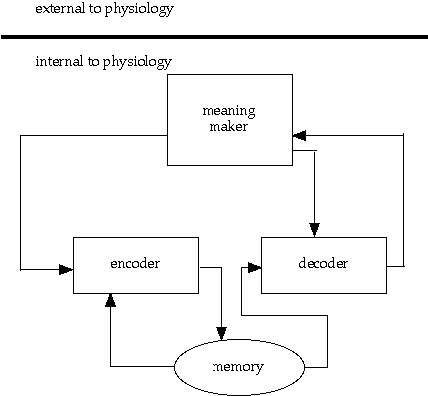
Figure 14.3 - 50 inference learning pathway
The figure is very simple. And while it hides the complexity of the meaning maker’s capabilities, it displays the two most important attributes of inference driven learning:
1) inference learning is freed from the temporal delays of a massed external world. And
2) (a consequence of this freedom) the tasks of the action initiator, the external world, and the data gather must be done internally as mental abstractions.
Thus my task, in the remainder of this book is to explain:
+ What is inductive inference learning?
Inference is the process of gaining a new relation, from existing relations – not from the outside world presenting that relation. A relation has been defined as two connected conditions. Below I describe two ways to perform inference.
These two inference pathways I call respectively "deductive" and "inductive" inference. Next I will describe their important temporal differences.
- Deductive inference (syllogism)
Most of us understand and can perform deduction. However its limitations are seldom made explicit. Let me give an example which most of us can perform using common sense.
Given:
Deduce:
If the first two relations in are in memory, and we also have logical rules with which to operate on them, then, we can "deduce" the third relation. This logical process is called syllogistic reasoning.
Notice that all of the conditions exist as "givens" in memory before the deductive process begins.
The two relationships are given:
1) the relationship between men and mortal is given (A implies B)
2) the relationship between Socrates and man is given (B implies C)
Thus we have:
A implies B B implies C
logical manipulation provides:
A implies C
While this is straightforward and powerful, no relations that contain conditions outside of the given set can be deduced. That is " Jake is mortal" can not be deduced from the two given premises. Jake (D) does not exist within the given set.
Thus while deductive inference creates new relations , it does not predict (create) conditions that did not exist in the original set. It does not create an image sequence, which has never previously existed, and thus deductive inference can not perform feedforward control.
- Inductive inference (simulation)
Inductive inference, as used in this discussion, refers to the connection of an action "A" to an end condition "B" where "B" is not a condition of the original set. Induction makes predictions like, "there will be no vehicle motion after 10 hours of driving without stopping for gas."
An inductive process makes this perdition as follows:
"A" is 10 hours of driving. The mental simulation (into which "A" is inserted) is that of a gas burning car which has a full 16 gallon tank which burns 2 gallons per hour (25 miles per gallon, when traveling 50 miles per hour.) The mental simulation runs the car for one hour and consumes two gallons of gas. The mental simulation is run through an additional hour and the car consumes an additional two gallons.... at the end of the 8th hour the engine has consumed 16 gallons – all the gas in the tank.
Since there are no gallons left in the tank after the 8th hour the car stops "B." An attempt to drive the car 10 hours "A" will cause the car to stop "B."
The condition that the car will be stopped is not a given condition. It is not among the possible values of "A." Yet for each value of "A" 1 hour 2 hours 3 hours... 100 hours, a condition "B" ("running" or "not running") can be created by a mental simulation. The mental simulation acts as an inference engine and infers the car’s running state.
The inference engine works because of the causality among the mechanisms within the mental simulation.
- Induction versus deduction
Let me provide an example of the two types of inference solving the same problem. Then show that the inductive inference learning pathway has superior temporal capabilities.
"The Wisconsin River is cold in January" can be deductively derived from the knowledge that:
To visualize how inductive inference provides the prediction consider the above problem where instead of the given premises you are given:
These two givens can be assembled into a mental simulation which runs months of cold air over objects and cools them. To answer the question, "Is the Wisconsin River cold?," all that is required is to treat the river as an object and enter it into the mental simulation. The cold air takes heat from the river. After three months of simulated cold air, the simulated river approaches the recent mean air temperature.
- What is temporal inference learning
Temporal inference is the ability to motivate production, and valuation of predictions.
Predictions are relations and conditions that are members of an abstract (verse a physiological) memory sequence.
Sequence implies time interval between the states of condition. That is predicting that "Tom will be wearing a black hat" is not temporal inference. It’s a logical deduction. Predicting that the hat will fall to the ground if the wind knocks it off Tom's head is temporal inference.
From the definitions above, deductive inference does not have time interval as an inherent aspect of its structure. Inductive inference on the other hand, at least when the inference engine contains mechanisms that impart a change to a physical object, or an abstraction of a physical object, do have temporal intervals as an integral part of their structure.
Thus temporal inference is a subclass of the inductive inference pathway.
- Temporal inference mechanisms
Temporal inference mechanisms must have the following capabilities.
The temporal inference mechanisms focus the mind on:
Temporal inference mechanisms, at another level identify the need to initiate mental modeling that predicts events using physical system variables connected together with causal mechanisms.
Figure 14.3-60 displays these mechanisms.
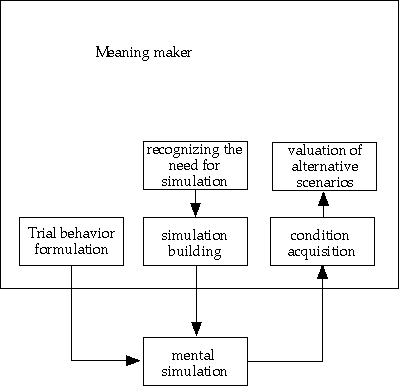
Figure 14.3 - 60 Extra tasks of the Inference MS’s "meaning maker"
While leaving an explanation of how the individual identified, acquired, and assembled these simulation building and exercising mechanisms, to later chapters, a brief description of each mechanism is included here.
Recognizing the need for simulation: Ë These mechanisms are checking the contents of memory to see if any of the physical objects are in motion – that is, have trajectories. For example, the objects will not be in the same place or have the same condition a time interval in the future.
Simulation building tools: Ë These mechanisms connect the variables discovered by the above recognition mechanisms to their forcing functions – the forces or momentum that account for the objects motion.
Mental simulation: Ë The product of the simulation building tools is a group of connected mechanisms
Trial behavior formulation: Ë Creates trial behavior to be tested in the simulation. These creation processes besides polling pass experiences, and transmissions, besides using logical extension, may contain additional layers of mental simulation.
Condition acquisition: Ë These mechanisms record the scenarios (image sequences) created by the mental simulation.
Valuation of alternative scenarios: Ë Finally these mechanisms first create visceral feelings for the conditions in the abstract predictions and then measure the difference among abstract feelings created by each trial behavior including the case of no behavior.
Pathways describe the flow of information through mechanisms. I have visualized behavior driven learning as mechanisms that implement trial and error learning activities. I have visualized transmission driven learning as mechanisms that allow symbol processing and physical system observation. And I have visualized inference driven learning as mechanisms that manipulate mental abstractions.
Each of these 3 learning pathways serves a function, "to help a being choose behavior." If or how the being uses the three pathways determines the robustness of the being’s success. I give two examples below.
14.4.1. Three pathways running in parallel
The environment determines which of these three pathways are required for an organism's survival. Assume that an organism needs ten relationships to operate in its environment. If these relationships were genetically encoded none of the three described pathways would be required to survive. If all ten could be learned experientially, functional operation could occur without the use of language processes. Similarly if the ten relationships could be transmitted, functional operation can be accomplished without the organism having any behavior driven learning processes. Of course if some of the relationships could only be gained by experience or only through transmission, then for an organism to survive it would need both pathways to learn all ten.
In the learning environment of the Martian born new driver, the existence of a car collision could not be learned using either experience or transmission pathways. Inference pathways would be required.
It would follow that in the human learning environment, all three learning pathways are required for survival.
14.4.2. Three pathways running in sequence
Each of the three learning pathways that insert image sequence into memory relies on memory to supply information as the basis for its activities. If this information is the result of previous learning, not genetic imprinting, then "LEARNING" is not a single pathway but a sequence of pathways. And image sequence placed in memory is the product of a sequence of pathways.
-Three learning pathways (simplified versions)
To facilitate this presentation, let me first condense the three-presented learning pathways into graphs each containing only three elements.
This produces three Figures. 14.4 -10, 20, 30. By comparing the three graphs shows that each of the three mechanism blocks has the same relationship to memory. That is, each mechanism sends its products to memory and each gets some of its sources from memory . However, a closer look at the three Figures shows that each as a different relationship with the physical world.
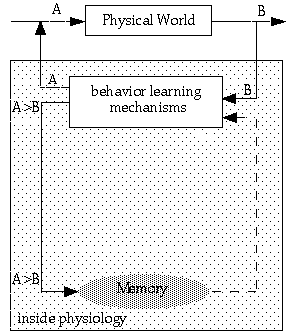
Figure 14.4-10 giving and getting from the physical world
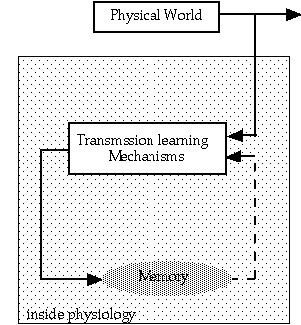
Figure 14.4-20 Gets but does not give.
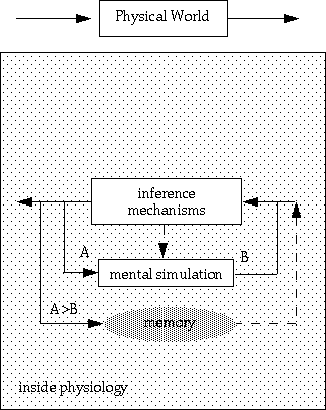
Figure 14.4-30 Nether gives nor gets
Furthermore, we can see from Figure 14.4-30, only the inference MS has a relation with mental simulation.
-Three learning pathways in one process model
The three learning processes can be combined into one process model Figure 14.4 –40.
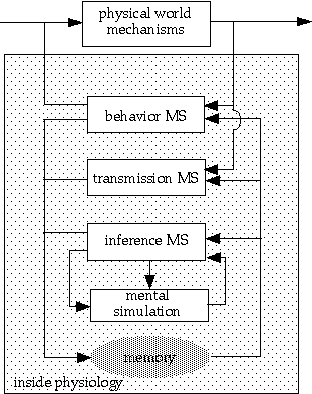
Figure 14.4 -40 Combined learning mental structures.
Once in this form, it is obvious that learning is more than a single pass through one of the defined pathways. Learning is information passing though a sequence of pathways; each pathway, using memory first as a source and second as repository of its output.
Therefore memory content reflects a previous sequence of learning. The preceding sequence then determines what can be learned through any pathway at any point in time.
- Classroom activities 3 pathways running in sequence (this section undeveloped nw)
Teachers can implement learning by:
14.5. Acquiring pathways and pathway sequences
Meta learning ==>>
Learning to learn ==>>
Changing a learning capability ==>>
Installing a learning pathway
Consider the possibility that when we were born the learning pathways were not fully installed. Then learning to learn means installing the behavior driven, transmission driven, and inference driven learning pathway. That the inference pathway is weak may imply that its installation was never fully completed.
To improve the inference learning pathway, I must describe the learning that installs it. I have to ask and answer questions like, "How did we become good behavior driven learners? How did we become good transmission driven learners? What information flows and mechanisms installed these pathways in our minds? If these flows and mechanisms succeeded in installing behavior driven and transmission driven pathways, why did they fail to fully install the inference learning pathway?
Brilliant men have considered these difficult questions for 1000’s of years. The contents of the next few pages outlines only a tiny sliver of additional illumination. However, that silver is part of the foundation of a temporal learning and thinking model.
14.5.1. Acquiring a pathway
Before describing the temporal aspects of the acquisition of the behavior driven, transmission driven or inference driven pathway, let me provide a brief foundation for pathway acquisition.
- "Learning to learn" is infinitely recursive
Assume the pathways we use for learning are called the blue pathways. One can ask how we learned the blue pathways? If we can describe the red pathways as those we used, then, one can ask how we learned the red pathways? If we can answer this question by describing yellow pathways then, one can ask how we learned the yellow pathways? This recursive questioning can go on ad infinitum.
Since each level of learning depends on a level below it to function, we cannot discover "the" bottom level. Just as we can not discover "god" by successive asking the question "What caused..." to explain why things change in our universe. However, we can give the search of each level and the interactions among levels a temporal cast – a cast that describes the development of temporal cognition.
- paths are parallel & competing
In Chapter 13, Figure 13.2 -10, I suggested that:
It follows, that in this discussion of learning to learn, a focus on just the temporal sliver of the total body of learning knowledge may illuminate a similarly large affect. Specifically that sliver may have a large affect on what learning pathways can be installed. That sliver may have an affect on what level of cognitive development can be attained.
Changes in:
create a temporal cast of "learning to learn. "
These changes could be considered temporal cognitive development. They change the:
- Experienced based acquisition
While there are as many ways to perform "learning to learning" as there are to create image, here I focus on only one. It is a derivative made from components of the behavior and transmission driven pathways. This collection is commonly called experiential learning.
Consider a series of experiences that an individual might have to change his or her sensitivity to temporal information. An individual
The steps outline a learning activity that does not beget a new behavior. Instead it begets a broadened sensitivity to available information. The key to having these steps occur is that the student is not focused on the goal of finding the correct behavior but on improving processes for finding correct behaviors. The learning to learning activity identifies which component of the thought process failed.
While in above example, the focus was on information sensitivity, it could also have been defective mechanisms, pathways, or pathway sequences. Any of these could have prevented perceiving the perceivable, storing the storable, extracting the previously stored, or constructing the previously unknown but constructable relationship.
Learning to learn, with all its recursive layers, may first appear like an impenetrable web. Many educators past and present give this web the name "maturation." They believed maturation is hard wired in the brain. Mental abilities emerged as part of "unfolding of the genetic code" just as fingers, eyes and organs unfold in the growth of a fetus.
The tragic implications of our temporal blindness, create motivation to re-investigate this web. Maybe some parts of maturation are not a genetic unfolding. Maybe some aspects of cognitive development are environmentally induced. Maybe the environment that we were all exposed to, naturally installed behavior driven and transmission pathways and failed to install the inference learning pathway. While I have no experimental proof let me hypothesize an experience based learning to learning pathway that explains this failure.
14.5.2. Acquiring the transmission driven pathway
In Figure 14.3 -20 I described the information flows and mechanisms in the transmission driven pathway. However I made no effort to explain how this pathway was assembled and inserted into an individual’s thinking process. Consider the possibility that this pathway is the residue of several experiences. The components (and subsequently the insertion) are derived (and made possible) from the observation and analysis of successful and failed transmission learning experiences. Let me give three examples.
- Buckets to make relations
A child focused on meta learning, could distinguish the difference between a transmission containing all three parts of a relation and a transmission containing only two. From these observations a child could generalize that a transmission must convey three parts to be comprehended. If hearing, A and a connective without B, connective B without A, or both A and B without a connective, a child can learn that "a relation has three parts."
When the three part generalization becomes a working component of the transmission pathway, the child has essentially built three buckets - a bucket for "A’s" a bucket for "B’s" and a bucket for connectives. (the child would have also developed a process for parsing the symbol stream into A’s, B’s and "connectives.") Then as symbolic strings are accepted from the external world they are taken apart or parsed. The parts are sorted into ‘subjects," "objects’" and "connectors" which can be deposited into the corresponding A, B, and connective, buckets. Relations can be made from the contents of three buckets. In this sense, the meta learning is the creation of the buckets. The buckets become mechanisms or part of the transmission pathway that creates relations.
+ Buckets to make temporal sequences
Creating buckets so that a transmission learning pathway can create relations out of symbolic strings is not the only form of transmission learning that can be build through experience.
Buckets can be created that acquire sequential conditions emitted by the physical world. These buckets can be ordinal or interval. -
- Ordinal
Ordinal samples, that is to say the memory sequence is only that event A was followed by event B that was followed by event C etc. Ordinal sequencing allows us to know that bibidy was followed by bopity which was followed by boo. when we heard bibidy bopity boo. then in the future time when we heard only bibidy bopity we can complete the ordinal string with boo.
- Interval
Sequences can also be designated as interval. That is condition A at time zero, at time zero plus 1 condition A’ which has changed by a small amount. And at time zero plus 2 condition A’’. The sequence is then a succession of conditions of A.
If the interval is two long then A and A’ look like two ordinal events. However if the interval is small enough then the events look like continuous motion of the same object. Learning to set the sampling interval (time between samples) so the object appears in motion is a learning to learn process.
14.5.3. Acquiring the behavior driven pathway
Experiential processes may also be responsible for creating and linking together the mechanisms that form the behavior driven pathway (Figure 14.3 -40). To identify these processes consider what mechanisms facilitate learning to playing catch. The tasks are:
How did we create and connect these mechanisms that form our behavior driven pathway?
Other than the genetic unfolding model consider an experiential explanation. For example I suggest the following four sequences.
1) the learner who throws the ball but fails to watch where it lands, then throws the ball and watches where it lands he opens an opportunity to learn that "a part of the behavior driven learning pathway is identifying the outcome of the activity."
2) the learner who uses random selection of trial behaviors and then uses a causal mechanism to choose trial behaviors, opens an opportunity to learn that a careful selection of A's to test, greatly abbreviates the learning process.
3) the learner who looks indiscriminately at the physical information stream, and also looks at the information stream with a model of the ball’s response to gravity, the throw, and the expected location, the student opens an opportunity to learn that building a filter to gather information from the stream greatly improves learning.
4) the learner who has the experience of "not remembering the throw" of a ball that landed successfully, and "remembering the throw" the learner opens an opportunity to learn that remembering an action in a form that allows it to be repeated is part of the behavior driven learning pathway.
These four cases are but a few of the possible learning to learn opportunities that can help install the behavior driven pathway.
These opportunities mean nothing if the genetic unfolding model of cognitive development is really how we develop the behavior driven pathway. However, if cognitive development is based on interactions with the natural environment, building the behavior driven pathway can not proceed unless these opportunities exist.
To follow this line of reasoning so it is useful in understanding the temporal learning and thinking problem would require an inventory of experiential opportunities created by the individual’s environment, and the resulting cognitive tools that derived from them. (This would help explain why the cognitive development we did achieve helps us learn to play catch in our world but not those mechanisms that would allow us to learn to play catch if the ball took six months to get to its destination.
14.5.4. Acquiring the inference driven pathway
The previous sections lead us to believe that the mechanisms and information flows, within the behavior and transmission driven pathways were installed because of experiences with the physical environment. Development based on experience can proceed only if the environment presents opportunities and the individual uses these opportunities. Peers, parents and teachers add or remove these opportunities and increase or decrease an individual’s propensity to use the opportunities in pathway development.
These social activities do not have to treat the development of the three learning pathways equally. The behavior and transmission pathways seem to develop naturally in our existing social context. Next I will show that these same social activities inhibit the development of the inference driven pathway.
To experientially learn the mechanisms and information flows contained within the inference driven learning pathway the:
Let me provide a few examples to describe the roles of social activities.
-Passively removing prediction opportunities
An infant comes into the world and is flooded with sensations. The sensations are immediately connected to one another. Many logical relations are made simply by tracking the incoming information.
As motor control develops, each trial behavior (in the beginning random acts) is connected to what the child chooses as the world’s response. The social activities install relations in memory and develop the behavior driven pathway.
However, these same activities remove relations from the pool that might be used to develop the inference learning pathway. That is, a relation is a connection between a behavior and a response. Once the behavior is connected to the world’s response, once the knowledge is inserted into memory, there is no opportunity to use that relation as a potential experience to develop the inference learning pathway. Once condition "B" is known to be the result of behavior "A" then the opportunity of predicting condition "B" is removed forever. Also removed from the learning to learn environment is the opportunity to predict in "B" incorrectly and thus create a situation where the error can be used to repair a defect in the inference driven learning pathway.
-Actively removing prediction
Experience, driven by the senses, is not the only activity conspiring to remove inference learning pathway development opportunities. As soon as the infant learns language, A causes B relations can be transferred. Parents, peers and teachers do their best to transfer as many relations as possible. Children ask questions to enhance the flow of these transfers. Learn to read also creates transfers.
The upside gain is clear. Successful transfer creates a family of relations that allow the child to correctly choose a behavior in a number of situations, without the time and resource consuming exercise of the behavior driven pathway.
The down side is quite hidden to us. We are giving up opportunities to develop the inference driven pathway. If we know the outcome of a behavior there is no need to predict it. If we don’t predict it there is no chance of predicting it incorrectly. If we don’t predict it incorrectly there is no chance to discover errors in our prediction capabilities and correct them.
-Institutional destruction of inference
Our schools and classroom teachers have taken the challenge of destroying opportunities useful in developing the inference driven learning pathway a step further.
Schools use the transmission learning pathways as its primary channel. However, Socratic schools use prediction errors in that process to motivate students to learn transmitted relations.
For example when a teacher asks a child a question, "What happens when you perform behavior "A?" If the child does not know the answer to the question, the teacher has created a situation where an inference prediction is required. Let’s assume that the child predicts the incorrect answer "C." The teacher in a normal classroom situation, after hearing the incorrect answer then goes to the next student and asks the same question, hoping that the second student will know the correct prediction is condition "B" and will announce it so the first student can hear.
The teacher has created two learning opportunities:
1) All the students in the room can learn by transmission that A causes B. (The first student can over write the incorrect relation ("A" causes "C") within his memory with the second student’s answer "A" causes "B."
2) The first student has been provided an opportunity to figure out why his inference pathways predicted "C" instead of "B. "
In the classroom, everyone is expected to implement the first. However the first student is never allowed enough time and encouragement to take advantage of the second.
-Classroom efficiency promotes indifference to development
The bias toward using the first learning opportunity and the bias against the second in school is a rational choice based on the goal of having the largest number of students know the largest number of correct A causes B relations per classroom/teacher hour.
Having the ability to develop relations through inference is of course a nice addition to any students cognitive development but it is very inefficient in a classroom environment to help a single individual develop inference when the opportunity costs to many individuals not receiving many transmissions is very high.
At least in the short run, and as borne out through testing , more "student learned relationships" per classroom/teacher hour can be acquired through transmission than through individual students developing an inference driven pathway and then using it to build relations during the same classroom/teacher hour.
Everyone agrees that it would be a better evaluation of classroom/teacher hour performance if the learning could be evaluated based on the collection of all students’ productivity throughout their lives. But this type of evaluation is beyond our reach First because of its longitudinal nature and second because we have no means for measuring changes in the inference driven learning path based on classroom activity.
Since no fair comparison can be made of the improvement in cognitive development, and the school must have some measure of performance, the transmission model of learning in schools dominates most activities.
The development of the inference driven learning pathway is and has been relegated to lessor importance. The effects on learning are two fold:
-Unconsciously converting simple learning
The most insidious activity reducing the opportunities to develop the inference pathway is that to improve the mechanisms and information flow, the errors in prediction process must be easily understood.
Errors are most easy to understand when the relations between behavior and physical world’s response are very simple. However, relations are simple only in simple environments. The simplest environments are those experienced by the very young. As the simplest relations are installed in memory by trial and error, demonstrations, and or symbolic transmissions, they are removed as opportunities for predictions containing errors. The environments that remain to create errors in prediction are complex. An error in prediction can be explained by many factors for example computation. Prediction errors caused by computation can not be used to a further develop the inference pathway.
-Unconsciously reducing the motivation to
These learning activities skim off the relations the student is most motivated to learn. The remaining relations are less important and thus there is less motivation to learn them.
With opportunities and motivation being reduced over time, the strength of the behavior driven and transmission driven pathways is increased.
-Good simulations promote guessing rather than inference development
We all know that it is easier to learn something from hands on experience than it is to learn something abstractly. So teachers work hard to covert as much of the material in to domains which can be easily manipulated. In some cases that mean simulation. Some times the simulations are so good, such efficient teachers, it is easier to guess a bunch of behaviors that might control the system, try them in the simulation to find the correct relation between behavior and outcome that to make any predictions.
-Summary
To learn the inference driven learning pathway requires that a prediction be made.
Of the few cases where a prediction is made,
Of these last cases the prediction error may be identified:
Cultural norms shaping educational practice unconsciously conspire to remove situations in which a child
Every time a baby shakes a rattle he creates a relation that eliminates an opportunity for prediction. Every time a parent shakes a rattle for the baby, opportunities are lost. Lectures and reading also each diminish opportunities and so do great physical simulations.
The result is a student with diminished predictive skills and no motivation to improve them.
With most of the easiest conceptual problems ruined for children by transmission and physical experience; with older children’s and adult’s learning environments filled with problems too complex to allow tracing a failed prediction down to a generalizable inference process error the meta inference learning environment is almost non existent.
For a child to learn inference requires three changes.
1) teachers can not justify ruining inference learning environments so that they can demonstrate higher test scores on rote learning.
2) we devise a learning environment in which the learning of inference is made an explicit part of educational practice.
3) we must devise explicit motivation for the building of inference. The student needs a failure in meeting his objectives to be motivated to change his inference pathways. We forget that while transmission and experiential meta learning are implicit in the learning environment the motivation to build experiential and transmission pathways are explicit. The motivation for changing a transmission process is that a transmission failed and the child missed out on something they wanted because they did not have the skills to gain the available information.
variable
Ë a descriptor of a system that can assumedifferent values but can have only
one value at each instant of time
condition
Ë the instantaneous value of one or more variablesthat describe a state of a system
relation
Ë two or more connected conditionsa function
a sequence of images
a logical declaration
(the derivative of a relation is a mechanism)
mechanism
transform one condition into another and
produce relations where the second
condition is a function of the first
(the derivative of a mechanism is a function)
system,
pathway,
or process
a myriad of relations where the connected
conditions are functions of each other
image
above terms, structures, and
their acquisition.
In this chapter, using the above definitions from Chapter 10, I defined the temporal aspects of the terms information, mechanism, pathway and pathway sequence.
Information:
Mechanisms:
Pathways :
Sequences of pathways:
The origins of the elements in a resulting relation delineate three unique pathways – behavior driven, transmission driven and inference driven. I described three graphs that show the mechanism sequence.
1) behavior driven learning pathway: A behavior produces a change in a changing world. The physical world, through a human sensory process produces a sequence of images in memory. These images are non-symbolic messages. The messages, are direct sensations of objects with mass. These objects can change their size and location in space only by following the physical laws of motion.
2) Transmission driven learning pathway: the memory sequence is the result of symbolically encoded incoming messages from the physical world.
3) Inference driven learning pathway: the memory sequence is created by mental manipulation of existing memory.
causal manipulation:
logical manipulation:
Ë A set of rules can operate on existing memory sequences to create a new memory sequence of group members.I have defined learning
Ë as loading sequences of images into memory.I have shown how each of these three pathways creates future image. I have shown why only the third pathway, inference creates, for a present or attainable condition, a future image that has never previously existed in physical form.
The three learning pathways operate in parallel as shown in Figure 14.4-40. That is they share common inputs and outputs. Each over time supports and depends on the others. Whether all of these pathways and connections existed at birth or were "wired up" using interactions with the environment remains an unsettled research question. What is clear is that the use an individual makes of each pathway in choosing behaviors for his or her day to day activities varies greatly. And there is some question as to whether the use of the pathways is adequate to the task of graceful survival
"Image sequence" in memory is the basis of all future image. Any pathway can produce image sequence. However, only future images based on inference can be used as a basis for feedforward control of behavior.
Feedforward control over learning behavior is required to implement the Martian child’s conversion of stopping experiences into seat belt wearing. This chapter succeeds if it described three learning pathways in enough temporal detail that you can use definitions of feedforward control of behavior described in Section 12.2 (figure 12.2 -70 a-g) to describe feedforward control of learning.
New temporal thinking/learning modelsChapter 15. A temporal inference learning model
Temporal sight
Ë the cognitive capacity that motivates and implements the acquisition and use of a system's temporal causal structure to infer future conditions and influence behavior.This definition of temporal sight focuses our attention on an objective,
the building of an individual whose thinking and learning
addresses more of the temporal nature of our existence.
It defines our goal: a model that describes both,
Building a model that describes human capacities, and how these capacities were developed, normally uses experiments that directly measure these capacities in a single individual and historical records to describe the developmental experiences of that person. We have already concluded that these methods can not be used because no such person exists.
What we have, to build this trial model is:
These four contributors respectively define the trial model’s target (a view of temporal sight), components, the model’s rules of construction, order of construction.
My efforts to create this first trial model follow in two parts. The first part, titled "content and context," I combine the tasks, definitions, and rules into a single graph containing processors and information flows among processors. In the second part, the historical record of my experiences, is converted into "steps" through that graph.
Fifty years of experiences contributed to my view of temporal sight. Since obtaining a view of temporal sight was not my primary objective during the first 25 years of my life, these experiences appear normal. During the last 25 years, some experiences have been not normal. My learning path has been circuitous. Only a small percentage of the migrations account for forward progress. The vast majority are just noise. Let me present the focusing concepts and the distilled results.
15.1.1. Learning is a sequence
Learning is the product of a pathway. Information, flowing through a sequence of mechanisms, creates:
These products are the inputs to other pathways. For example, Figure 14.4 - 40 showed the connections among three pathways named behavior driven, transmission driven, and inference driven.
These connections form loops. Overtime the loops channel the outputs of past pathways into the inputs of future pathways. Therefore, any pathway activity, comes after a pathway activity, which comes after a pathway activity , which comes...
For example, extracting a meaningful relation from a stream of spoken sounds depends on a succession of successful previous learning. This learning includes
a) declarative content, like:
b) development and installation-of-process content like:
Learning is a never-ending forward-in-time sequence where everything that can be learned is based on what has been learned.
15.1.2. Investigations that trace the sequence
I have been describing learning as a forward-in-time sequence. However, in any investigation of what produced a given level of knowledge or processing power, there must be a tracing of this sequence backward in time. However, tracing learning backward in time has an inherent hurtle. The trace leads back to an impenetrable source, E.G. our unconsciousness, or our genetic code at inception.
Either may make complete understanding of the learning sequence impossible. However, if we use the competition model proposed in the behavior chapter, and we believe that behavior describes what we learned, then behavior describes the residue of competing learning sequences.
When behavior from unconsciously produced learning is adopted it implies weakly competing consciously produced learning. It follows that in the absence of full knowledge, a study of just conscious learning sequences, becomes a worthy activity.
Assume:
15.1.3. Graphs and map
With these assumptions, understanding learning requires
1) a set of graphs (each graph depicting an instant in time) that explains:
2) A set is required because any graph is only momentarily correct. Over time the learning systems are forever changing their form and content.
Consider a road map analogy for these graphs. On these maps think of:
Think of learning as motions on, and changes in, the map. This includes both:
a) he simple transformation of information into new relations and
b) the modification of old and the building of new, roads and factories.
From such a map it is easy to see that:
15.1.4. Order and timing
If these maps describe learning, then the order and timing of information flows among pathways, memory and the physical world, radically change the attainable learning. For example, different sequences change which behaviors, relations, pathways, and connections among pathways are created.
Using this map (road/factory/warehouse/raw material/product) analogy, the plan in this chapter is to begin describing:
Ultimately, the map describes the
The map describes the bootstrapping of a new processes from existing processes. In terms of the map analogy, the map must describe:
1) what factories and roads exist at various time periods in an individual’s development
2) how those factories use:
3)successive rounds of learning produce the
15.1.5. bootstrapping
This is a very tall request for any model. If cognitive development is a sequence spanning pre-birth through death or dementia, then, one inopportune choice at a fork in the road and development proceeds away from temporal sight as it did for most of us.
Furthermore, with our (the reader’s and author’s) indirect view of temporal sight, there are parts of the ultimate model which you and I probably won’t be able to understand even if some researcher in the future could discover and present them. We do not have the cognitive underpinnings to give the words and concepts the researcher presents their real meaning. Our learning to understand:
1) What is temporal inference learning ,
2) Why it wasn’t (in our cases)developed, and
3) How we might design a sequence of experiences for infants to develop it as part of their cognitive development,
is itself a sequential process.
We, (the reader and the author) have to build a model that makes sense of our temporal grasp of the world, at the level of temporal cognition we have. Then we have to hypothetically expand that model at its spatial and temporal periphery. And this must be done in successive rounds.
The first rounds will not bring our temporal cognition to a level that can perform temporal inference but it may be enough to perceive its operation. Future rounds of such bootstrapping (years of research) must continue until:
a) a final map shows the of flows of information through pathways that implement temporal sight, and
b) a movie shows a sequence of activities beginning at infancy that allows the concluding map to become part of any child’s thinking.
15.1.6. Depiction
Figure 15.1 - 05 maps my personal journey; if not to "temporal sight," to "sight of temporal sight." It is a map of the information flows during a 25-year period when I pieced together my first views of temporal sight. Using my experiences with crashing cars, human injury, and irrational human behavior, as a trigger, I describe information flows during:
My collected experiences are not normal. But for many readers, some of these experiences will be familiar. However, for most readers, my experiences are closer to familiar than theoretical abstractions describing either:
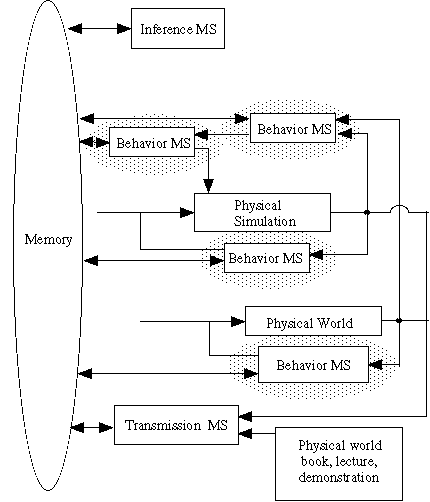
Figure 15.1 - 05 My experiences to sight of temporal sight
The map in Figure 15.1 - 05 shows flows of information, among instances of behavior driven, transmission driven, and inference driven pathways. Each instance is shown as a rectangle. Each is like a factory filled with machines that transform incoming information into memories and behaviors which travel on the arrows in the figure to other factories, memory, or the physical world.
- Pathways with and without MS (rectangles)
Some rectangles have been given the suffix MS. The MS stands for mental structure. The notation means that the mechanisms within the box are mental and internal to the individual (rather than external and physical.) Some of these mental mechanisms have already been described in Section 14.3.
Other rectangles in the model, do not have this MS designation. For example, physical world, and physical simulation are like factories containing physical mechanisms. The mechanisms change the state of the physical world.
Another non MS rectangle in the Figure 15.1 - 05 is the "book, lecture, and demonstration physical world." These physical mechanisms produce, a series of symbols or physical world motions suitable for acceptance by the transmission pathway.
- Memory (ovals)
The oval in figures is a repository for pathway-learned relations, sensed sequences, constructed scenarios, and causal functions. (Unfortunately it is also the repository for a lot of spurious learning and fantasy.)
- Information flows (arrows)
An arrow entering a rectangle from the right or left end plate is information to be processed by mechanisms that are operational within. An arrow entering the top or bottom of a rectangle is information, which changes the mechanisms doing the processing.
- Pictures & movies of information flows (arrows)
Figure 15.1 - 05 is a picture of a system that could be more correctly depicted by a movie. Imagine trucks carrying information to and from the factories at night. Imagine the picture created by a camera with its shutter left open for 25 years worth of nights. The streaks of light left by truck movements would then look like a plate of spaghetti. Imagine the resulting picture as a representation of my 25 years of groping around in the darkness with my temporal blindness looking for a view of temporal sight.
Next I trace my 50 years of learning experiences through Figure 15.1 - 05. The steps make my journey appear direct and concise while in reality it took millions of tiny, sometimes almost random, steps. Many learning experiences provided no temporal cognitive development. Others caused spurious development.
My first steps of my journey do not appear in this discussion for they do not exist in my memory. The final steps toward temporal sight will not appear for I have not completed them. Within these constraints the steps follow my route to my view of temporal sight.
To implement the steps I had to learn both:
from the accumulation of previous steps. When learning failed on either aspect, the journey stopped and waited for another experience to spring it back to life. Therefore, I show the motivation to use cognitive skills as well as the new mechanisms and connections of each step.
The steps are those of a blind man’s search The blind man had no guide for there was no curriculum or classroom teacher that addressed this special area of human thought. These are not the steps that I propose for new infants to follow. New infants will have a curriculum designed by research yet to come. Infants will accomplish much greater progress than I as they advance to adulthood.
15.2.1. Step 1 Experiencing the physical world
Of the four behavior driven pathways visible in Figure 15.1 - 05 only the one (lower right) directly below the physical world was in use during the first 25 years of my life. This behavior MS is common trial and error learning. Its mechanisms were discussed in Chapter 14.3 and were shown in Figure 14.3 - 40.
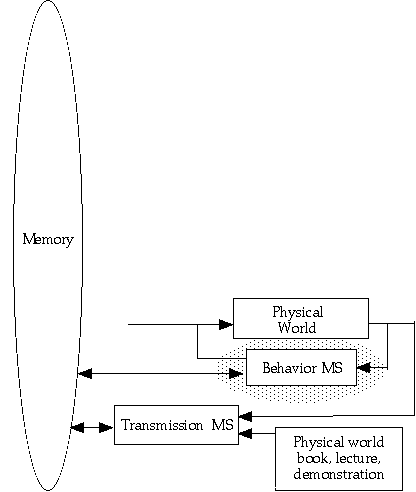
Figure 15.2 -10 Step 1 Behavior MS with physical world
Figure 15.2 -10 highlights information flows from and to this behavior MS. These include input and outputs to the physical world and to and from memory.
The figure also shows a transmission MS which is a feeder to memory. The inputs and outputs of this transmission MS come from both the changes from the physical world cased by behavior and the outputs of the physical world that happen independent of behavior driven changes, namely books, lectures, and demonstrations.
To put these flows into a temporal context, consider learning that may have taken place before and during the trial and error part of learning to play catch.
Independent of Step 1 behavior driven learning, learning activities could include transmission pathway activities that create a concept of:
While trial error behavior is proceeding, there can be contributions from the transmission MS in the form of "coaching. " For example:
For me Step 1 behavior MS ran for 20 years in isolation of the other three behavior MS’s labeled in Figure 15.1 -05. It was not until late in my undergraduate engineering program that I realized that there were other ways to "learn to manage system motion " let alone had the opportunity to use any of them.
15.2.2. Step 2 Experiencing physical simulations
Only after I completed my engineering degree did I get to manipulate a simulation of the physical world. Only then did I learn to control a system that was too expensive and too dangerous to learn to control by my Step 1 behavior MS learning pathway.
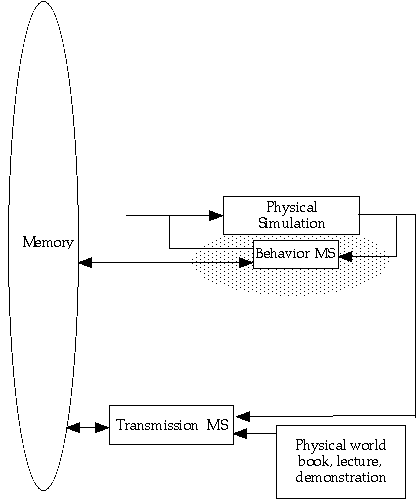
Figure 15.2 - 20 Step 2 – Behavior MS with physical simulation
The Step 2 learning environment was a crude flight simulator. With a flight simulator an individual loads into memory behaviors connected to the produced responses made by that physical simulator when given a behavior derived from sensing the circumstances of the simulator. In Step 2 behavior MS learning:
From the learner’s perspective, the Step 2 learning activity is identical to that in Step 1. However, the movements created by the simulation are much cheaper to produce and are limited to the non-injurious.
While pilots in the simulation learn to understand how an airplane responds to his or her controls; should the pilot perform a behavior that would crash the real airplane into the grown or rip the wings off in the air, the simulation simply reports that the pilot’s behavior produced an undesired result. There is no injury except to the pilot’s pride.
Other than these extreme cases the quality of the simulation is determined by how well it makes the pilot feel like he or she would feel in the actual airplane.
To give you an idea about how close to real life these simulations are, consider the story of a commercial airline pilot who had been in a flight simulator for 4 hours flying from airport to airport. During the final landing exercise, he instinctively reaches into his flight bag for a flashlight to check if the windshield wipers are frozen tight to the fuselage and will not work on landing. The simulation, for this pilot has become so real he has forgotten that he is in a box that is inside a building and the wipers could not possibly be frozen.
Coaching in Step 2 learning is two fold in the flight simulator. First the flight instructor can sit with the student to guide his learning just as he or she would in a real airplane.
In the second case, instructors can direct the learning environment from outside the cockpit by having the simulation create good weather or bad, ground obstacles and even affect various airplane system failures.
Whether the instructor plays the first or second role the conditions of a simulator can be made much more dangerous, and demand much higher skill levels than would be allowed in a real training flight.
After successfully flying the simulator, the pilot still has to learn to fly the actual airplane. However, he or she does so with a memory loaded with:
Step 2 learning is not a common learning opportunity. Most of us have never flown a flight simulation. The closest we ever got to a simulator might have been an automotive brake simulator in driver training. If we did have that experience it was not very robust. The simulation was limited to visual feedback. Visual cues showed how cars slowed down for various pedal forces and reaction times. However, no deceleration forces were created and therefore no feelings of deceleration forces were integrated into a memory of brake forces and stopping distances.
Without the physiological feedback of our bodies being thrown forward, what was stored in our memory was not that helpful in learning to brake in normal or emergency situations.
I have presented the Step 2 behavior MS learning environment not to show that available simulations produce weak learning. Instead I presented it to illuminate that simulations were not available, and if they were available they formed too small a part of each of our learning experiences to provide the underpinnings of the third Step in my journey to a view of temporal sight.
15.2.3. Step 3 Experiencing simulation flaws
The behavior MS shown in the upper right hand portion of Figure 15.2 -30 can operate only if:
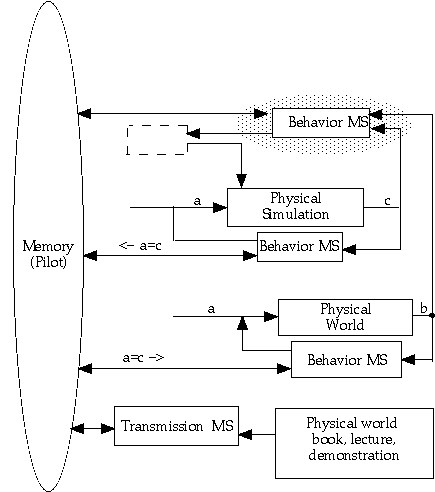
Figure 15.2 – 30 Step 3 Behavior MS - differences among Steps 1 and 2
Consider that after running a simulation (middle behavior MS in Figure 15.2 -30) the pilot has learned that "behavior A produces a response C." That is, "A implies C" is stored in memory.
If "C" is the desired final condition for the real airplane, the behavior MS lower right searches memory, finds the relation A implies C, and then, believing that behavior A will produce condition C, executes behavior A as input to the physical world. "When the physical world responds to "A" and produces condition "B" instead of the expected condition "C," then the Step 3 behavior MS (Highlighted top right) gets an opportunity to operate.
I say opportunity because most normal pilots when encountering the second experience "A implies B" hardly notice the contradiction between the simulation and the real aircraft. They just overwrite the memory location where the C result of behavior A is stored with the more recently learned B result of behavior A.
However, the special pilot who brings the contradiction to a conscious level creates an opportunity (if not the motivation to be discussed later) to create one or both of the following results:
a) a transmission to the pilot’s, memory that simulations may not be perfect and trusting them can be harmful to ones heath and/or
b) a transmission to the simulation builder that the simulation and the real world do not agree, (the simulation builder is denoted by the dashed rectangle.)
15.2.4. Step 4 Simulation building from pilot experience
As planes got more expensive to build and fly, the bean counters began looking for ways to make learning to fly them cheaper. Reducing the flight time it took for new pilots to learn to fly them was a large cost saving. So flight simulations of existing aircraft were born of financial necessity.
It takes a lot of skills to make a simulation that looks and feels like a flying airplane. It takes skills;
With this complexity, simulations are not built correctly the first time. It is a trial and error process. This process is described in Figure 15.2 - 40. The behavior MS (highlighted top left in) is a learning pathway exercised when building simulations iteratively. The highlighted behavior MS belongs to the simulation builder. The behavior MS below the plane simulation is that of the pilot experienced in flying the real aircraft. Through interaction with the new simulation the experienced pilot (not student pilot) identifies errors in the simulation and transmits them to the simulation builder, who incrementally improves the simulation.
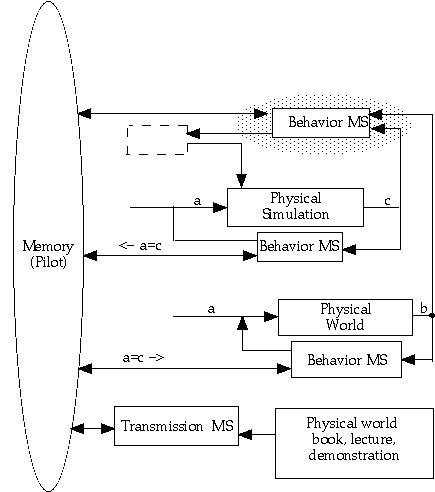
Figure 15.2 -40 Step 4 – behavior MS building simulations
Notice that in this figure perspective has changed. The memory now reflects the simulation builder not the simulation user.
In terms of my journey to temporal sight I had to play all of roles in all of the steps to complete the required learning.
Notice that the simulation builder does not insert trial behaviors into the simulation, as pilots did in the previous steps. In stead he or she instead implements changes in the simulation’s structure.
While the behaviors that exercise the simulation are those of a pilot who has already flown the real aircraft being simulated, these exercises could be directed by the simulation builder.
This pilot compares the responses of the simulation to the responses he or she experienced while previously flying the real aircraft. The pilot computes the difference using a Step 3 behavior MS (shown Figure 15.2 -30 but not shown in Figure 15.2 - 40.) Then, the pilot’s output of his or her Step 3 behavior MS, the differences, are transmitted via language transmissions and demonstrations to the simulation builder to improve the simulation.
In this sense the solid lines in Figure 15.2 - 40 belong to the learning activity of the simulation designer. The dashed lines and rectangles are the subset of the learning activities performed by the skilled pilot. For example, the memory in the figure relates not to the pilot to be trained in the simulator, or to the memory of the skilled pilot. The memory in the figure refers to the simulation builder.
Also notice that the feedback to the Step 4 behavior MS is not sensible using subconscious physiology as it has been in most previous discussed Behavior MS’s. Instead, while the changes in a simulation are derived from the skilled pilot’s physiological senses of the differences between the simulation and real world aircraft, these differences must be converted into abstractions to be communicated to the simulation builder.
The physiological information must pass four abstract filters to perform a change in the simulation’s design. First the skilled pilot must converts sensible differences into symbols. Second by the simulation builder must convert symbols to memory. Third memory must be converted into an input to the Step 4 behavior MS and fourth the behavior MS must create a physical action to change the structure of the simulation.
15.2.5. Step 5 Simulation building from aircraft design
Thus far we have used pilots (experienced with an existing aircraft) to help design a simulator to help pilots in training for that aircraft. However, simulators were soon pressed into service to help test pilots train to fly aircraft they had never previously flown. Instead of incrementally getting a simulator to be like a historic real life experience, the simulator was to be like a real life experience that they were going to have in the future. That is the simulation could not be a cut in past exercise on the part of the simulation builder. It had to be right the first crack out of the bag or the test pilot was going to learn things from the e simulator that were going to kill him when he flew the real air craft. (If you are listening carefully you might hear a bell ringing out "feedforward control." Read on - I will put this all together in a few more pages.)
Though iterative experiences with Step 4 learning, the simulation builders created a set of simulation building tools. These tools described aspects of systems that humans used to
These tools were stored in memory, written into tech notes, published, and converted into classroom curricula.
A cadre of simulation builders were created. Some builders focused on:
With these, simulation builders could build simulations of aircraft that were designed but not yet built. Or built but not yet flown. This is shown in Figure 15.2 - 50.
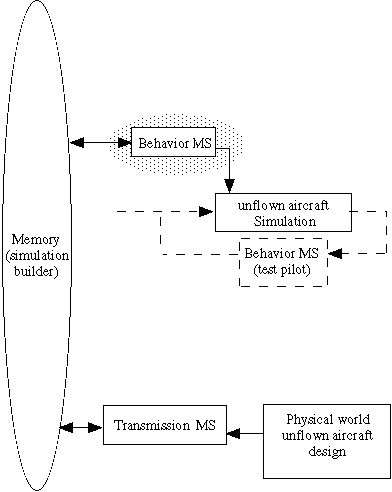
Figure 15.2 - 50 Building simulations from design
The existence of this cadre with their simulation building tools created a whole class of new learning opportunities. With a completed simulation built from tools a test pilot could learn to fly the aircraft, using all of his highly developed physiological senses in a safe environment. He could get experience with a new aircraft before taking off – possibly before it was built.
15.2.6. Step 6 Repairing simulation building tools
The Step 5 learning activity opens a second learning activity similar to Step 3 (refer back to figure 15.2 30). Previously in Step 3 we discovered that when a simulation taught a pilot incorrectly, we could use this information to repair the simulation. However, when a simulation is created for a system that exists only as a design, then when the simulation produces errors in prediction, these errors can be used to repair the simulation building tools as well as the simulation.
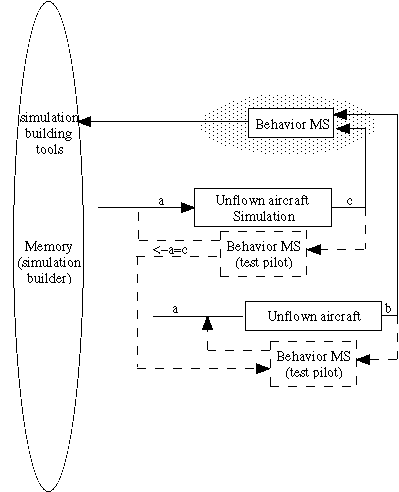
Figure 15.2 - 60 Step 3 repair simulation-building tools
Notice that in Figure 15.2 - 60, the dashed lines and rectangles are learning of the test pilot the solid symbols and arrows refer to the learning of the simulation designer.
15.2.7. Step 7 Using simulations to choose pilots
When Boeing brought out its model 727 they also created its simulator. Just consider the following as hypothetical since the data to prove its truth is not available. Older more experience pilots had more trouble learning to fly the simulator than relatively inexperienced pilots. At first they attributed the experienced pilot’s failure to the simulation which they assumed was error. However, as the planes rolled off the assembly lines and took to the skies the experienced pilots had more trouble flying them than their juniors.
May be the simulator was not in error. Maybe as shown in Figure 15.2 - 70, the simulator could pick good pilots for an aircraft.
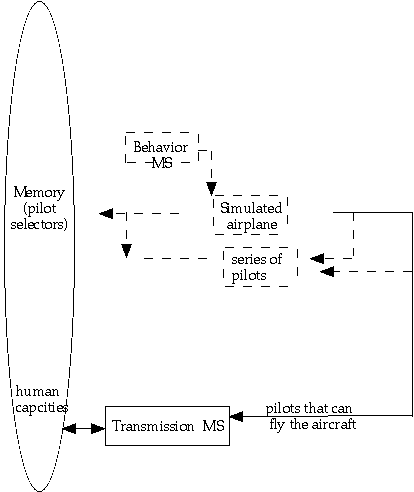
Figure 15.2-70 Simulators pick good pilots
15.2.8. Step 8 Using simulations to redesign aircraft
The information resulting from simulation and real world experience established that the 727 design was different than older aircraft. If they could just find out what it was they could redesign the 727 to make it appear in the cockpit similar to older aircraft and thus easier to fly for experienced pilots.
They eventually traced the difference to the new control system of the 727. Older pilots felt the impending stall of older aircraft through shaking in the control yoke between their legs. The shaking was felt because of the direct connections between the wing’s control surfaces, which began to flutter just before the whole wing stalled, and the airplane fell out of the sky.
The new hydraulic control system used in the 727 and later the "fly by wire systems" of newer aircraft removed the direct connections. In fly by wire airplanes, the yoke movement is sent to the computer and the computer sends a message to the actuator, which changes the control surfaces of the wing. The control surfaces in these newer aircraft shuddered. However, the shuddering was not communicated to the yoke.
This did not bother the young pilots they had never felt this shaking and thus relied on other indications of stall which were also provided in the cockpit. However the senior pilots, that had grown up with the shuddering treated its absence as a cue that stall was not eminent. They could have observed the other stall indicators but their experience told them that the yoke shaking was a better indicator than the stall horns, which they felt, were too conservative. The older pilots ignored the stall horns and were waiting for the yoke shake when the aircraft stalled and they lost control.
That’s an easy redesign. If control surface shudder is a good cue for pilots to have and the aircraft control systems removed it. Control sticks of "fly by wire airplanes" are now often equipped with a motor that shakes the yoke when a sensor on the wing’s control surface senses the flutter before stall.
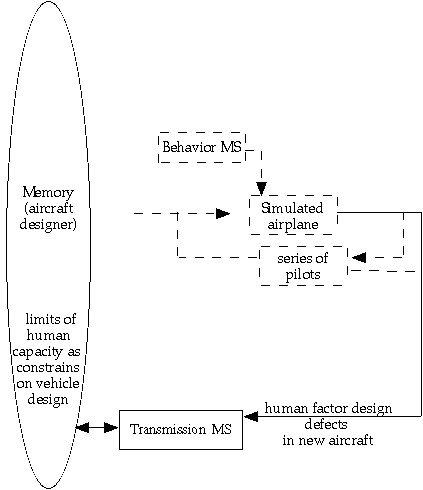
Figure 15.2 – 80 Step 8 Using simulations to redesign aircraft
Step 8 learning is the same as step seven learning except as shown in Figure 15.2 - 80 the solid lines refer to the learning of the aircraft designer rather than the pilot selector.
15.2.9. Step 9 Using interacting simulations
Pilots are systems. Therefore, simulations can act like pilots. Furthermore, pilot simulation outputs can be fed to the inputs of aircraft simulations, whose outputs can be returned to pilot simulations. The aircraft simulation can be flown by the pilot simulation.
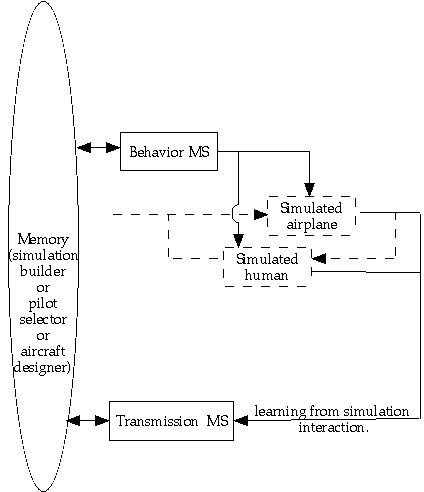
Figure 15.2 - 90 Step 9 – Learning from interacting simulations
The interaction among simulations opens many opportunities for learning and learning about learning.
First a simulation can learn from a simulation. The aircraft simulation can instruct the pilot simulation by responding to its commands. That is, the pilot simulation, since it simulates a behavior MS, can change its structure based on the aircraft responses to its behavior.
Second the simulation builder, or human factors engineer, or aircraft designer by directing the behavior of the pilot simulation, can learn the planes limitations. Or by directing the aircraft's failures, or the weather the aircraft is flying through, can learn about the compatibility between aircraft, the pilot.
For example, an observer can identify when the pilot simulation wants to put in a control that the airplane can not perform. Or when an airplane produces conditions to which the pilot simulation can not correctly respond. That is if the same conditions were presented to the pilot in the real world the pilot would lose control, damaged the airframe, or crash the aircraft.
Let me give a second example. Flying skills vary widely among pilots. Pilots focus their attention on different aspects of the aircraft; for example the shaking yoke. A pilot simulator can simulate all of these different pilots and thus it can be used to learn how a range of pilots will respond to an aircraft design.
Conversely, six different designs of a not yet built aircraft can be tested to see how one pilot flies them all.
15.2.10. Step 10 Discovering simulated time
Exercising all possible pilots and all possible aircraft designs through hundreds of hours of flight can keep interacting simulations at work for thousands of hours. Getting answers could take months and even years. That is just too long. Simulation designers began searching for ways to speed things up.
They began with a review Figure 15.2 - 90 where the primary objectives of the activities was to design better aircraft, pick better pilots and make the simulations more accurate. Figure 15.1 - 100 is very similar instead the primary objectives of the activities is to do those tasks faster.
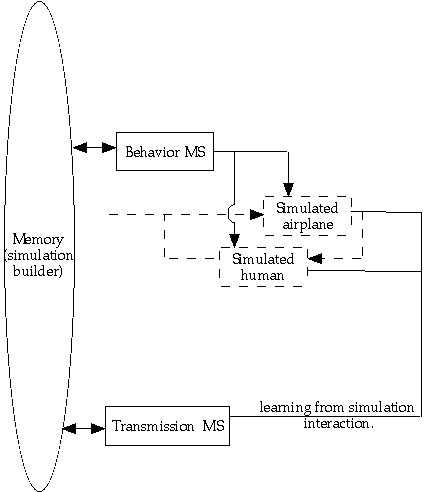
Figure 15.1 - 100 Step 10 – Simulation time and clock time
Simulation designers first focused attaining faster results by running multiple sets of interacting simulations. That meant two computers just to double the speed and halve the time. These computers were not much more powerful than today’s desktop, However, at this time in history a computer big enough to run such interacting simulations would fill a three car garage, an industrial connection to the power grind, and enough air conditioning to cool three homes. The engineers, by economic demand then focused on ways to get one second of simulated time to take less duration than one real second.
It turned out that this latter idea was not as hard as it sounded. The one-second-duration of a simulated second, originally was chosen in flight simulators to give the proper look and feel when the student pilot flew it.
The first simulation of a pilot, built to accurately reflect the pilot’s senses and reactions, also used one-second durations to perform one second of simulation time. If both simulations performed their operations in lock step with clock tics from two clocks, there was no reason to have two clocks. Both simulations could pace themselves using the tics from the same clock.
After both simulations were running using the same ticks, the simulation designer discovered that the interactions between the two simulations would be the same even if the clock did not keep exact time. As long as the pilot and aircraft simulations could accomplish their respective computational tasks between each tic, that is as long as the plane simulation correctly presented itself to the pilot simulation which correctly responded and presented actions to the plane simulation, the duration of a simulated second could be chosen to be any real time duration.
If the duration of a simulated second was set to a tenth, a hundredth, or a thousandth of a real second then the two simulators could complete their interacting tasks in one tenth, one hundredth or one thousandth of the time required in the real world. Engineers could complete their observation of interacting simulators ten, a hundred or a thousand times faster.
Did the ground just shake for you. It did for me when I realized on to what I had stumbled. Learning about the future was no longer tied to:
By changing the duration of a simulated second I had a causal way of making multiple variable interacting systems unfold their future in the present.
Learning took on a whole new meaning. Content which heretofore was unattainable was now within my grasp using simulations driven by simulations.
All that was required were interacting simulations that represented the:
15.2.11. Step 11 Temporally modified simulations
Experience changing the duration of a simulated second had some additional benefits besides getting the:
The variability of the duration of a simulated second within a single simulation that interfaced to the physiological senses of a pilot could create a special learning environment never before see without all of this technology.
Let me give two examples the first a familiar theoretical example already used several times in this book "learning to play catch in a strange land," And second, "learning to land the lunar lander," based on a brief conversation with a NASA simulation engineer.
- Learning-to-play-catch
Assume that parents took their infant to a strange planet where a thrown ball took six months to reach from the pitchers mound to home plate. In this strange learning environment, using the normal trial and error procedures, the child would have little opportunity to learn to play catch It would take lifetimes to build the same database built in one afternoon on Earth.
Furthermore, even if the child lived long enough to have the appropriate number of experiences, the child’s physiological mechanisms that remember the feelings associated with the throw would not retain them for six months. When the ball finally got to its landing location there would be no feelings of the throw left in physiological short-term memory. There would be no short-term memory of the intended destination. Lacking these there would be no way to perform the normal comparisons. There would be nothing in memory to modify to obtain the next throw. Human learning capacities would be defeated.
Enter a physical simulation of the strange planet. However, in the simulation the simulated second is shorten from a real second until in the simulation the ball takes only two seconds to get to the destination instead of six months.
Now the child could learn all the subtleties of various ball speeds in relation to various ball trajectories using trial and error, just as they would in our natural world. For example he or she would learn to throw low fast throws to get to the ball to the destination quickest. He or she would learn that to get the greatest distance by throwing the ball at a 45-degree angle with horizontal.
The physical simulation of the slow world, facilitates learning by reducing an impossible situation to one that can be solved using genetically optimized physiology based learning.
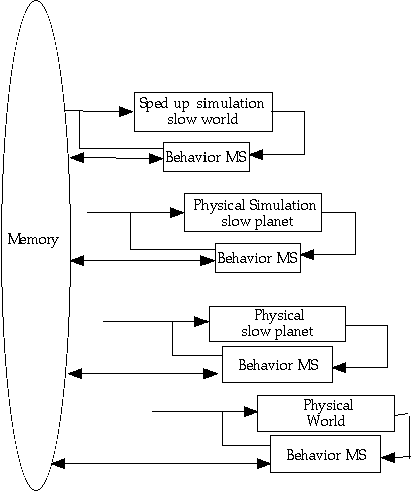
Figure 15.2.110a Learning to play catch in a slow world
The learning steps are shown in Figure 15.2-110a.
- Learning to land the eagle
The following story was related to me in an informal conversation by a NASA simulation engineer. Its authenticity can not be verified. Just consider it a hypothetical used in my learning path to temporal sight.
The lunar lander, the eagle, was a 1/6 gravity, wingless, rocket propelled rock, with some shock absorption landing appendages. It had a very limited fuel supply. Which meant the Eagle’s pilot had to do everything pretty much correctly the first time. Multiple tries at landing would consume too much fuel and the rock would crash on the moon. Worse the rock would land but would not have the fuel to get back to the command module orbiting the moon.
The pilots had lots of experience in operating in the gravity on earth and in the micro gravity of space. But no experience in the one-sixth gravity provided by the moon. There were few if any good ways to create these feelings for the astronauts. They would have to rely on instruments. If these instruments failed then they would not be able to fall back on feelings created from experience and the powerful computational physiology that went with it.
NASA made a simulation of the eagle and the moon and they let the astronauts try and land it using different sets of instrumentation and visual views. They even tried some landings without a lot of instrumentation assist. That is the astronauts flew by the seat of their pants; a physiology which had no experience in the domain of 1/6 G.
Apparently, the eagle, with diminished instrumentation was nearly impossible to learn to land. One simulation engineer got the idea that they should expand a second of moon landing time to two seconds in the simulation. This gave the pilot twice the time to sense his environment and twice the time to create and execute his behaviors.
After the pilot found a combination of sensory parameters, computations, and behavior actuations, that he could read and used for successful landings of the slowed down simulation, the simulation was sped up incrementally. The pilot used the learning at each successful level to solve the control problem at each slightly faster level until the simulation was operating at the one simulated second for each real second.
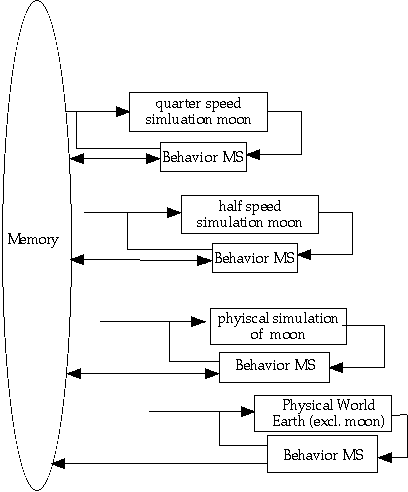
Figure 15.2.110b Learning to fly the Eagle
The steps are show in Figure 15.2-110b:
I have no proof that these experiments existed. I only know that at least some simulation engineers at NASA gave the experiments, or the hypothetical experiments serious thought relayed that thinking to me and became step in my journey toward a view of temporal sight.
Temporally modified physical simulations could bring both
a) success to learning situations that might other ways be impossible. And
b) advancement to my own temporal cognitive development, that is to be sensitive to expanding or contracting time in a simulation as a means to understand my dynamic world.
15.2.12. Step 12 Discovering mental simulation
Thus far all of my learning experiences relied on an interface between a physical system and my physiology. I learned from physical simulations that made airplanes appear to me. I learned from watching physical people fly the physical simulations of airplanes. And I learned from watching one physical simulation fly another.
In each case a physical system provided what I was sensing. For example, in the earliest flight simulations, physical change was limited to moving cockpit instruments. As simulations became more advanced I heard engines groaning, wind whistling and tires chirping. I saw out-the-window-scenes of the mountains or runways approaching. In the really good simulations I felt the motions of hard landings or bumpy weather. From this trend, one might conclude that the quality of "simulation supported learning" depended on how much of my personal physiology was accurately stimulated.
However, when learning began to depend on simulations driving simulations, that trend reversed. When simulations began driving simulations all that was produced was printed summaries. Learning could be accomplished limited to the physiology required for reading symbols. All that was required to create the printed symbols was a bunch of tiny bits of information flying around inside a computer. I learned that:
simulations can provide learning through summaries of moving bits of information,
If:
learning can be had from moving tiny bits of information,
and
the human mind can move tiny bits of information,
Then:
learning based on simulation can be produced entirely within the human mind.
For example, I can remember the first day I saw a 747 fly. That night I had a dream only a crash test engineer could have. In the dream I saw a 747 crash into the ground. However, instead of seeing a big fiery ball of flame and hearing a loud explosion, the crash happened very slowly. I could see the plane slowly bend and tear apart.
First the nose hit the ground at about a 30-degree angle. The front 120 feet of fuselage began to fold up like the paper cover of a soda straw. The rear of the plane held it shape undamaged. When the middle of the plane approached the nose, the wings slowly detached in two big hunks and floated horizontally beyond the crash site as the rest of the fuselage continued to fold and tear apart.
Wait a minute. There had never been a 747 crash. There had never been a 747 crash test. There was no super slow motion film of the event for me to recall. My mind had created all these views. My mind had made a mental simulation and the simulation had created these images.
My mind had built the simulation from my images of running automobile crash tests – hundred’s of them. Coupled to these real time images were images produced by viewing and reviewing the super slow motion movies of these same tests. Together they developed my library of mass, force, deformation relations that could be used to create mental simulations that could crash anything in slow motion – including a 747!
How do I know that what I saw was not just a fantasy like it would be if a fire breathing dragon burned up the 747? How do I know that the deformations were mechanistically built, based on the relations that exist among mass, force and change in speed? The 747 dream was silent. I did not hear any crash sounds.
The silence is explained by the missing content in my memory. For example, while all the memories of hundreds of crash tests that I witnessed contained the thud of the car hitting the wall mixed with the thuds of dummies hitting the car interior, these thuds were not present in any of the slow motion images. (FN) The silent 747 crash was a direct result of my experiences with "silent" slow motion films, which did not reproduce any crash sounds. My mind’s simulation could create images of the 747 crashing but not the sounds of the 747 crashing in slow motion.
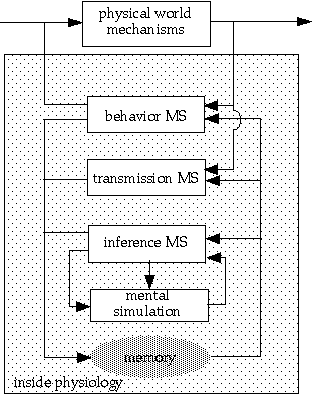
Figure 15.2-120 Mental simulation’s contributions to memory
It took twenty years of learning research to facilitate a reflective view of the 747 dream. It was presented in Chapter 14 and is repeated here, in Figure 15.2-120. I concluded that:
The output of the mental simulation within the inference structure could shape behavior and guide cognitive development. When causal mechanisms are used to make mental simulations, the inference MS can get beyond the limits created by logical mental manipulations. The simulations, driven by compressed and expanded clock tics, create future images of events that never previously existed. These images become the basis for feedforward control.
15.2.13. Step 13 Fuzzy self referencing mental simulations
Up until this step, my experiences in my search for a view of temporal sight, while unique, could be reproduced. A person with engineering training, running crash tests, simulating crash tests, flying flight simulators, using flight simulators to train pilots or to design airplanes, designing and building interacting simulations, and optimizing these interactions, could have had all the experiences I had and at least an opportunity to learn the things I learned. An observer could have the opportunity to make measurements of these learning experiences.
However, as I proceed through the remaining steps you will see that the experiences are the manipulations of mental abstractions within my mind. In these abstractions, the mechanisms and connections are quite hidden from direct measurement. They are less concrete than the mechanisms, connections , initial conditions, and trial behaviors observable when watching a person as they experience a physical simulations.
The abstractness makes it more difficult for the researcher to understand or modify any particular mechanism or its connections. It is more difficult to understand:
In addition to the fuzziness of the abstractions, the trial behaviors fed to mental simulations are themselves abstractions. Instead of being traceable to past experiences, transmissions and logical extensions, they are products of mental simulations. They are the end result of another layer of connected hidden thinking mechanisms as shown in Figure 15.2-130.
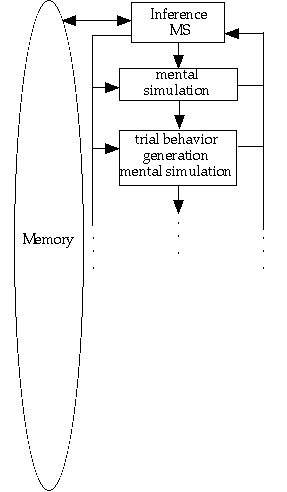
Figure 15.2-130 Mental simulations driving mental simulations
The fuzziness due to abstraction, the obscurity due to self-referencing (recursiveness due to the mental simulations driving mental simulations) makes replication of the next steps more difficult.
Without replication, the steps can not be, tested, manipulated or proved. At best, descriptions of my mental experiences must be considered hypothetical and candidates for future research.
I am willing to take this risk into the hypothetical because using mental simulations to create trial behaviors that manipulate either the physical world or physical simulations facilitate the feed forward control capacity of human thought and action.
Mental simulations provide images of the future based on causal extensions of the present. The images can be those that lie beyond images created by recall of past real behavior, transmissions of the results of other people’s behaviors, or even logical extensions of those behaviors. These extensions are made possible because the images are not dependent on the constraints in motions (changes) imposed by physical mass.
Using mental simulations to create trial behaviors, for mental simulations, extends this feedforward control capacity to another level. It implies an even higher level of cognitive development. It also makes the tracing of either the production mechanics and the underlying cognitive development all that more difficult.
With these caveats, I briefly describe the last and the most hypothetical parts of my journey to a view of temporal sight. These include the:
15.2.14. Step 14 Mental simulations in thinking
Mental simulation as a subset of mechanisms within the inference MS. Mental simulations make their contributions to behavior, and cognitive development by creating and placing in memory some of the images resulting from the inference mental structure. The flow of these contributions to memory can also be seen in the trial model I am using to describe my path to a view of temporal sight Figure 15.2-140a
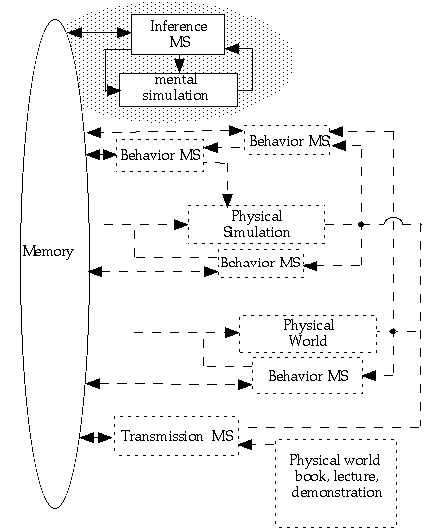
Figure 15.2 -140a Mental simulation in the trial model
Double-headed arrows have been used to show that information flows both to and from memory to some mechanisms. This means that the products of mental simulation can be used in any of the mental structures and in any of the flow patterns in the previously described steps. Also that any images created by any mental structure can be used in the creation of mental simulations.
However, this is not the full story. Memory can contribute content and structure to any mental structure. That is, memory can feed a mental structure the:
Let me add some detail to the trial model to depict the difference between these two flows. Figure 15.2-140b shows that when memory contributes conditions to be processed by a mental structure they enter from the side of the rectangle.
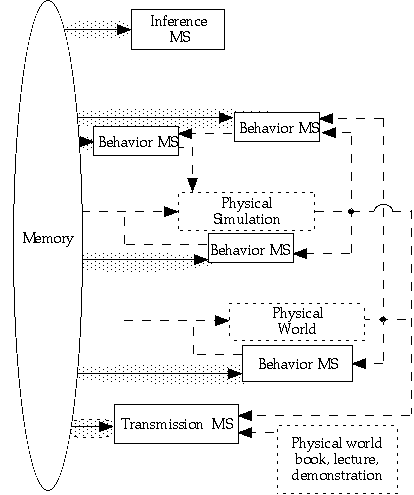
Figure 15.2 -140b Memory contributes conditions to be processed
However, when memory contributes changes to mechanisms within the mental structure, the information enters from the bottom or top of the rectangle as shown in Figure 15.2 -140c
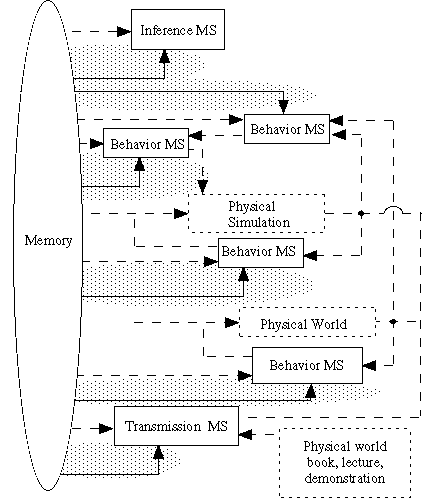
Figure 15.2 -140c Memory contributes mechanisms to do the processing
Changing the mechanisms changes not what is processed but how it is processed. It changes what information is attended to. It changes thinking. These changes in thinking can be simple equalities resulting from direct experience, transmission, logical inference, and even serendipity. Some of these changes can be algorithms.
However, some are more than algorithms. They are active agents which both poll for their needs and can be in a continuous state of structural change. Some are created by a recursive nest of mental simulations. These might be considered agents of cognitive development.
By cognitive development I mean that the focus of attention is internally directed. What is paid attention to is controlled by a mental simulation. If the student wants to learn to play catch, the coach should certainly get more attention if he is throwing a ball from one hand to the other than if he is describing the color of the ball.
Let me relate this focus of attention attribute of mental simulation to the Martian child’s learning problem. A car going 30 MPH is a different system than a car standing still. At 30 miles per hour, every object in the car has more energy, than that same object in the car standing still. The focus of attention is more on energy management than the make or color of the car.
When a person sees a car, or is traveling in a car going 30 MPH they see an energy management problem. When a car decreases its speed to zero everything in the car must give up energy. The energy given up is equal to force applied to the object times the distance the object travels with the force applied. To get rid of a given quantity of energy within an object using a long distance takes a smaller force, than the force required to get rid of the same amount of energy in a short distance.
The Martian child has some experiences that establish these facts. He or she has decreased the car speed to zero using different braking forces. The two experienced distances were 30 ft and 300 ft. The two resulting experienced forces were,
1) not large enough to move the pie off the seat and
2) large enough to move the pie onto the floor.
The generalization is that the shorter the distance the larger the force.
After building a mental simulation that produces this information, he or she can create a range of trial behaviors. The limits of this range can be very long distances (coasting to a stop) and very short distances (running the car into a fixed object.)
A summary of the stopping distances and the forces to bring a 150-pound person to zero from 30 MPH are presented in Figure 15.2-140d. For example, a stopping distance of 10 feet requires a 450-pound stopping forces.
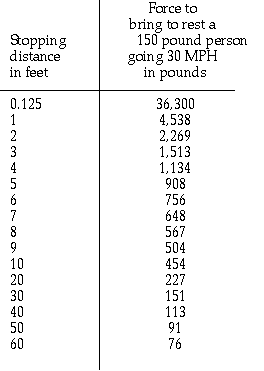
Figure 14.2-140d Forces to bring a passenger to rest
450 pounds exceeds peoples’ ability to hold themselves on the seat so even slowing from 30 MPH in ten feet will cause an unbelted person to hit the dash.
In an accident, Running into a tree at 3OMPH produces a seat stopping distance of 1.5 feet. If 150-pound person wants to stay on the seat he or she requires a restraining force of about 3000 pounds.
If he or she failed to provide this force by wearing a seat belt and as a result smashed the dash, his or her body would then change from 30 MPH to zero in 1.5 inches (.125 ft). This would require a force of about 36,000 pounds (18 tons) or about the weight of ten cars. No wonder unbelted passengers are so injured in 30-MPH car crashes. It is like having a car with 10 cars stacked on top of it run over you.
15.2.15. Step 15 Building mental simulations
The creation and use of mental simulations in thinking and learning was originally outlined in Chapter 14. Figure 14.3-60 showed the extra tasks in the inference mental structure’s meaning maker which were responsible for creating and using mental simulation. Three of these, high lighted in Figure 15.2-150a, are the central elements in feed forward control of thinking.
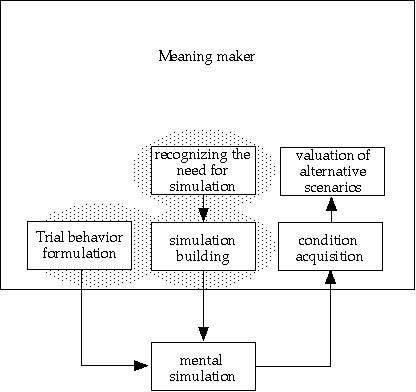
15.2-150a Feed forward control elements of thinking
The last 14 steps through the trial model, provide clues as to how "simulation building," "trial behavior formulation," and ‘recognition of need for a simulator," operate and could have been acquired. Here I focus on mechanisms within "mental simulation building." In Steps 16 and 18 I will focus on "trial behavior formulation’ and "recognition of need for a simulation." In each case I discuss the people’s limitations to perform them when most of the relevant information and processing capabilities are in place.
Building a mental simulation is a similar task to building a physical simulation. In making a physical simulation, behaviors create a device in the physical world which:
The creation of a simulation depends on the collection and assembly of relations and initial conditions describing the physical world. This information comes first from polling memory. However, if the physical simulation can not be completely assembled in a consistent manner, the meaning maker in Figure 14.3-40, triggers the action generator to perturb or search the physical world with intent to get the missing relations or conditions.
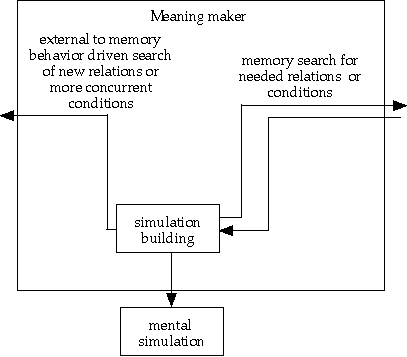
15.2-150b Feed forward control in mental simulation building
In building mental simulations, Figure 15.2-150b, the simulation building mechanisms must perform the same tasks. The recognition of information inconsistency or incompleteness depends on images in memory. However, from the previous 14 steps we know that these images depend on all previous learning. For example, transmission learning or experience with the:
If any of these experiences and resulting images is not available or the time required to create them is not available, then the mental simulation suffers.
For example, without some experience with inference thinking, specifically temporal aspects of inference thinking, how would the mental simulation builder know that the mechanisms gathered were an incomplete description? How would they know that the initial conditions gathered were not concurrent (all taken from the exact instant in time when the trial behavior would be elected?)
I realized further that the images required to build mental simulations were not placed in memory in their fully fleshed out form. The images were the result of an iterative dance. They were accumulated from a process that oscillated between the building and using of mental and physical simulations. An individual needs some physical experience to build mental simulations. They need some mental simulations to build physical simulations.
Superimposed on this oscillation is a second oscillation between content and context. For example, both mental and physical simulations produce errors. The error creates an incorrect image of the results of a behavior. These incorrect images can be content error. However, if a simulation creates a content error, which can be traced to many simulations, then we have a context error. This second kind of error leads to learning about:
useful temporal distortions in simulations as aids to learning. This meta learning contributes images that help in the building thinking and learning processes.
15.2.16. Step 16 Mental simulations create trial behaviors
The second set of mechanisms within the inference MS’s that contribute to feed forward control is trial behavior formulation.
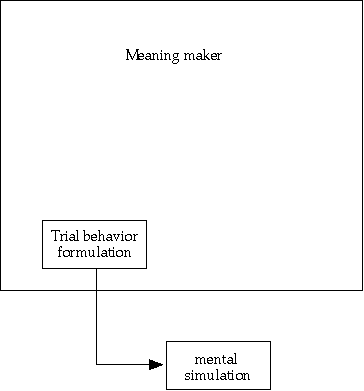
15.2-160a Feed forward control by trial behavior formulation
As seen in Figure 15.2-160a a mental simulation must receive trial behaviors to produce images. Discovering the mechanisms by which these trial behaviors were formulated will require endless research. However, an inspection of existing trial behaviors suggests processes, which produce feed forward control over thinking and learning.
For example, trial behaviors that derive from direct experience, coaching, or logical extensions of these behaviors are not examples of feed forward control. Trial behaviors, stemming from images created by mental simulation are. This has already been explained in Step 13 and Figure 15.2-130, which shows the possibility of a mental simulation driving a mental simulation.
For a third time in my journey to a view of temporal sight the ground shook. What was driving the trail formulation in the heads of the NASA pilots when they were learning to fly the lunar lander simulation? If the answer was all of the above would imply that some of trial behaviors came from the pilots running mental simulations of the strange flying machine.
Anyone who had learned from:
would have some abilities to create mental simulations and use them to formulate trial behaviors.
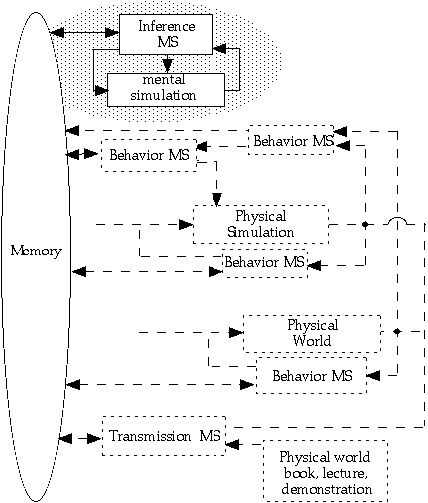
Figure 15.2 -160b Trial behaviors from mental simulation
It follows that trial behaviors formulated by mental simulations within the inference mental structure, and transmitted to memory can be used in any of the mental structures outlined in Figure 15.2-160b. These include:
Transmission MS’s are included because the mental simulation can formulate acquisition filters for symbolized data searches.
To back up one more step, there is another level of feed forward control of thinking and learning in that each of these mental structures in Figure 15.2 -160b can make requests (through memory) and trigger the creation of a mental simulation, which triggers a meta mental simulation, which....
15.2.17. Step 17 Motivation for building and using mental simulation
Understanding that a car can crash and create injury without an experience or a transmission of such information can be accomplished by building a mental simulation of a vehicle slowing down from 30 MPH. The simulation will describe the force to slow down for each stopping distance and the force can be converted to injury. The trial behaviors used to drive this simulation come from a second mental simulation. The first simulation produced images of forces for any stopping distance. The second defines the different stopping distances to be used as trials.
Assume our high school physics educated adolescent from Mars has the ability to create the first and the second simulation. However, just because he or she can build them, there is no guarantee that he or she will execute the option. There has to be motivation to build and exercise them.
This motivation can not use a memory image of injury (at least not crash injury) because these products do not yet exist. The motivation to build the two simulations must come from the existing pre crash (physical or mental) environment.
This may appear un-resolvable. Just as the classic question, "which came first the chicken or the egg," appears unanswerable. The "origin of motivation" to think about preventing crash injury before you have an image of crash injury, and the resolution of the egg chicken question, both resolve when a longitudinal view is applied.
For example, over several million years, life evolved. The chicken gene mutated. The gene incrementally migrated as it was carried from generation to generation. While the present state of the chicken life cycle may lead to a question, which came first the chicken or the egg, no genetic scholar would bother with that question. He knows they both derived from a migrating gene and for him the study of the migration process holds the keys to intervention into the process, not the philosophical question suspended in an instant of time.
Similarly the "origins of motivation" for building a mental simulation must focus on the migration of thought process over time not the resolution of an instantaneous dilemma in temporal order.
We have already described development of the ability to build simulations as a complex process made of many sub processes. These processes run in parallel and compete for dominance. Each process has mechanisms strung together in chains, trees, and loops. The connections among mechanisms are ever changing. Each burst of information down a chain, up the branches of the tree, or around a loop is an iteration leaving in memory an image. Each burst of information is based on images already in memory. The images are the content, context capacities to develop the physical and mental simulation.
I refer to this iterative boot strapping process, because the motivational capacities, that drive the building of mental simulations , must follow the same processes for their development. The "utility of mental simulation," the motivation to build one, came from a lifetime of iterations of the previous 16 steps.
For example, if injury does not yet exist, and must be discovered, what does exist? It is a recursive chain. For example, injury occurs when people walk into walls. Walking into a wall is changing speed. Therefore, anything with speed has the ability to run into a wall and change speed and create injury. Thus the motivation to investigate the car environment for potential injury is the car’s 30-MPH speed relative to objects that can change its speed.
When motion exists, a range of stopping distances exist, a range of forces exist and a range of injury exists. An abrupt halt can create high forces and high forces can create great injury. Therefore while the injury does not exist in memory, the mechanism that causes such injury must be in memory. Mechanisms are a part of a simulation that can:
15.2.18. Step 18 Recognizing when mental simulations are needed
The most critical part of motivation to build mental simulations is recognition of environments that require a simulation to manage its temporal characteristics. 15.2-180.
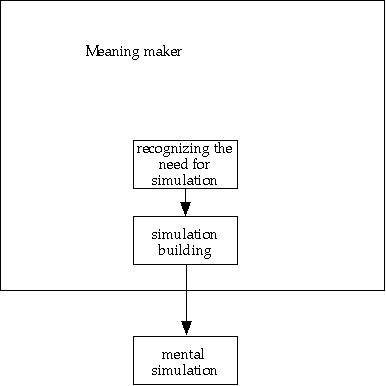
Figure 15.2-180 Feedforward control based on recognizing need for simulation
Recognizing a part of one’s environment
For example, in conversations with NASA simulation people I was in awe of the breath of their understanding of humans and the use of simulations that helped them learn to land on the moon. The group of scientists that focused on human factors, human computer interface, learning, system design, and piloting all performed their duties at the edge of the envelope of human capacities. These were the best and the brightest, and certainly the right stuff – they got to the moon and back.
However, with all these special skills, all this experience which included much success (and much learning from failure) not one of these people could read the morning newspaper, and RECOGNIZE, their world as a system in need of the same special skills they applied to their everyday job. They could not recognize their world as a system:
They could not RECOGNIZE, that the behaviors available to modify the trajectories were too small to avoid collision. They could not recognize their world as a social physical system that while driven to great speeds by their collective behaviors was not capable of being safely steered by the institutions they had chartered for the task.
If they could make this recognition, they would immediately have built mental simulations to understand the possible alternative scenarios.
15.2.19. Step 19 feedforward control of thinking
The trial model shows that:
1) the output of any mental structure is fed to memory and from there to an array of other mental structures including looping back through the mental structure that created the image in the first place.
2) An image from memory can be used by a mental structures as information to be:
3) The behavioral output of a mental structure can be used to change the world, a physical simulation, or a mental simulation.
The alternative uses of the same output are diverse. With so many options:
1) What determines the use (or disuse) of information?
2) What controls if the information goes to one mental structure or many?
3) What makes it pass through a chain, tree, or a loop?
4) What determines if the flow of information flows through:
5) What maintains control of the flow of information in a recursive stack of mental structures. That is, what control process knows that to solve problem "A," you must first solve problem "B" which requires that you solve problem "C." Given this recursion, the flows of information can not be contained in the single layer as shown in the trial model Figure 15.1 -05. Instead the control of information is maintained by a stack of similar models. Control is distributed among these layers.
This complexity makes a brute force approach to understanding control of the human thought processes most cumbersome. To manage this complexity, at least for our objective of understanding temporal sight, consider dividing all learning processes, no matter what their level in the stack into two groups. Those that use physical or mental simulation and those that do not.
This division is useful because we are interested in "thinking" that facilitates feed forward control of learning and behavior. Learning that does not include simulation can not perform feedforward control.
We have already seen that working with simulations, even the most advanced simulations as do NASA engineers or experiencing them as do NASA test pilots, in and of itself, does not lead to the level of temporal cognition which I have described as temporal sight. While the simulations were exotically built and were exhaustively experienced, the resulting temporal cognition was domain specific. That is their appreciation of simulation to understand systems in motion was limited to the cases of experience and could not be applied to the engineer’s or pilots life environment beyond the domain of vehicle maneuvering.
If we assume that:
it follows that:
15.2.20. Summary of steps – Plan for research
My circuitous life has produced this view of temporal sight. While I still do not have temporal sight my goal is to prove to you that we need it. We must find a way for a whole generation to obtain it. We must research thinking and learning as if human life depended on it.
Blind as I am in the next chapter I will proceed to outline research opportunities that may help us understand how educational interventions may be designed to enhance temporal cognitive development.
Chapter 16. Temporal sight building
*The model in Chapter 15, showed that behavior and cognitive development, depends on processes that gather, remember, and construct information. The model shows what information flows among what mechanisms, in what sequence. Harder to show are two implied motivations. One that directs the search within the environment for variables, their manipulating mechanisms, and the connections among these mechanisms. And two, that motivates the integration of these into physical and mental simulations.
The model showed that direct experience with the environment created an ever-changing collection of variables, mechanisms and connections as well as images. Again by images I mean what things are, how they work, and values for them. With the help of logic and physical and mental simulations abstracted experience produced additional images which I called future image. Experiences even change all the supporting processes that facilitate experience.
The model showed how my experiences changed my thinking a small amount and gave me a view of temporal sight, if not functional temporal sight. The model showed how I gained a bias for:
The model does not show the best way for billions of new infants to develop their thinking so as adults they attain temporal sight. This is the task of future research. However, in this chapter I provide directions for these research activities. These include showing that:
1) future research in cognitive development will have to overcome limitations of past research,
2) education objectives will be different when derived from feedforward rather than feedback control.
3) temporal cognitive development requires new differentiations and aggregations of information
3) temporal cognitive development requires new curriculum in a least three new areas.
16.1. New curriculum new research
We are on a search for curriculum that here-to-fore has not been discovered. Based on research that here-to -fore has not been attempted. The first task is to place this new research in context to what has come before.
Jean Piaget, a French psychologist, described cognitive developments in his children. From observations of when his children mastered progressively more difficult tasks he hypothesized a progression of capacity developments and an age range when most child attained them.
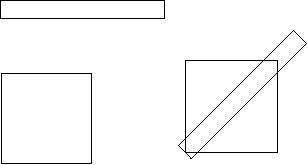
Figure 16.1 -10 Which is bigger the ribbon or the square?
For example, one of his experiments showed, that a young child compares the size of two pieces of cloth ignoring area and using only the longest dimension of each. For this young child, a one-foot long by 1-inch wide ribbon of cloth is "bigger" than a square of cloth six inches on a side. That the square has 3 times the area of the ribbon does not, for the young child, make it bigger. One foot is longer than even the diagonal of the six-inch square. When the child advances to Piaget’s next cognitive level the square of cloth is bigger than the ribbon of cloth. The child uses two dimensions simultaneously, or area, to measure size.
Other researchers confirmed that "Piaget’s development path" was true for most children independent of their culture. These observations suggested that some cognitive development was a genetic unfolding driven by experiences available in the environment common to all cultures. These include, conservation of 3 dimensional space, gravity, inertia, temperature, wetness, wind, light, time and some common parts of a social environment, like language or demonstrations of physical life support behavior.
This form of "descriptive" research left open an important question. "Are there some cognitive developments, left uncompleted because this common environment was too impoverished to facilitate their development?"
Descriptive research can not answer this question. Nor can descriptive research describe sequences of experience that lead to their development.
Consider, for example, what additional cognitive development might be made possible by part time exposure to micro gravity. Suddenly, the difference between
becomes accessible through sensed experience and behavior can be guided by physiological computation. This is far different that behavior guided by abstraction created by a manipulation of Newton’s equations.
Consider what new advancements in temporal cognition might become possible, if motion near the speed of light was present in the common environment. Then understanding shrinking or expanding time would be a common experience rather than only an abstraction understood by those that manipulate Einstein’s equations; or those that manipulate physical learning simulations.
Since temporal sight, as I have described it, has not been developed by any individual let me hypothesize that:
the common environment inhibits a natural genetic unfolding process
that would result in an advanced form of temporal cognition
that would support a succession of learning experiences
leading to a more advanced temporal sight.
If this hypothesis is true, then developing temporal sight would be accomplished through changes in the common environment. For example, adding new experiences, subtracting old experiences, changing the order of experiences, or a combination of the above.
The previous chapters have already shed much light on this question. In summary, To overcome the limitations of descriptive research (Piaget et al), the new research will have to be causally predictive, to allow it to visualize changes in thinking that have never before existed; as well as new experiences and sequence of experiences that could lead to them.
The research must describe thinking capacities that "could be" rather than thinking capacities that "are" and sequences of experiences that could be rather than those that have been.
16.2. Feedforward control of educational objectives
Society picks the experiences it provides its young.
How does it make these choices?
What objectives are to be met through educational efforts?
How did parents, teachers and society choose (come to accept) these objectives?
The answers most of us would give reflect cultural habits. However, these habits are modified by the benefits and liabilities that accrue to the student, to society, and possibly to the teacher.
Education can help the student establish his or her material well being, improve his or her chances of passing on his genes, and promote his or her hierarchy in the social group.
Unfortunately, some of these benefits promote conflict within the community, both in the present and in the future. These liabilities, when recognized, alter conventional educational objectives. However, when liabilities are not recognized, they can have no affect.
Since none of these "objective-choosers" has temporal sight, there is a class of future information that never gets an opportunity to shape educational objects. For example, who ever heard of an educational objective like: "each individual should behave in a way to provide a clean, abundant and peaceful environment for unborn great-great grand children."
For this objective to shape curricula, there must be a structural change in an educator’s "objective-choosing" process. Surprise (or no surprise if you have been reading carefully) if we want this change in our educational objectives we have to use a feedforward control process rather than the feed back control process that exists today.
16.2.1. Feedback control of educational objectives
Our current educational objectives, and our current learning activities are based on feedback control. The acquisition of additional objectives, depends on the use of feed forward control.
I have presented feedforward and feedback control processes in other contexts but now we apply these differences to the design of educational objectives.
With fear of being redundant I repeat definitions first presented in Chapter 12.
Control models make explicit:
The definition of control is:
"See a bad condition – fix a bad condition. "
Our sight of a bad condition can came from three points in time.
1) The present Ë there are conditions that exist in the present which we want to eliminate.
2) The past Ë memories of conditions that we have had in the past that we want to not repeat.
3) The future Ë we have sight of conditions in our future, which we have not experienced in our past that we wish to avoid.
The word "back" in feedback control, means the system has created a present and observable condition that is the result of the system’s motion from back in time to the present. The conditions may be connected to a behavior taken "back" in time.
Feedback control is the most common human thought process. It is the most common learning process. It is how we learn to walk, and play catch. Feedback learning relies on past action and past world response" to learn that an action causes a response. Feedback learning is the basis of trial and error.
So it is not surprising that:
Educational objectives that reflect feedback control include turning out a student:
These objectives are based on a "feedback" control model. These educational objectives appear wonderful but have limitations. The limitations are defined by limitations in the feedback control model.
The unstated assumption about feedback control, is "If its not broke, don’t fix it." Backyard mechanics live by this rule. However, this guiding rule is the Achilles heal of systems controlled by feedback. Feedback control requires that the bad condition exists today to get the repair process rolling. If there is no bad condition to observe, there is no problem to fix. For system’s whose bad conditions exist only in the future (that is they have no physical presence in the present), feedback control is not functional. For these systems we need to use feed forward control.
16.2.2. Feed forward control of educational objectives
In feed forward control, while the driving condition never exists in the physical world, action to avoid it is still created. The motivation for action comes from an abstraction – a prediction of the future bad condition rather than the existence of the bad condition.
Feed forward control, like feedback control has an Achilles heal. Its weakness lies in our lack of motivation or inability to create believable predictions. Without a prediction, there is no possibility of feed forward control.
Predictions derive from many processes. Some processes create predictions that are seen as weak. Some processes create predictions that are seen as strong. Unfortunately, with our limited temporal abilities, predictions from causal trends are seen as weak when they are usually very strong. Predictions from rules of thumb (cultural mythology) are seen as strong when some times they are weak.
Feed forward control when dependent on causal "trends" can be summarized as – "See a bad trend – fix a bad trend." However, seeing trends and fixing trends is not our educational objective. Making predictions, learning how to create them from trends, comparing them to other predictions, ranking their ability to correctly predict the future relative to their competitors is not our educational objective.
We are picking our educational objectives using feedback control and fixing bad trends would only be seen if we were using feed forward control.
The feedback control learning models, that underlay most current learning activities, do not help the student develop predictive skills.
This skewness of educational objectives is not surprising given that the educators themselves do not have as their goal to reverse societal trends. Teachers define war as a condition. They do not define a trend toward war (when there is peace) as a starting point that defines a learning objective.
Neither is it the teacher’s objective to reverse the trend toward famine when there is abundance, or reverse the trend toward pollution when the environment seems clean.
In a larger sense it is not the teacher’s educational goal to have the next six billion individuals choose behaviors that control trends. It is not the teacher’s goal to have them choose different behaviors than they, the teachers themselves choose.
Controlling trends is not on the teacher’s personal agenda outside of school. Saving the species may be each teacher’s personal wish but it is not their intellectual agenda. It is not surprising that reversing trends is not in the teacher’s curriculum.
Existing models of learning differ from the one proposed in Chapter 15. Current learning models have feedback objectives. The temporal learning model promotes feed forward objectives.
Present learning models have as their central hypothesis that knowledge exists and the learner absorbs it. New knowledge is serendipitously imagined and tested by scientific method. Knowledge results from activities that use feedback structure.
In the feed forward model of learning, students make predictions about the future conditions that have never existed (or at least have never been experienced by the student.)
The student’s predictions are a form of knowledge, which did not previously exist at least for the student. The key idea is that if the students can create new knowledge in their learning process, they will be able to motivate action to avoid the predicted conditions. If the students learned the knowledge through language, it is no more valid than any other bit of information most of which has been shown to be suspect and thus not worthy of use in decisions that demand immediate cost.
The feedback learning model has been in place as long as human communication. It is unfortunate that for all of this period social systems have moved toward war, famine, and pollution and we have come to accept these social conditions as natural and acceptable. For example, we accept the injuries that go along with car transport and worse drunk driving.
However, motivation for a new learning model, one based on feed forward control, has appeared. It is the societal movement toward war, famine and pollution. We either find and implement a new (feed forward) learning model that turns out people who think differently from ourselves or we follow this movement into our future.
Using feed forward control over any system, be it physical, thinking, or the development of thinking, depends on motivation to create and use physical and mental simulations. Cognitive development, the advanced form we need to create temporal sight, depends on motivation that is not created thought interactions with our natural and social environments.
Even when an individual has the extra experiences of engineers who design and build simulations, or the special experiences of pilots that fly both the simulations and the aircraft, the resulting motivation does not motivate the advancement of cognitive development toward temporal sight. What is developed, motivates the building and using of simulations only for the narrow environments in which the experience exists.
This "domain specific" motivation, does not motivate the building of physical or mental simulations in general. That is, there is no motivation to build simulations for parts of the environment outside of the domain of those extra experiences.
Why is the resultant motivation "domain specific?" The question must be answered to allow us to design curriculum that leads to temporal sight. I suggest that the domain specificity is based on several imperfections in the information stored in each of our minds. And further, that these imperfections were the result of experiences induced by cultural activities.
16.3.1. Understanding vs. knowing information
In Chapter 15, we discovered that:
The information required by these two types of control is different.
To implement feedback control over thinking, learning, and behavior,
To implement feedforward control over thinking,
Ë connected mechanisms (simulations) operate on a continuous flow of variable states (relatively small aggregations of information.)Thus for feedback control the information required in memory includes logical rules and large aggregations, while for feedforward control the information required in memory is causal mechanisms and small aggregations.
Facilitating feedforward control also requires additional information to be in memory. Beyond just the symbolic view of causal mechanisms, there must also be "understanding" of how the mechanisms both work internally and fit together.
The word "understanding" is in quotes because it has special meaning. "Knowing" that an output follows an input is not the same as "understanding" the function that caused the input to be transformed into that output. "Understanding" facilitates the building of mental or physical simulation and knowing does not. Understanding facilitates the possibility of feedforward control and subsequently temporal sight, and knowing does not.
The difference between knowing and understanding has been described by cognitive psychologists, Hinsley, Simon and Hayes. Developmental psychologists like Wertheimer, Piaget, and Smedslund have shown that learning that produces "knowing" is different than the learning that produces "understanding."
- Max Wertheimer’s knowing Vs. understanding
Max Wertheimer begins his discussion in Productive Thinking (1945) by identifying differences in mental procedures used by children, all of whom have successfully solved the same problem. He then uses these differences to predict performance on other tasks.
He discusses the difference between what is taught in an introductory geometry course and what is learned. In his case study, he uses the problem of finding the areas of squares and rectangles. He discusses three students, each of whom can respond correctly if asked the area of a square when given the dimensions of the base and height. However, each student has a different understanding of what he or she is doing.
These differences are not made clear by answers given on a simple test question. They are made clear by asking the student to extrapolate his or her "knowledge/understanding" to a problem which he or she has not seen before - in this case, the area of a rectangle.
The first student (Jane) learns, "The area of a square is equal to base times height." Her proof is that she had been given the quoted statement as an axiom. Her image of the problem is the same as that drawn on the board during class and shown below.
Figure 16.3-10 Area of square - Student 1
The square is not broken up into unit squares. The units of "b" and "h" are given and the equation is "remembered."
The second student (Bob) "knows" what the first student knows, but he also knows that the square can be broken down into unit squares and that the area of the large square is the "sum of unit squares." He "knows" that the sum is equal to the area. (While he could just count the squares, 1,2,3 ...25, he was shown how, to count them by groups the size of the base or height. Thus, when asked for a proof, he separates the large square into unit squares (as shown below) and counts the unit squares in groups of five as shown. He explains "five groups of five sum to 25." Since A = bh = 5x5 = 25 the student is satisfied.
Figure 16.3-20 Area of square - Student 2
The third student (Sue) knows what the previous two know, but when asked the area, she doesn't count all unit squares. She counts only the unit squares of one line and then counts the number of lines. In her equation, b = number of squares per line and h = the number of lines.
Figure 16.3-30 Area of square - Student 3
These differences in solutions might seem very small, especially the difference between the solutions of the second and the third student. But Wertheimer proposes that the differences are significant and clarifies them by asking the students, without any further training, to compute the area of a rectangle.
Figure 16.3-40 Area of rectangle - Student 1
Student 1 (Jane) cannot produce an answer. She does not "know" if the rectangle is similar enough to a square such that the square's equation of area, A=bh, will produce the correct answer. Thus, it was difficult for her to produce any answer.
Student 2 (Bob)proposes to use A = bh. However, when asked for a proof, he divides the figure into unit squares and counts the squares in groups of five (corresponding to "h"). Student 2 shows that because there are 3 groups of 5, the equation A = bh correctly sums the unit squares and gives the correct area!
Figure 16.3-50 Area of rectangle - Student 2
While there are three groups of five, student 2 has missed entirely the relationship between the format of the equation and the spatial relationships of a "right angled 4 sided" figure’s sides to its area. While he has been able to extrapolate his knowledge, it is clear he lacks the understanding of the spatial relationship that is the foundation of the equation A = bh.
Student 3 (Sue) uses the squares equation on the rectangle and produces the proof below which reflects her understanding of the geometric implications of the length of the figure's sides to its area.
Figure 16.3-60 Area of rectangle - Student 3
Thus, Wertheimer shows that a correct test answer does not always determine the level of understanding.
While several different levels of understanding produce the correct response when computing the area of the square, when asked to compute the area of a rectangle, something they have not practiced, the three levels of understanding do not extrapolate equally.
The performance of the first and second student explodes the myth that high test scores reflect high levels of understanding. Many students understand very little. Instead of understanding their scores reflect knowing-a-strategy.
- Hinsley, Simon, and Hayes understanding vs. knowing
Work done by Hinsley, Hayes, and Simon [Hinsley 77] shows students have abilities to distinguish 15 types of algebra word problems commonly found in standardized tests. Each of the 15 types, for example, river crossing problems; round trip airplane-wind problems; mixture problems; etc. - have algorithmic solutions. These algorithms have the same distorted connections to the causal mechanisms in the physical system, as Area = base times height has to the second student's "count by groups of size height and multiply by the base number."
These 15 algorithmic solutions can be memorized and utilized to obtain correct answers. A causal understanding of the physical need never be obtained. The problem with this knowledge is that it does not extend to solving problems in the physical environment that are just slightly different.
Wertheimer's work ,combined with research of the research of Hinsley, Hayes, and Simon, may explain why many students can get high grades on the math sections of SAT's and then never take a math course in college. They can obtain correct answers to problems, but there is nothing beautiful or enjoyable in the solution itself. It certainly does not apply easily to any problem, which they face in day to day life. The reward they did receive for learning these algorithms was a grade written in their report card not an illumination of life.
It is no wonder they don't like analytic problem solving when they obtained their answer by a method that required that they "remember the equation and/or problem type then grind."
This method of learning to problem solving perverted both the path to understanding and educational activities. Possibly unintentionally, tests were designed around the problem solving algorithms. Using the algorithms instead of a more time consuming process derived from understanding, a student could complete a larger number of problems on timed tests.
It follows that if these types of tests were used to admit students to advanced study programs, then a higher value was unintentionally placed on knowing over understanding. Once these programs of study were saturated with students that could learn to know at the highest rates then the curriculum was designed to take advantage of these learning capacities.
It is not surprising then that in advanced programs the requirements for understanding might be diminished. This in turn diminishes the capacities to improve learning abilities that lead to understanding.
Since feed forward control is dependent on the building and using of mental and physical simulations, and the building of simulations depends on understanding rather than knowing, "knowing" curriculums act to confound feedforward control.
I conclude that there is a difference between understanding and knowing. To know something means to recognize it as a fact or as a total pattern without understanding its constituent parts. That is the information that is operated on by connected causal mechanisms. To understand something means the variables and the connected mechanisms have been made explicit. While knowing relies on the simple recall of experience, and algorithmic manipulation of these memories, understanding relies on mechanisms operating on flows of information to create non-experienced future images.
Spatial and temporal variables, operated on by mechanisms create future image. In the same way that space differentiates the understanding of the second and third students in Wertheimer's experiments, time could differentiates future images in their use in feedforward control.
- Piaget's development of spatial conservation
Jean Piaget described the development of a child’s ability to use two dimensions simultaneously to make differentiations of object size. He called this ability "conservation." He postulated that humans integrate elementary schemata (definitions of variables) into flows of information through mechanisms. After these mechanisms were in place the individual could resolve problems which he or she had never before seen.
A variation of Piaget's conservation deals with understanding the relationships between geometric shape and amount. Briefly reviewed, a child of five is seated at a table with three glasses. Two are short wide cylinders and the third is a tall thin cylinder. The experimenter pours liquid into the two similar glasses. The child is asked which has more liquid and the amounts in each glass are adjusted until the child declares they are the same.
Figure 16.3 – 70 Three glasses of volume conservation
The experimenter then pours the contents of one of the glasses into the tall thin glass the liquid level is of course much higher. The experimenter then asks, "Is there more liquid in here (pointing at the short fat glass) or in here (pointing at the tall thin one)?" The child points either to the tall one and justifies his answer because the liquid level is higher or to the short fat one because the glass is wider. This pre-conservation child fails to realize that the liquid must be the same before and after pouring.
By the time the child is seven, despite size illusions, he or she realizes that a substance does not change its quantity when it changes it shape. In Piaget's view, the important difference between children who conserve and those that do not is that non-conserving children can attend to only one dimension (such as height or width) at a time, while conserving children can attend to several dimensions at once and can understand that an increase in height can compensate for a decrease in width and vice versa. That is, conserving children can trade off one dimension against another.
The question to be answered is, "What caused the transition?" Was it a genetic unfolding triggered only by biological time or did experience within the environment trigger it.
(I am indebted to John Hayes, Cognitive Psychology Thinking and Creating Dorsey Press, Homewood Illinois. 1978 p.107 for his clear explanations which in some cases I have used here almost verbatim. [Hayes has cited his sources as [Ginsburg 69], [Piaget 51], [Piaget 65], [Piaget 74].)
In the previous example, we saw that very young children make their judgments of quantity by focusing either on the height or on the width of the column of liquid. They never try to use height and width simultaneously in making their judgments. Shortly before they achieve conservation, however, some children pass through a stage in which they attempt to use both height and width, but fail. The following imaginary interview illustrates the dilemma, which such children face.
The child and the experimenter sit at a table on which there are two glasses a wide one, W, and a narrow one, N. The experimenter fills W about one-fifth full of liquid and asks the child to put the same quantity in the narrow glass, N.
Child: fills N to a level a little bit higher that the level of W and says "No, it's too much" (Child then makes the levels equal.)
Experimenter: "Are they the same now?"
Child: Examines the glasses and- says "No this one (pointing to W) has more because it is wider." Child adds a little to N, and compares the glasses and then says "No it's too much" (child starts over)
This process can go on for some time. In some cases, the child never reaches a satisfactory conclusion. The child appears to know that both height and width should be taken into account at the same time but cannot quite manage to consider more than one dimension at a time.
Piaget believes conservation depends on the completion of a complex mental structure, which encompasses three interrelated skills (mechanisms.) The child must:
If these three skills, are considered mechanisms, then they can be used in creating simulations. Or conversely if these skills are not developed, then the mechanisms that underlie simulation will not be developed.
While Piaget’s work was with children developing cognition in the spatial domain, simulation has a temporal domain. I propose that a child could learn to use information from four domains (x, y, z, and t). This capacity might be called temporal conservation.
Like conservation, this capacity allows those who have it to understand and resolve problems that contain time as one of its variables, and prevents those without it from attaining understanding and resolution.
Temporal conservation, its use and development will be more fully addressed later in this chapter. But I first would like to present one more piece of research, which will help define cognitive units and their role in creating understanding.
- Smedslund's "training conservation" experiments
Hayes (78)description of Piagetian theory and its relation to Smedslund’s are quoted directly.
"...for Piaget the development of conservation... depends on the completion of a complex mental structure. Consistent with Piaget's view of development in general, this mental structure is a schema, which has been constructed under the influence of experience by modifying and combining earlier schemata.
Piaget's emphasis on mental structures is in sharp contrast with the Behaviorist doctrines which played down (or in some cases forbade) consideration of mental structures. This theoretical difference led to different expectations about the effects of experience on development. When word of the phenomenon of conservation reached America, it seemed natural, in the hotbed of Behaviorism, to teach conservation through the direct reinforcement of 'conservative responses'. Piaget would not expect such a simple approach to work. Direct reinforcement of conservative response would not build the structures, which underlie conservation.
Consider a crude mechanical analogy to Piaget's view of the development of mental structures. An engine is manufactured first by fabricating parts and then assembling these parts a few at a time into a complex structure. The engine typically will not run at all until it is complete. Pressing the starter button early neither starts the engine nor hastens the manufacturing process. In Piaget's view, the attempts to hasten the appearance of conservation by direct reinforcement is like pressing the starter button before the engine is complete. It neither makes the mental structure operate nor hastens its development.
Smedslund [Smedslund 61], a Norwegian psychologist, has explored this issue in detail. He has attempted to teach conservation of weight to young children by direct reinforcement. In the training procedure, five to seven year old children were given clay in the form of a ball, which they were allowed to weigh it. After weighing the ball they were asked to predict the effects on its weight of flattening it into a pancake or of rolling it out into a hot dog. At first, of course, non-conservative children predicted that these changes in shape would result in change in weight. After they had made their predictions, the children checked them by weighing the clay again. In each experimental session the children made 15 such predictions and checks. After two training sessions, Smedslund was able to identify 11 children who showed no conservation beforehand and perfect conservation afterwards.
Now comes the dirty part. After this apparent success in teaching conservation to non-conserving children, Smedslund compared his 11 training successes to 13 children who had acquired conservation in the 'natural' way that is, without special training. The comparison trials were just like the training trials with one exception. Smedslund secretly, and with malice aforethought, pinched off a little bit of the clay and hid it (after the first weighing and before the second.) Conservative predictions that weights would not change were suddenly and surprisingly dis-confirmed. The result was that all 11 of the children trained to conserve promptly regressed to their non-conservative ways. However, 6 of the 13 'natural' conserving children resisted regression, saying such things as 'We must have lost some on the floor,' and so on. Smedslund concluded that the training procedure, which appeared to produce conservation, had not produced real conservation. This result, of course, is consistent with Piaget's view,"(Hayes 1978 p.109).
Smedslund’s work supports the existence of a difference between knowing and understanding. Knowing means the individual remembers past experience in the aggregate. Understanding means the variables and the connected mechanisms that transform them are connected together in a mental simulation.
Smedslund’s work suggests a training curriculum could inhibit the development of understanding. That is, some curriculum could inhibit cognitive development.
If as Piaget suggests, mental structures (mental simulations) are constructed under the influence of experience by modifying and combining existing schemata (relations), then mental structures (mental simulations) will be developed only in an environment of inadequate performance of existing elemental schemata.
Hypothetically, if a behaviorist could successfully train an individual in all everyday conservation problems, the individual would be prevented from experiencing the inadequacy of his existing elementary schemata and would not develop the mental structure of conservation. The individual would still be using "algorithmic problem solving" as used by Wertheimer's first two students.
This may be exactly what is happing to us in terms of the absence of our development of a mental structure I call temporal conservation (the simultaneous use of space and time dimensions. This will be taken up in more detail later. In the next section I explain more of the difference and implications between knowing and understanding.
16.3.2. Mismatched physical and cognitive units of information
In the previous section I suggested that information could be classed as either knowing or understanding.
Understanding allowed information to be used in simulation building, knowing did not. To be used in simulation building the units had to be small; either variables, simple mechanisms that transform variables from one state to another, or connectors among mechanisms.
Knowledge was knowing that outputs followed (some times equaled) inputs without knowing causality.
In this section I will group memory information into units. I call them cognitive units. After defining additional aspects of cognitive units I will use them to outline capacities and limitations in: behavior, learning, and cognitive development.
The knowing cognitive unit, can be very large. Large in that the inexplicit (unstated, unconscious, unseen, undefined) operating system between the input and the output can be very large.
On the contrary, the understanding cognitive units are much smaller. They consist of one variable and a causal function that transforms it. The causal functions of the system that lay between input and output are known.
Both knowing and understanding depend on declaration or experience of conditions. However, they are not the same.
In knowing, existing cognitive units are the measurers of experience. That is, existing cognitive units from any source, truly existing in nature or imagined, are pattern matched to existing conditions. It is a fairly dangerous learning process. Once a set of anomalous cognitive units are in place, new learning produces images of the world that have the integrity of a house of cards.
Note: (needs reorganization nw)
The development of understanding is an equally tenuous task. Assume these understanding cognitive units are the result of genetic unfolding triggered by experiences. Then A Darwinian model would say these cognitive units develop to provide species sustainability. Beyond sustainability their development stops. Let me explain the Darwinian’s model’s mechanisms in information flow terms.
Let me hypothesize that:
For example, the unit of information that connects the motion associated with walking into a wall and bloodying one’s nose, won’t make a driver of a car traveling 30 MPH any more sensitive to the potential hazard created by adding 30 MPH to the condition of sitting in a car which was previously standing still. (People do have some idea that walking and riding in a car are not the same but these ideas, on which they base behavior do not map one to one with the real differences
Building simulations and exercising them requires taking small informational units of temporal information and connecting them into a causal structure. However, the assembly, and more importantly the motivation to assemble them into a simulation, can be done only if the smaller motion reference units
That is the physiology does not provide a person who has been in a moving vehicle at a constant speed in straight line on a smooth road any reference for the magnitude of his motion. The direct experience of velocity is a vacant set.
That is larger units of information (direct experience) do not provide an accurate indication of the motion implication of car travel and small units can.
For example, consider the experiences of the a blind folded person traveling at two different speeds:
a) a car going 30 mph or
b) a car up on blocks (zero speed) with its wheel going round and its engine revving at 30 mph)
The large units of experience can not distinguish the difference between the two conditions. However, a mental model of velocity (made from smaller units of information) can.
Furthermore, the smaller units of information can create a search for possible implications of the 30-mph case. A search being the creation of a simulation that describes 30 mph changes in speed and the accompanying injuries. All of which are not part of direct experience.
Limited to "specific case experience" that is larger informational units, the individual has no motivation to create mental or physical simulation.
Whatever set of information units are in memory at each instant of an individual’s life represent what that person can bring to bear on the choice of behavior. I call these units of information "cognitive units."
Cognitive units are unique to an individual at an instant of time. Cognitive units measure and differentiate the incoming information. In these terms, one form of temporal blindness, means that an individual’s cognitive units can not covert the environments physical motions (too slow or too fast for direct conversion by physiology) into the mental abstractions (simulations) which can give them meaning.
Next let me give some examples of an individuals cognitive units in solving spatial and temporal problems.
- Wine mixture problem
To bring this concept of cognitive unit into perspective let me give an example of a problem that if approached with the proper cognitive unit is trivial and if approached with other than the proper cognitive unit is almost impossible.
Consider two identically shaped wineglasses. Each glass is filled to the same level, one with red wine and one with white. One full spoon of the red wine is removed from the red glass and is put in the glass of white wine. The mixture is stirred
Figure 16.3- 75 Two wine glass problem
Then a spoon full of the mixture is returned to the red glass.
The question is: "Is there more red wine in the white glass or is their more white wine in the red glass?"
You might even dog-ear the top of the page if you think there is more red in the white. Or you might dog-ear the bottom of the page if you think there is more white in the red. Take a few minutes to justify whatever your conclusion before reading on.
I do not know what cognitive units you used to visualize the problem. spoon fulls , glass fulls, mixture percents, percent of mixtures moved, color changes, etc. However, I will show that all of these, which are natural "knowing" units, are all too big to solve the problem. A smaller more causal more manipulatable unit is required.
Consider what Piaget calls atomization. That is the red wineglass instead of containing red wine contained 1000 small red marbles. The white glass contains 1000 white marbles. Assume the spoon could scoop up exactly 50 marbles.
Then in the first move of red marbles into the white glass, 50 red marbles were added and stirred in.
Then in the second move, 50 marbles of the mixture were moved back into the red glass.
How many marbles are there in each glass? We are back to 1000 marbles in each.
How many red marbles are in the white glass?
I don’t know? However, I do know that whatever the number of red marbles in the white glass, they are displacing an equal number of white marbles which have to be in the red glass.
Thus there is the "same" amount of red wine in the white glass as there is red wine in the white glass.
All that was required to simplify the solution to the problem was to use a manipulatable number of units in each glass. A large enough unit that the number in a single spoonful would be easily counted. Had I used thousands of tiny beads the reader would not have been sure that the spoon contained exactly the same number of beads and it would have been reduced to the fluid problem.
- Checker board domino problem
Next let me present two similar problems. One almost impossible to solve and the other trivial because the two problem while similar map differently to the common knowledge that is inside our memories. The cognitive units existing within the average mind easily solve one but not the other. The cognitive unit that solves the second problem is too to help solve the first.
Consider the harder of the two problems.
Figure 16.3 - 80a Checkerboard domino problem
Imagine an ordinary checkerboard with 64 squares and a set of 32 rectangular dominoes, each of which covers exactly 2 checkerboard squares. Clearly, the 32 dominoes can be arranged to cover the board completely. Now suppose two black squares were cut from the diagonal corners of the board. Can the remaining 62 squares of the checkerboard be covered using exactly 31 dominoes? (Hayes 78 Pp. 180)
Figure 16.3 - 80b Mutilated checkerboard problem
This is a tough problem. I will give you the answer "no." The 31 dominoes can’t cover the 31 remaining squares.
Can you tell me why?
Take some time to solve it. When you are stumped read the next section. It contains a slightly different version of the same problem, which you will find easy to solve. As you are reading think of the cognitive units that made it easy to solve you will be able to come back and solve the first problem.
- Matchmaker problem
In a small but very proper Russian village, there were 32 bachelors and 32 unmarried women. Through tireless efforts, the village matchmaker succeeds in arranging 32 highly satisfactory marriages. The village was proud and happy. Then one Saturday night, two drunken bachelors, in a test of strength, stuffed each other with perogies and died. Can the matchmaker, through some quick arrangements, come up with 31 satisfactory marriages among the 62 survivors? Hayes (78)
It is easy to determine that the matchmaker can not make 31 marriages. A marriage is one man and one woman. After matching 30 men to 30 women, she is left with two extra women.
This problem is much easier to solve because the unit of information "marriage" means one man and one woman. In the checker board problem it is not immediately obvious that a domino covers one black and one red square, just like a marriage.
Lacking the "couple-unit" information in the domino problem, the problem solver doesn’t even look to see that both of the removed diagonal corners are black. It is not then apparent that removing them is like removing two bachelors from the matchmaker.
The cognitive unit used to solve the matchmaker problem "marriage’ is the standard product of our social environment. However, the cognitive unit" marriage" is too big to apply to the relation between a domino and two adjoining checkerboard squares.
The wineglass and checkerboard, and problem were examples of the environment emitting information units which, were mismatched to the cognitive units that existed within the problem solver’s mind. The matchmaker problem was an example of the emitted information units matching the cognitive units within the problem solver.
- Monk travel time problem
The three previous problems all have a spatial or verbal context; that is the cognitive units and the emissions have no temporal requirements. Next let me describe a temporal problem where the units of information emission and the cognitive units mismatch.
Once there was a monk who lived in a monastery at the foot of a mountain. Every year the monk made a pilgrimage to the top of the mountain to fast and pray. At 6 A.M. he would begin climbing the only path, resting as the spirit struck him, but making sure that he reached the shrine at the top at exactly 6 P.M. that evening. He then prayed and fasted all night. At exactly 6 A.M. the next morning, he began to descend the path, resting here and there along the way, but making sure he reached the bottom by 6 P.M. of that day.
That evening as he was hastening to a much-needed dinner, he was stopped by the monastery's visiting mathematician, who said to him, "Do you know, I suddenly realized a very curious thing. Every time you make your pilgrimage there is always some point on the mountain path, perhaps different on each trip, that you pass at the same time when you are climbing up as when you are climbing down." "What!" snorted the monk annoyed. "Why, that's ridiculous. I walk at all manner of different paces up and down the path. It would be a great coincidence if I should pass any spot at the same time of day going up as coming down. The idea that such a coincidence might happen time after time surpasses belief!"
The mathematician, who had a touch of fiendishness in his soul, smiled sweetly and said. "Bless you, brother, not only should you believe it, but if you will just think about it in the right way, it's obvious." He then locked himself in his cell, confident that he had spoiled the monk's dinner and probably his night's sleep as well.
This is another example of the information units emitted by the environment being in mismatch with the cognitive units within the monk’s mind. The environment has the monk going up one day and down the next. This presentation however is difficult for the mind to manipulate. Suppose we change the emitted information to be that instead of one monk who ascends the mountain on one day and descends on the next, there are two monks, one of them ascending the mountain on the same day that the other is descending.
Then it is easy for the mind to see that at some point on the mountain path, the two monks meet and must therefore be at the same place at the same time.
This example uses temporal superposition of the emitted units to get a match to cognitive units.
I will show a second superposition that is slightly more abstract but equally powerful. Assume that the monk makes a graph of his elevation against time for each trip - one graph for each day.
Figure 16.3 90a Two graphs -one for each day
These two graphs do not help answer the question is there a point on the trail for any two trips that the elevation is the same for that instant in time. However, the temporal super position is accomplished by superimposing the two trips on the same graph.
Figure 16.3 90b Superimposing the two graphs
Then it is trivial to see that the two lines, any two lines representing any two trips, must intersect.
- Summary
Whatever set of cognitive units you developed determines how easy it is for you to understand your environment. It determines how easy it is for you to solve problems; How easy it is for you to determine behavior. And most importantly how easy it is for you to learn new cognitive units.
Next I will discuss the role that social action plays in the development of cognitive units. I will consider the possibility that in the domain of "feedforward control of thinking:"
16.3.3. Curriculum shapes cognitive units
Thus far we have learned that cognitive units,
A question remains un-addressed:
"What role do social activities play in cognitive unit development?"
"More specifically, did the consul of our peers, parents, and teachers, cause us to develop larger cognitive units with their advantages and limitations, or did that consul cause us to develop smaller cognitive units with their alternative assets and liabilities.?"
- Existing curriculum
Students construct explanations of the physical universe from experience. These explanations are replaced when additional experience creates new and more compelling explanations. If a student had to build and reject the chain of explanations that scientists followed to understand that "stars do not rotate about the earth", and that "heat is not temperature," each learner would have to live 2000 years to achieve high school level explanations.
To help speed the student’s progress along the chain of explanations, teaching might be described as "making experiences" that help a student create better explanations so he or she may more readily give up previously adopted lessor explanations.
Teachers have rules for the construction of these experiences. The rules form the basis of how a teacher interacts with a single child’s questions, how the teacher leads a class through a curriculum, and how the curriculum fits together to make an education.
The rules and the resulting school activities are judged on their capacity to shorten the time required to attain a testable level of knowledge of the universe.
While time compression is a useful result of this teaching theory there are some less desirable side effects. The student learns that:
As a result of this learning,
1) the student’s skills to initiate learning outside the curriculum, atrophy or are inhibited from development.
2) Learners stop improving some means of observation and differentiation at infancy or soon after.
3) The learner to some extent stops making transitions if no external curriculum is presented
4) "Curriculum–design" and "learning–abilities" cause incestuous changes in one another
- Curriculum implications for cognitive units
Next I will transform these conjectures in to a context of cognitive units, and their development.
Socially driven curriculum, (books, lectures (coaching), experiments, simulations) are representations of the physical world. Each was developed to optimize empirically measured transitions from one operational level to another. That is from one set of cognitive units to another.
The student’s transition proceeds because the presented representation and the existing cognitive units have a good match.
Improving the curriculum is an iterative process that follows three steps in a cycle.
1) Create a new curriculum,
2) Test its performance in making a transition against the old, and
3) Retain aspects of the new representation that account for better performance.
This process seems to produce a more productive curriculum until one realizes an insidious flaw. Performance is based on the new representation being more compatible with the "existing" cognitive units.
If the cognitive units of the existing student, are deformed, or are a subset of the units a student could have at this point in his or her life, the curriculum unknowingly perpetuates and even extends these limitations of thinking and learning. For example the curriculum could combine two large aggregations into even a larger aggregation and make the resulting cognitive unit even more domain specific.
Curriculum in this sense can move:
Most teachers at any point in time in a student’s development are unconscious of their control over the student’s development of cognitive units. They don’t realize that the cognitive units, which shape their curriculums, are the products of previously teachers. Who among us thinks about the recursion of cognitive units leading back to infancy. Who among us realizes that every teacher before us was equally unconscious as to the affect of their activities on cognitive units?
For example, most parents, the first teachers, will agree that at the time of infancy, they had little conscious intention to shape these observational and differential skills (or cognitive units.)
They were unaware that their "goo gooing" unconsciously set their infant on the road to adopting his first cognitive units. They were unaware that these units would forever be the basis of the next round of learning. And that possibly, a whole collection of alternative cognitive units were extinguished by their initial success.
Parents were also unaware that toys for a large part of this early learning environment. Toy rattles are not too different from those of our ancestors tens of thousands years ago. With all our technology, an infant sees in size shape and performance about the same things his ancient ancestors saw.
It is horrifying to realize that today’s infant develops about the same observation and differentiation tools of his ancient ancestor. Yet his abilities to manipulate the environment, E.G. greenhouse gas load, chemical, and thermal pollution, genetic materials modification, are vastly more powerful.
Whatever the breadth of cognitive units that are part of our genetic encoding, social activity has done precious little to either uncover or develop them.
- Cognitive units in curriculum design
In this perspective any curriculum designer who accepts the student’s observational and differentiable toolbox (cognitive units) as the only one that could have been available may be tolling the death knell of our species.
Instead the curriculum designer’s first step might be to consider changing these tools. Maybe these tools should be inspected for their smallest cognitive units. With explication of the smallest cognitive unit, the teacher could determine;
Designers should be able to see that cognitive units of too large aggregations disrupt the development of the development of the students learning process and cast uncertainty on what is learned. For example, when a cognitive unit becomes a large aggregation it becomes an explanation, rather than an understanding.
When existing explanations must be readily discarded when they conflict with what appears to be better explanation, the student gets a view of knowledge that is very volatile. The transient nature of any explanation gives the illusion that all knowledge is transient and arbitrary relative to the physical environment.
In this learning environment the student may always be off balance. No explanations remain solid. Everything is in a state of change. Students learn all knowledge has equally weak integrity.
On the contrary if cognitive units are smaller aggregations, while explanations change all cognitive units that support them do not all change. Smaller cognitive units are less susceptible to challenge and thus the entire platform of learning is more stable. A more solid footing allows more self-guided learning. This in turn supported the building of mental and physical simulation, which leads to feedforward control.
- Cognitive units and empirical curriculum
When a curriculum is developed empirically it seldom makes explicit its own limitations. It does not explain what experiential domains can be processed, or can not be processed, with the cognitive units that result from its success.
An empirically derived curriculum, which produces larger cognitive units, runs faster in narrow domains. However, this success seldom reveals itself as one that produces cognitive units that impede understanding of the universe.
For example a curriculum that imparts an algorithmic understanding of the difference between heat and temperature (the algorithm being a large cognitive unit) can not empirically be determined to be different from an energy (a smaller cognitive unit) description of the difference.
The motivation for the creation of the algorithmic cognitive unit is base on the fact that existing cognitive units provide an opaque view of heat / temperature.
The algorithmic cognitive unit may be the quickest why for the student to learn the difference. However, the curriculum which promotes the use of the algorithmic cognitive units ignores the opportunity of changing the student’s blindness into an opportunity to learn a smaller cognitive unit (energy) that deals directly with the physical world and thus a much larger domain including differentiating heat and temperature.
If the student’s cognitive units contained an "energy" cognitive unit at the start of the heat and temperature curriculum, the student’s learning path would not have to be algorithmic. Potentially the teacher’s role in providing algorithmic representations (empirically discovered) would not be needed. This type of learning would depend less on a teacher’s support. Previously opaque domains would now be directly observable and differentiable using an energy cognitive unit.
- Cognitive unit size as basis for curriculum
Leonardo di Vinci was said to be an intellectual giant. His writing showed that he had a firm grasp of most scientific knowledge available at his time. In a single lifetime, learning from books, he learned what took thousands of years of trial and error and serendipitous luck. With today’s curriculum most high school physics major’s attempt to shorten Leonardo’s accomplishment to 18 short years. I don’t mean high school students will be as creative. Just that they will have at least an algorithmic knowledge of the same body of knowledge.
Given a few more years of college physics and these students will have an algorithmic understanding of Einstein’s knowledge. Given future improvements to curriculum, knowledge of Einstein’s algorithms might be accomplished even earlier.
However, these improvements in speed have come at a cost. The cognitive units of di Vinci and Einstein that allowed them to make the great contributions to science are not the same cognitive units of the students who learned these scientist’s science in a classroom or from books.
As the body of science that we want students to know (I did not say understand) grows, the cognitive units have grown. What is learned has caused the smaller cognitive units to retreat into obscurity. They are replaced with cognitive units that are ever larger and ever more domain specific. This has left the student functional in the abstract and at the same time, blind to most of the universe.
Computer simulations, the backbone of some of the new curriculum, themselves built on algorithms, hide these algorithms from the student. Thus new simulations are an extension of physiological learning which hides its algorithms, for example in the case of bike riding. This leaves the student with even larger cognitive units with which to measure the universe and even less "understanding."
Therefore, if we wish to reverse this trend in educational activity, we should look to a different model of learning. A model that uncovers the widest range of the smallest cognitive units, at the earliest age, and then teach the student how to integrate them into mental simulations.
I suggest we have to replace our well developed theory of teaching with a well-developed theory of learning,
I expect but can not prove that the theory will show that if a learner had smaller less aggregated cognitive units then many of a child’s early concepts or explanations) would never have been adopted. Without having to discredit these incorrect explanations the child’s learning process would contain many fewer steps in getting to a more functional understanding of the physical universe. In addition the inertia of discarding incorrect theories, now inadvertently taught or spuriously constructed from experience, would be greatly reduced because old explanations and new explanations would both be constructed from mostly common cognitive units. Every comparison process would be made simpler and more concrete.
Temporal cognitive development is a broad area of study. However, I will present three areas that seem futile starting points.
1) develop an inference learning pathway that produces predictions that compete equally with predictions made by transmission or behavior driven pathways.
2) develop an additional step in Piagetian conservation – a cognitive level I call temporal conservation. And
3) advance the development of
16.4.1. Developing the inference pathway
To develop the inference learning pathway, the learning environment must contain problems that require the use of inference. However, when comparing various means for learning an image, the inference learning pathway is by far the most inefficient when compared with the behavioral and transmission learning pathway.
Teachers in group settings are loath to let a child struggle with inference. Every wrong inference mumbled by the unknowing student is a candidate for being absorbed by the partially attentive classmate. As a result teachers by their practices enhance the behavioral and transmission learning pathways leaving a child’s inference pathway relatively weak and his opportunity to develop it almost not existent. A child will use the inference learning pathway, only in the absence of either of the other two alternatives.
Very early infancy may be the only time when language driven transmission and physiology driven behavior are not strong alternative competitors to using and thus developing the inference learning pathway.
Therefore, I suggest that early infancy is the interval in which to introduce environments that force the use and thus the development of the inference learning pathway.
I propose an environment that can be introduced as soon as an infant’s eyes can focus and track. Consider variations using the following apparatus. The baby faces a surface with a spot of light dancing on it. Instead of moving the light spot to see how the baby's eye tracks it, the baby's eye movements are tracked and the light spot is moved in relation to the baby’s gaze. For example, if the baby looks left the light moves left. If the baby looks right the light spot moves right.
After the baby learns that she has control over the light spot's location through gaze, then many very simple planning games can be created. That is, the light can be moved from one location on the wall to another to achieve goals.
I do not envision using the apparatus as a language communication device. I am trying to attend to learning other than the baby learning that moving the light to the top of the wall means change my diaper and moving the light to the left of the screen means feed me.
Instead I want the light movements on the wall to require planning. Through solving planning problems I see the infant learning to perform inference. That is to develop an inference pathway.
For example, first the baby learns to move the light toward a stationary object. When it arrives, something the baby likes happens.
At the next level, there is an obstacle between the light spot and the target. This prevents the strait line approach and the baby must infer that the light spot’s trajectory must move around not through the obstacle.
From here the baby graduates first to mazes and next to environments with temporal aspects. For example moving the light toward moving targets.
After the baby masters control over the light spot with the one to one relation between gaze vector and particle location, mass is introduced into the particles movement. The light spot gains Newtonian properties. The light spot reacts to the eye movements not directly but as if the eye controlled the direction and thrust of a small rocket motor attached to the light spot. The light spot now has mass and takes both time and distance to accelerate to a velocity.
Light spots with mass require time and distance to slow down. These times and distances are related to gaze in that the gaze vector now controls the rocket motor’s direction and force output. Looking a little bit to the left of center of the screen turns on the rocket motor to accelerate the particle to the left. The particle then steadily increases its velocity to the left until the eye looks back at the center.
Then the particle proceeds in the left direction at constant velocity.
Gazing to the right of center will make the spot accelerate to the right. This means slow down. Returning the gaze vector to the center of the screen when the particle comes to zero velocity will complete two rocket firings that will move a particle from one location to another.
This may be difficult to abstractly visualize for the reader who is lacks high school physics. However, remember,
There is always the chance that the infant will not have the attention span to focus on this system. However, if the baby does play with this device, the hypothetical construct describes an environment that is richer in the inference and temporal dimensions than those of the baby rattle that you and I played with.
This brief discussion cannot comment on the baby's motivation for controlling the light spot's location any more than we know why a baby is fascinated with a rattle. I assume that the motivation for playing with the light spot will be driven by the same native curiosity.
The connection between gaze and the light spot’s movements is called a transfer function. That the teacher can change the transfer function allows an infant to experience the challenge of describing a transfer function. The tools for describing the transfer function are themselves the mechanisms required to perform inference. Learning that geometry, time, mass, and causality are manipulatable abstractions as well as physical entities are components needed later to develop temporal conservation and temporal inference.
This special environment, at least in theory, seems to overcome some of the theoretical limitations in development of the inference learning pathway. For example, our subject infant has not yet developed the physiology that makes the behavior learning pathway such an inviting alternative. That is physiological feedback control (the way a person normally learns to shake a rattle and balance a bike) cannot be substituted for mental simulations. It’s as if the child must learn to understand dynamics before learning rattle shaking and later bike riding.
A child could not teach a computer to ride a bicycle because much of their personal learning was done at the motor sensory level. Senses of acceleration taught the body the appropriate responses. Because these relationships do not exist at a cognitive level the child cannot tell the computer what information the computer needs to ride the bike or what to do with the information once it has it.
Even if the subject infant has some extremity physiological abilities, the absence of a physiologically sensible eye rotation moment (that is sensitivity to the polar inertia of a rotating eyeball) precludes their use.
Also the lack of linguistic skills in infants of this age, precludes the damage to an inference learning environment, created by transmitted relationships. It also precludes the problems between equality and causality, which is so prominent in linguistic learning. For example, when children linguistically learn that "two plus two equals four" and the number theory part of the inference is absent, the child cannot tell the inferential difference between "bippidty bopbidy leading to boo" and " two plus two leading to four." To the child both statements are linguistic equalities. Only later does "two plus two equals four" take on the causality implied by number theory. Thus in the eye driven light spot environment, the default learning pathway would be inferential. Failure would lead to improvements in the gathering and connecting of abstract mechanisms of the inferential pathway.
16.4.2. Developing temporal conservation
Piaget suggests that spatial conservation is not learned by simple behavior driven or transmission driven learning. Rather the acquisition of a cognitive area and volume dimension is a complex process built on modeling concepts like reversibility, atomization, simultaneity, and accommodation. If this is true why does conservation stop with the development of volume? Why does it not proceed to the development of a similar construct for rate?
I hypothesize that spatial conservation is developed because the child's "physical world" learning environment is rich enough. It allows manual manipulation of each of the two length dimensions, which need to be integrated to create area conservation. For example, twelve dominoes can be stacked twelve tall or two stacks of six. The stack with twelve is taller than the two stacks of six but both piles contain twelve dominoes.
Temporal conservation is not developed because "time," one of the two dimensions in rate terms, in the child's physical world cannot be manipulated. The world plows forward at one second per second.
To allow development of temporal conservation "time" must become as manipulatable as the dimension with which it is being integrated.
The mental simulations, (learned in this curriculum in early infancy) allows the time variable to become a conscious abstraction and thus manipulatable. Mental simulation predictions can be made about physical dynamic systems. When these predictions fail, they can be used to recognize limitations in the existing cognitive processes. In this case they recognize that length and time taken separately is not the same as the two variables taken simultaneously.
16.4.3. Developing temporal inference
I now define temporal inference as the ability and motivation to search the environment for its temporal aspects and when found to be motivated and capable of inferring the systems future conditions.
To help develop temporal inference requires, as a precursor, that the student:
a) have developed the inference learning pathway and
b) the concept of temporal conservation.
These two as a minimum are required to get the Martian child to convert "things sliding off or staying put on the seat" into a conception that "the car at 30 MPH" is a distinctly different system from "a car at zero MPH."
Once this is established then the individual can proceed to create a physical or mental simulation of the car stopping at various speeds. The new learning environment must cause the student to use inference and temporal conservation to build mental simulations that stretch or shrink time. The new learning environment would cause the learner to experience some of the 19 steps described in Chapter 15.
These simulations must predict non-experienced events dependent on alternative actions chosen in the present. I say steps because the learning activity’s motivation is created incrementally by preceding experience. That is, utility of "making predictions to identify non-experienced and unknown events" is created by the previous rounds of learning.
Within these learning environments, the problems must have appropriate delays between action and physical world response;
The content of the problems must not be as important as the meta learning objective or the student will think about solutions to be stored in his database rather than the
The problem's solutions must be outside of the student's knowledge. If the student knows the answer he will not build models to find it. On the other hand, he must be able to model the problem with images that are in memory, or images that can be obtained through the experience or transmission pathways given existing images as starting points.
Darwin’s theory "survival of the fittest" describes a feedback control process. If an animal survives life's experiences long enough to pass on his or her genes to the next generation, the species will be more like this animal than the sister or brother that did not respond correctly to the environment and did not reproduce.
Besides the best sight, strongest legs, and sharpest teeth, an animal’s knowledge contributes to behavior and thus selection. Parents can transmit their knowledge and behavioral codes, and if this knowledge has survival value the children that absorb and use it will have a better chance of passing on their genes.
The absorption of knowledge by transmission is not exactly what Darwin had in mind. Individuals with good reading and recall skills survive even thought they wear coke bottle eyeglass, and have flabby and hypertensive bodies. Cultural transmission, modifies Darwin’s "survival of the fittest individuals," to "survival of the fittest social unit." Also that, the survival is subject to the limitations of a historical perspective, that is, survival remains a feedback process.
However, just as human thinking and learning can be influenced by feedback or feedforward learning activities, the information and activities used in cultural transmission can come from, or be simulations. Education can be of a feedforward or feedback design. Education can act as a feedforward or feedback control process over the human life system.
By directing our educational activities using feed forward control to develop individuals who can themselves facilitate feed forward control over their own learning and behavior, we can have a world system controlled by feed forward control rather than feedback. We can have a world with trends that are different than what we have today.
The reader has labored long and hard to get here only to find that he or she stands at the beginning of a research effort not the end. The learning activities that develop temporal sight will take the work of many people and many years. Only the goal, a world heading toward peace, abundance, and purity, can justify the effort.
Chapter 17. Temporal sight – what is enough?
I have proposed a theory of social control based on:
All members of a constituency attaining
a minimum level of temporal cognition.
The current cognitive level attained by most individuals keeps each from stepping in front of moving buses. However, this same level encourages each one to take behaviors that moves the world toward violence, scarcity, and poisoned habitats.
The minimum level of cognition must be raised. How high do we set the cognitive development bar? This chapter describes the minimum level of temporal sight that has to be developed to actually achieve a reversal in our global society’s directions. This level is defined in terms of Emanuel Kant's definition of right, John Rawls' definition of justice, and Garret Hardin’s description of a commons. As a minimum, human cognition must visualize "two kids per family," zero population growth as second best behavior to choosing one kid per family or rapid negative population growth.
Immanuel Kant was a German philosopher 1724 - 1804.
Kant proposed a definition of moral behavior, which he named the categorical imperative. I interpret his formulation to mean:
a behavior is good if good results occur when the behavior is universally taken by all members of society.
Kant gives the example of someone that borrows money, promises to repay it, but has no intention of doing so. If this behavior became universal, – that is, if everyone behaved this way – promises would be meaningless, and no one would lend money to anyone.
Level of cognition has impact on an individual’s application of the categorical imperative. That is, an individual must be able to imagine the results of his action being taken by everyone. If bad results are hidden for lack of cognitive capacity, then the application of the categorical imperative leaves the door open to believing bad behavior is good.
Given the temporal blindness described in the book, there are many behaviors today deemed moral when in fact they do not qualify as moral under Kant’s categorical imperative.
For example, in our world’s overloaded state, the universal behavior of having two children per family moves society toward war, famine, and pollution. However, our universally low level of temporal sight allows these bad results of behavior to remain invisible.
At a minimum the common level of cognition (the minimum level of temporal sight of 6 billion individuals) must be able to image future results of personal behavior if they are universally taken. Kant’s definition of moral behavior will be able to govern an individual’s choice only if the consequences are visible and valued.
17.2. John Rawls’ definition of justice
John Rawls, is an American philosopher and educator 1921. In his, A Theory of Justice (1971) he describes how an individual could create a system of justice independent of his or her past cultural conventions. According to Rawls, all that was required was for an individual to be required to design the justice system (the guides for individual behavior within a society) without knowledge of which role within that system he or she will play.
For example, making slavery just behavior in the new system, when the designer does not know if his role will be that of slave will certainly bias the designer to not consider slavery just behavior.
In a temporal sense, if the designer does not know when he will play a role in the system – now or in 100 years – the designer will not make behaviors that pollute the system for future generations "just."
It follows that Rawls’ hypothetical individuals can make a just system only so far as his temporal sight allows a clear prediction of the conditions which result from his or her determined just behavior – that is the conditions in which he or she might have to live. If any results of allowed behaviors are invisible, the system the individual will create will fail to be just.
From this we can see that at a minimum, we have to achieve a level of temporal sight that connects results to the actions which cause them. At a minimum, we have to achieve a level of temporal sight that places similar value on conditions no mater when they happen in time. At as a minimum we need a temporal sight that connects an individual’s procreation behaviors to scarcity, social conflict and environmental destruction.
17.3. Garret Hardin’s tragedy of the commons
In 1968 Garret Hardin, a biologist and one of the grand old men of ecology wrote a classic article in Science magazine (vol. 162 pp. 1243) about how individual desires for immediate improvement in wellbeing would collectively beget degradations in the shared environment that no one wanted.
The article was called "The tragedy of the commons." It showed how a group of users of a common good, the productivity of a grazing pasture, would unknowingly destroy that productivity by choosing behavior that appeared to produce immediate personal good, while also producing hidden and delayed liabilities.
While Hardin describes this loss of wellbeing to all commons’ farmers as a loss of grass production, due to over grazing and cow droppings, I will focus on a more subtle loss of well being that exists even if there is no degradation to the commons’ productivity.
Let me construct a simplified version of Hardin’s argument. Ten dairy farmers share a 100-acre pasture. That is the cows from each farmer graze on the same 100 acres of grass. Assume that if a cow has one full acre of grass on which to graze, each cow can produce 1 gallon of milk per day. The one hundred-acre pasture can fully support 100 cows and thus the pasture can produce 100 gallons of milk daily. However, if the cow has only a fraction of an acre of grass it can produce only that fraction of a gallon of milk each day.
For example if there are 101 cows in the pasture, and each cow gets an equal amount of the pasture’s grass, all the cows together would still produce 100 gallons of milk. Each cow would produce slightly less than a gallon or 100 gals. divided by 101 cows or ~.99 gals/cow.
Initially each farmer is milking ten cows to get 10 gallons of milk. If a farmer wants to improve his milk production he can add an eleventh cow to his herd. Then he will receive the milk from eleven cows. Given that the pasture is still producing 100 gallons and that now all his cows are producing .99 gallons, he has improved his production from 10 to 10.89 gallons of milk.
The decision to add or not to add an eleventh cow to a farmer’s heard is based on his or her knowledge and thinking capacities. Different knowledge or thinking capacities produce different decisions.
Next I will show that three levels of thinking capacity, specifically three levels of temporal sight, combined with the knowledge about the distribution of these three levels among the ten farmers, will lead individual farmers to different behaviors.
The three levels of temporal cognition are listed below.
Level 1 A farmer:
Level 2 A farmer
Level 3 A farmer:
Next let me describe several different distributions of temporal sight levels among the ten farmers.
Distribution 1: When all of the ten farmers have a Level 1 cognition, then no farmer will add an extra cow to the commons.
Distribution 2: If some or all of the farmers have Level 2 cognition then the community will be subject to continuous rounds of cow additions.
Distribution 3: If some of the farmers have Level 3 cognition. Then either
a) they do not have the power to impose this view on the level 2 farmers in which case growth occurs.
b) Level 3 farmers can create a government of coercion to limit the actions of the Level 2 farmers.
Distribution 4: If all farmers are of Level 3, the community will not have growth. Each farmer may want to add an extra cow to his herd, however, he knows that the other farmers are watching and will immediately add an eleventh cow to their herds. This will result in 110 cows in the commons. One tenth of these cows are the farmer’s. Since he will be obtaining one tenth of the milk production, he and everyone else will be milking 11 cows instead of ten to get ten gallons of milk. Understanding there is no advantage in adding the eleventh cow the decision to add a cow is a negative cost and will be rejected.
It is from this sub view of Hardin’s tragedy that it is clear how successful cognitive scientists must be in advancing the temporal sight of an entire generation. Each individual, of the 10 billion, must reach Level 3.
Each must be able to transform his or her behavior into future conditions. Each individual must give these future conditions equal meaning as if they occurred today and to them. Each one must know that the other people in the system are equally capable of these transformations and valuations. Each must know the others will give the same huge value to abstract images of peace, abundance and purity of environment.
It may seem like an exceptional request to require that 10 billion people to have a higher level of cognition than is universally in residence to day. However, we don’t think it exceptional for 6 billion people to have a level of cognition that prevents each one of them from stepping in front of a moving bus, when trillions of other living things on the planet do not have such cognitive capabilities.
Each of us was not born with the bus avoidance cognitive skills. We developed them. We developed them so we could survive in an environment with busses. It is again time for us to raise the cognition bar so human beings can live in a peaceful, abundant, and pure environment.
How to invest for your great grandchild’s future?
or
A Manhattan Project to stop
scarcity, social conflict, and environmental destruction
Today billions of people experience violence, famine, and pollution. Each day these plagues encroach further into each of our lives. Past and current efforts have been able to reverse these trends for small fractions of the global population and for short periods of time. An example is the immigrant experience in the United States during the years 1760 -1960. However, for Native Americans and most other global inhabitants, the trend has been toward deterioration since hunters and gathers began to farm.
The cause of the trend is people do not have the thinking capacity to comprehend and value the non-immediate and non-intimate results of behaviors that promote the trend. The task of changing this aspect of human nature appears so impossible, most people have given up hope of finding the change process. Instead, most rely on moral and physical coercion to get other than natural behavior. Others depend on their competitive advantage to shield them from the trends.
It may be impossible to adequately change the thinking processes of fully developed individuals. Maybe people with normally developed thinking capabilities can only learn from terrible experiences or respond to harsh coercion.
While this may be the best we can do with present individuals, it may not be the best we can do with the thinking capacities of future generations. We may be able to develop a new generation of individuals who have the cognitive capacities to understand the trend and the cause of the trend. We may be able to create a new generation of individuals who may be able to value trends enough to make decisions to address the trends. They will make decisions that we can not.
For example, to reverse the trend toward war, famine, and pollution we might reverse the trend that increases the human load on the environment. One powerful way to do this is to rapidly reduce population. If a couple chooses to replace themselves with one child, human numbers will halve each generation.
The problem cognitive scientists must solve is that today’s parents do not see trends or use trends in their analysis nor can they give the future results that trends predict value. Cognitive scientists must find a way to develop a human mind that sees "the trend in environmental load" as a "trend toward war, famine, and pollution."
The motivation for putting cognitive scientists to work on this problem is that "reversing the trend of ever increasing human load on the environment" is not on the agendas of government, religion, or industry. These institutions only attend to the overload created by trends. These institutions have no controls over these trends. Trends toward famine, war, and pollution result from "population" and "per capita consumption" trends. These trends are the result of the sum of six billion "child-bearing-decisions" and six billion sets of decisions to improve life.
The cognitive science solution to humanity’s trend toward chaos is not a simple project. It is as abstract as atomic physics. It is as labor intensive as the Roman aqueducts. It is longer in duration than the building of the great cathedrals and maybe as costly as the arms race.
The project has two phases. The first phase is a Manhattan-Project-style technical effort that identifies the processes that develop the temporal capabilities of the mind. These are the capabilities that facilitate the mind’s gathering and utilizing information to choose behaviors that shape future conditions. The project’s product is a mind that is better equipped then yours and mine in the temporal domain. The "Manhattan project for stopping war, famine, and pollution" is a group of cognitive scientists mounting an effort to learn the process for developing such a mind. Phase II is creating six or possibly ten billion such minds.
The people who fund Phase I will not understand all of the cognitive science any more than Roosevelt and Truman understood the physics of the Manhattan Project. However, like Truman and Roosevelt, they will understand the problem of deteriorating world conditions. They will appreciate that the trend is turning the world into Lebanons, Bosnia Herzegevenas, Oklahoma Cities, Kosovos and our need is to find new and more powerful ways to reverse that trend.
In January of 1993 Stanford Knowledge Integration Laboratory (SKIL) became a non profit foundation that will lead Phase I. SKIL raises and channels funds to cognitive scientists defining these processes.
A SKIL newsletter provides more information. If you have friends who would be interested in cognitive means for dealing with the deteriorating human condition, please let them know about SKIL and please let me know their names, addresses, and phone numbers. So I can keep them appraised of SKIL’s efforts and progress.
SKIL – Who else has a plan to improve the life of your great-grand child.
SKIL, P.O. Box 3727, Stanford, CA. 800-327-4416
When a project spans 25 years, during which the writer has 5 careers, attends 3 universities, has advisors in 8 different departments, and has readers in 20 countries, it is hard to choose who has been influential in shaping its ideas. The ideas have migrated a great distance during their development. Some readers have revisited them many times, some only once. However I wish to thank those listed below and the uncounted hundred’s that go unnamed who listened and contributed to the final result.
Adams, James
Burnell, Roger
Chubb, John
DiSessa, Andy
Fullwielerxx , Toby
Garet, Michael
Harmon, Willis
Harrison, Howard
Linnvile, Bill
March, Jim
Noddings, Nell
North, Robert
Pacheaco, Art
Phillips, Dennis
Walker, Decker
Zwieffelxx, Leroy
Bradley, Ray
Carey, Susan
Clifton, Rachel
Cohen, Mark
Collins, Alan
Feurzeig, Wally
Gorin, Ralph
Greeno, James
Hardin, Garret
Hirschhorn, Joel
Johnson, JQ
Kay, Alan
Lansky, Amy
Laventhol, Peter
Lesgold, Allen
Martin, Paul
McCarthy, John
Melman Arthur
Ng Yu-Shen
Pak, George
Papert, Seymour
Pribram, Karl
Resnick, Mitch
Rubin, Steve
Sachs, Joe
Sayed, Hasem
Siegel, Dave
Skinner, Brian K.
Stroik,Tom
Turkle, Sherry
Wilkins, David C.
Winograd, Terry
Young, Oran
Zimmer, Alf
Zuckerman, Ben
Berg, Mark
Chicowskixx, Bill
Lutkefedder, Norm
Mckibben, Jon
Repphun, Bill
Ruster, Tom
Alpert, Mayer
Alpert, Bernice
Alpert, Eliot
Alpert, Lois
Niemi, Tina
Alpert, Ray
Barton, Roger
Bizzarri, Maurice
Bosack, Len
Debano, Tony
Endicott, Michael
Fisher, Scott
Harris, Jay
Huang, Alex
Jewel-Larson, Steve
Lerner, Ned
Lerner, Sandy
Ludington-Carmichael, Max
Mazza, Judy
Miller, Cindy and Allen
Morgridge, John and Tasha
Navas, Henry
Osherenko, Gail
Quinn, Brian
Reisman, Ron
Scott, Clair
Scott, Martin
Seelig, Tina
Sher, Vic
Stiggelbout, John
Woolhouse, Chris
Agoff, Edith
Berardi, Gigi
Corse, Sarah
Erlbaum, Larry
Flagle-McClure, Jude
Goodman, Eric
Jacobsohn, Tamar
William Kaufmann
Prall, Marilyn
Sacks, Ed
Teicher John
Whitmore, Susan